



One phrase, said at the scene of clashes near Kyiv in early November, came full circle within two weeks. russian channels turned it into an “admission of a network of torture chambers”, a network of websites translated that into about ten languages, and on 13–14 November the claim returned to Ukrainian Facebook groups — this time as a reproach: “why hasn’t he done it yet”.
The InfoLight.UA research and analytics group traced this path in the course of its continuous monitoring of the information space, from 30 October to the morning of 15 November. This is not a story about what happened in the building near Kyiv: that is for investigators to establish. It is a story about how an official’s words are turned into a weapon against him and against the state.
The story is not over, and the figures may change. Monitoring data were collected up to the morning of 15 November; Facebook and Telegram counters were read the same day at about 12:45 Kyiv time. Some posts may no longer open or may have been deleted.
Key points
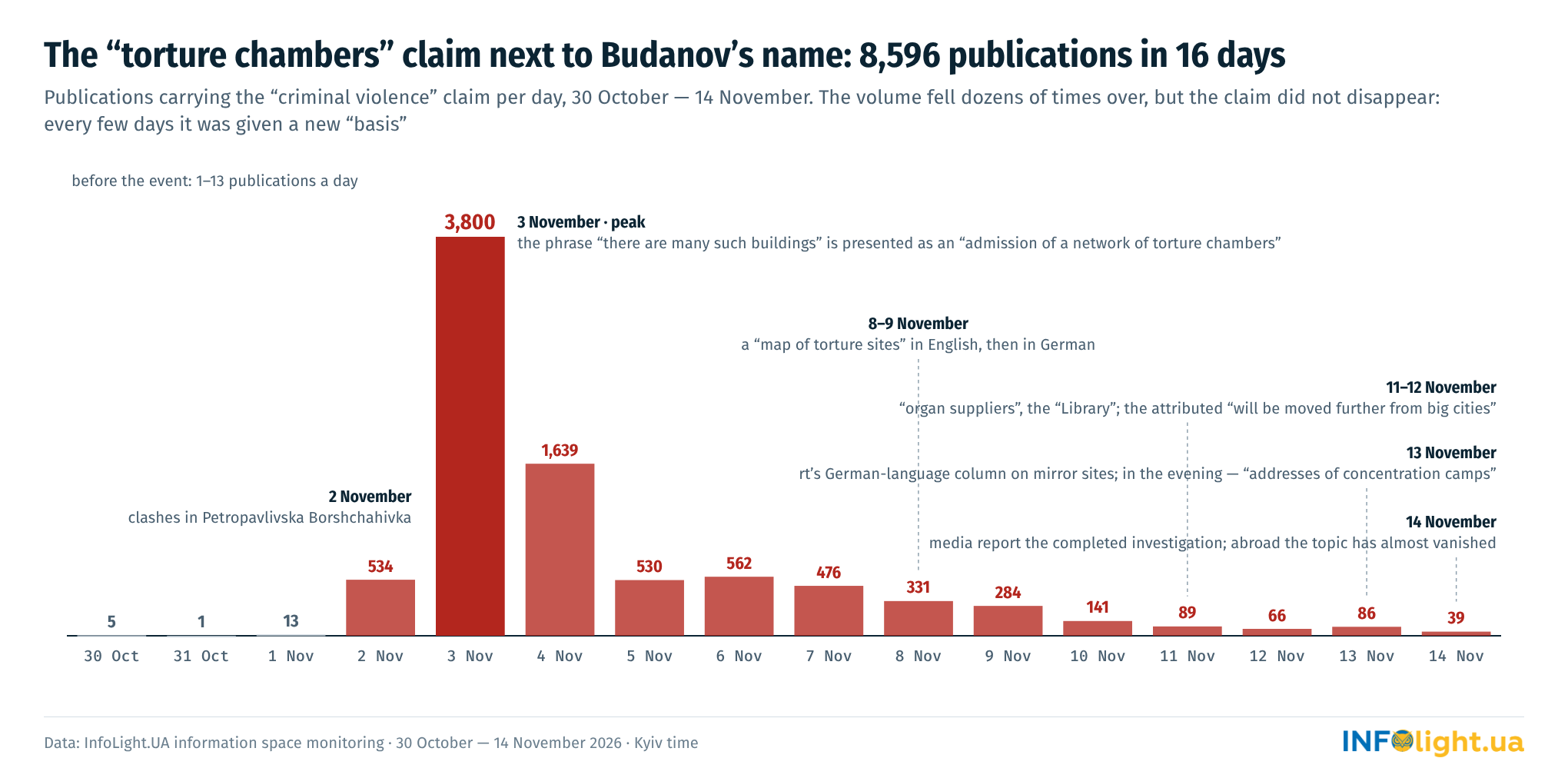
- 8,596 publications in 16 days carry the claim about torture chambers and violence next to the name of Kyrylo Budanov, Head of the Office of the President of Ukraine. Before the event there were between one and 13 a day.
- 3,800 publications in a day — the peak, on 3 November. On 14 November — 39.
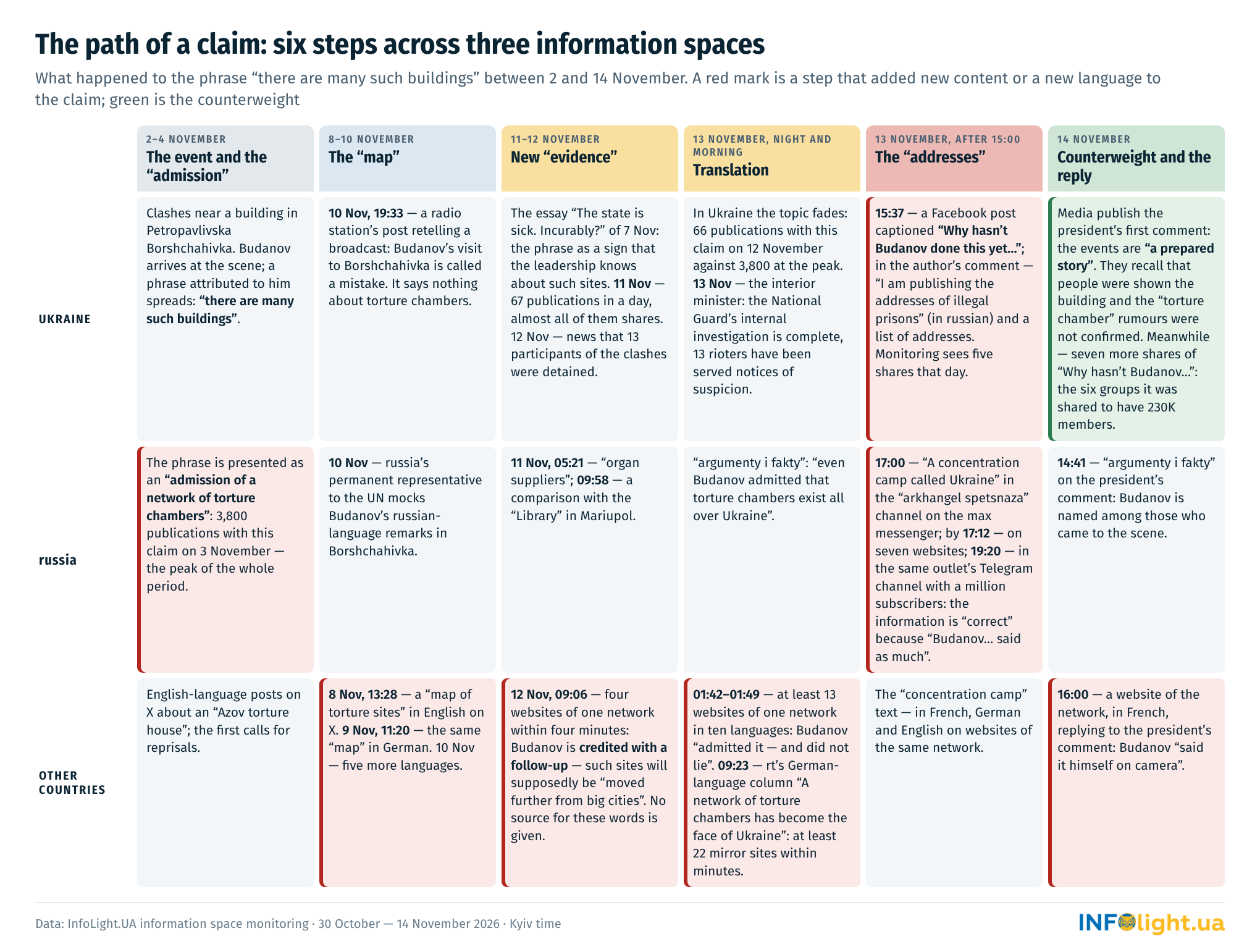
- Six steps: the “admission”, the “map”, new “evidence”, translation, the “addresses”, the return to Ukraine. At each step new content or a new language was added to the phrase.
- At least ten languages: texts about the “admission” appeared in English, German, French, Japanese, Arabic and other languages.
- 230,000 members — the combined size of six Ukrainian Facebook groups to which a post with “addresses of illegal prisons” was shared on 14 November. The channels and communities that spread the “concentration camp” text that day have 32,000 subscribers.
- The ending. The internal investigation is complete; 13 participants in the riots have been served notices of suspicion. Abroad the topic has almost vanished: 9 publications on 14 November against 90 the day before.
The event and the words
In early November, clashes broke out in Petropavlivska Borshchahivka near Kyiv outside a building that social media called a “torture chamber” and a “secret prison”. Kyrylo Budanov came to the scene and spoke with people. From that conversation a phrase spread — that “there are many such buildings”.
In retellings it sounds different each time: “there are many such places”, “there are many such buildings”, “there are hundreds of them”. What exactly was said, and in what context, can no longer be reconstructed from the retellings. That is what made the phrase convenient: everyone adds something of their own to it.
Before the event we recorded the claim about violence and torture next to Budanov’s name only a handful of times a day. On 2 November there were 534 such publications. All mentions of Budanov that day — 7,928 against 694 the day before.
2–4 November: “Budanov admitted”
On 3 November, 3,800 publications carried the torture-chambers claim next to Budanov’s name — the peak of the whole period. That day Budanov was mentioned 27,830 times, and 8,769 publications carried negative claims about him. Before the event there were fewer than a hundred a day.
The mechanics are simple, and they repeat at every subsequent step. Three substitutions were made to the phrase:
- buildings became “torture chambers”: a word from social media posts was attributed to the official;
- “many” became a “network”, and later “all over Ukraine”;
- a remark at the scene became an “admission” — a word implying that the state itself has confirmed the accusation against it.
russian channels presented it exactly that way: Budanov “admitted a network of torture chambers”. At the same time, English-language posts about an “Azov torture house” and the first calls for reprisals appeared on X.
By 4 November the number of publications had fallen to 1,639, by the 5th to 530. The event was receding. The claim was not.
5–12 November: the wave subsides, the claim acquires “evidence”
Between 5 and 12 November the number of publications with the claim fell from 530 to 66 a day. If we looked at volume alone, the topic could have been closed. But it was in these days that things the phrase never contained were added to it, several times over.
The “map”. On 8 November at 13:28 an X account run by a former officer of the Security Service of Ukraine (SBU) who defected to russia published, in English, a “map of torture sites” — 752 likes. On 9 November at 11:20 the same “map” appeared in German. On 10 November — 25 shares and five more languages: Dutch, Spanish, Polish, Slovak, Italian. The phrase about “many buildings” was given a picture meant to show where exactly they are.
Mockery. On 10 November russia’s permanent representative to the UN mocked Budanov’s russian-language remarks at the scene. This attached a second topic to the torture-chambers one — language. That same evening, at 19:33, a Radio NV post appeared in Ukraine retelling a broadcast with Yurii Butusov: he called the visit of Budanov and the National Guard commander to Borshchahivka a mistake. The post says nothing about torture chambers — it criticises the visit itself. At 12:42 on 15 November the Facebook counter showed 2,200 shares. Monitoring recorded 86 publications of this text on 10–14 November, 80 of them on Facebook; almost all are shares.
New “evidence”. On 11 November at 05:21 russian channels launched a story about “organ suppliers” — seven publications; at 09:58, a comparison with the “Library”, a long-running russian propaganda story about an alleged secret prison in Mariupol — five publications. In Ukraine, meanwhile, the essay “The state is sick. Incurably?”, published on Facebook on 7 November at 23:39, was circulating. It names Budanov’s phrase as the prompt for the author’s reflections: “if the leadership knows such sites exist, it also knows what happens there”. At 12:44 on 15 November the Facebook counter showed 2,500 shares. Monitoring recorded 114 publications of this text on 8–14 November, 67 of them on 11 November; almost all are shares.
An attributed follow-up. On 12 November at 09:06 four websites of one network published, within four minutes, an English-language text titled “A Private Azov Prison in Ukraine — or russian Propaganda?”. It attributes to Budanov not only the “admission” but a plan: such sites will supposedly be “moved further from big cities”. The text gives no source for these words. The same day the russian website vz.ru wrote about “secret prisons in every battalion of the Armed Forces of Ukraine”, and a Czech website wrote that “MEPs are calling for the closure of torture chambers in Ukraine that the media keep silent about”.
On 12 November, of 66 publications with the claim, 23 appeared in other countries and 18 each in Ukraine and russia. A topic born near Kyiv had, for the first time, become primarily a foreign one.
That same day a different kind of news appeared: 50 publications reported the detention of 13 participants in the clashes.
13 November, night and morning: translation
On the night of 13 November the claim received what it had lacked to reach beyond the russian-speaking audience — translation and circulation.
Between 01:42 and 01:49 at least 13 websites of one network published the same text in at least ten languages, among them Japanese, Arabic and English. Its content: former Ukrainian TV presenter diana panchenko had allegedly received more than a thousand letters about “illegal prisons”, and Budanov had “admitted that there are many such buildings — and did not lie”.
At 09:23 the German-language service of rt published a column, “Ein Netz von Folterkammern ist zum Gesicht der Ukraine geworden” — “A network of torture chambers has become the face of Ukraine”. Within minutes at least 22 mirror sites reprinted it. By keywords, that is 42 publications in a single hour — the most in the day.
The same day the russian weekly “argumenty i fakty” fixed the formula: “even Budanov admitted that torture chambers exist all over Ukraine”. Compare this with the original phrase about “many buildings”: it contains neither “torture chambers” nor “all over Ukraine”.
Over 13 November the number of publications about “torture chambers” from other countries reached 90.
What these websites are
The addresses of the network’s websites are built the same way: the name of a language or a country plus news-pravda.com. Texts appear on them simultaneously, minutes apart, and are translations of a single original. By their names and behaviour these sites resemble the network that the French agency VIGINUM described in 2024 as Portal Kombat. We did not establish this link — we only note the resemblance.
This method has a name: “information laundering”. The NATO Strategic Communications Centre of Excellence describes three stages: placement, layering, integration. A claim is placed in a source few people trust, passed through a series of reprints and translations, and then presented as something “the world is writing about”.
13 November, after 15:00: the “addresses”
During the day on 13 November the claim took one more step: “addresses” were added to the “admission”.
At 17:00 the text “A concentration camp called Ukraine” appeared in the “arkhangel spetsnaza” channel on the russian messenger max. By 17:12 it was on seven websites: three of them russian, with the name of the city of Cherkasy in their addresses; four more belong to the already familiar network and carried the text in French, German and English. At 19:20 it was published by the “arkhangel spetsnaza” Telegram channel, which has a million subscribers. The formula: “a Ukrainian journalist has published the addresses…”, and the information is “correct” because “Budanov… said as much”.
Here it becomes clear what the “admission” was needed for. Nobody checked the list of addresses. Its truth is “proved” by reference to the words of a Ukrainian official — the very words that had been distorted ten days earlier.
Over the evening of 13 November and the first half of the 14th we recorded 30 publications of this text in four languages. The “arkhangel spetsnaza” channel gathered the most views: 102,000 on Telegram as of 12:48 on 15 November and 35,700 on max at the time monitoring recorded the post. Another 45,900 came from a forward of this post in a channel with 478,000 subscribers, and 14,700 from a publication in a channel with 233,000. The remaining 26 publications together gathered about 800 views. Websites do not show views.
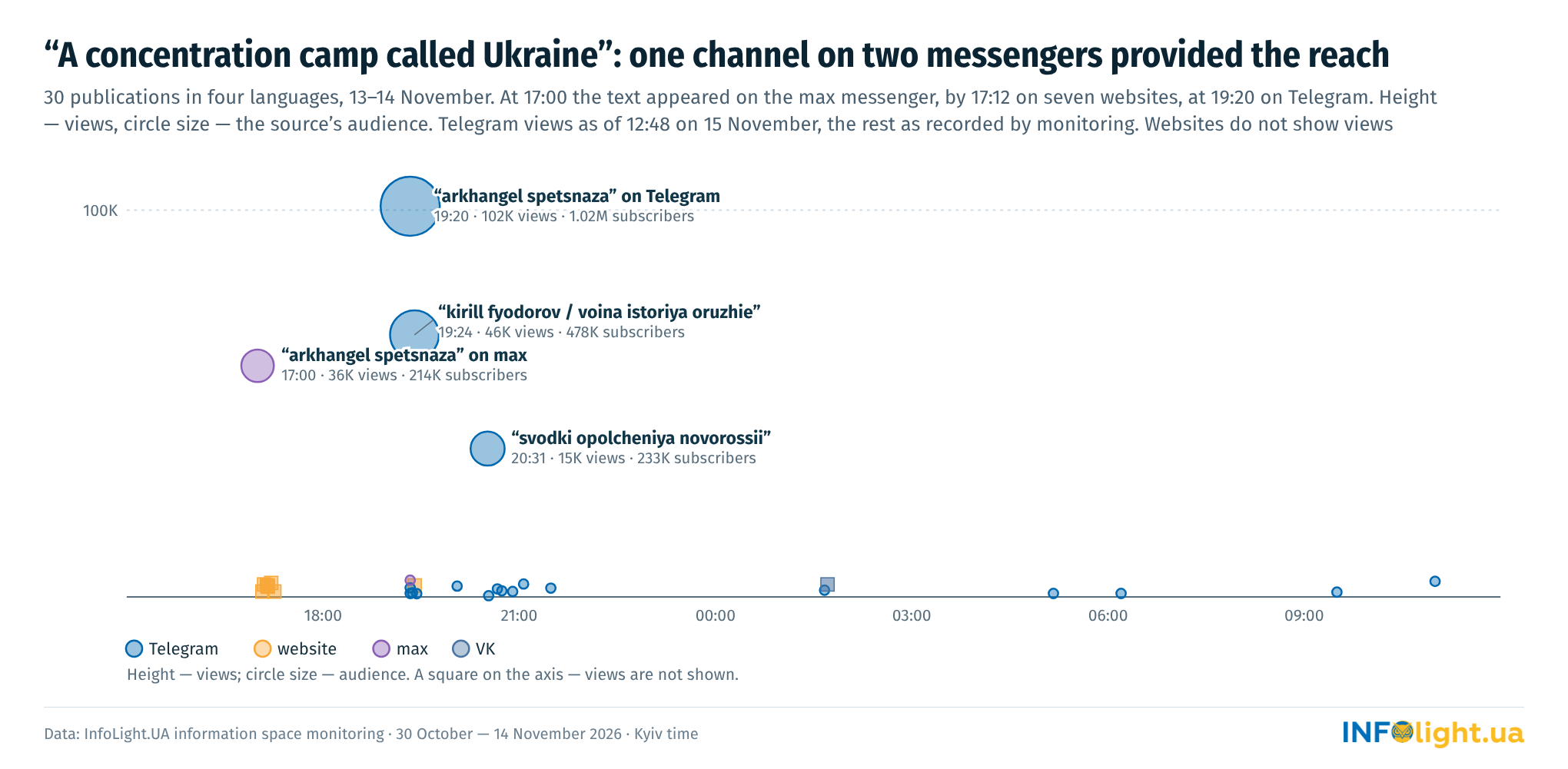
The conclusion is practical. Reach here is created not by dozens of small reprints but by two or three large channels. Those are the ones to watch to see the next step.
13–14 November: the return to Ukraine
The same day the “addresses” topic appeared on Ukrainian Facebook as well. At 15:37 a post was published with the caption “Why hasn’t Budanov done this yet…” and a picture reading “diana panchenko publishes addresses of illegal prisons in Ukraine”. In a comment under it the author gave a russian-language first-person text — “I am publishing the addresses of illegal prisons in Ukraine” — and a list of addresses. At 12:40 on 15 November the Facebook counter showed 350 shares, 300 reactions and 57 comments. Monitoring sees only part of the public shares: 12 on 13–14 November, seven of them in groups. The last one was on 14 November at 09:35.
Note the timing. The Facebook post appeared earlier than the “concentration camp” text in russian channels and on websites: 15:37 against 17:00. Both refer to the same source: the Ukrainian post names diana panchenko directly, the russian text speaks of “a Ukrainian journalist”. That is why we do not claim that Ukrainian groups took it from russian channels. The data show something else: within a few hours the same material spread in both spaces, each time in its own frame. In russia: it is true, because “even Budanov admitted it”. In Ukraine: why hasn’t Budanov done this yet.
The second frame is the more dangerous one. It does not ask anyone to believe a russian source. It addresses people who demand order from the authorities and offers them a ready-made reproach in place of a question. A person sharing such a post is sure they are acting as a concerned citizen.
Among the groups the post was shared to are “Typovyi Kalush” (97,900 members), “Pro Movu” (79,000) and a group in support of Mikheil Saakashvili (41,400). A group’s name proves nothing: any member could have shared the post. Together, the six groups it was shared to on 14 November have 230,000 members. The six channels and communities that were still spreading the “concentration camp” text that day have 32,000 subscribers between them.
The claim moved to where the Ukrainian patriotic audience reads it. Words spoken in Ukraine returned to Ukraine as a reproach. Between those two points lie russian channels, the “map”, a network of websites and ten languages.
14 November: the counterweight and the reply to it
On 14 November the media published the president’s first comment on these events, made the day before at a meeting with journalists: the events in Petropavlivska Borshchahivka were “a prepared story”, and law enforcement must provide the answers (LB.ua, Apostrophe, ZN.UA; all in Ukrainian). The same reports recall how events unfolded: the Head of the Office of the President, the commander of the National Guard and police leadership, together with representatives of the people who had gathered, entered the building and checked the basements. The “torture chamber” rumours were not confirmed.
The reply came within hours. At 14:41 the russian weekly “argumenty i fakty” retold the president’s comment and separately named Budanov among those who had come to the scene. At 16:00 a French-language site of the news-pravda network reminded its readers that at the start of the affair Budanov had “said it himself on camera”. The rebuttal was used as an occasion to repeat the “admission” once more.
Meanwhile the volume keeps falling. Publications with the claim about torture chambers and violence: 66 on 12 November, 86 on the 13th, 39 on the 14th. From other countries, 9 publications about “torture chambers” appeared on 14 November against 90 the day before: the mirror sites that had been circulating the rt column a day earlier fell silent.
The ending: the investigation is complete, the topic is fading
On 13 November, during the government’s question hour in parliament, the interior minister said that the National Guard had completed its internal investigation into the events of 2 November and was handing the materials to the State Bureau of Investigation. According to him, the premises were officially used by the National Guard, and there were no “forty hostages” and no dead person there. More than 160 participants in the riots have been identified, and thirteen have been served notices of suspicion (TSN, in Ukrainian). On 14 November, 33 publications mentioning Budanov referred to this.
At the same time the topic almost vanished from foreign websites and russian channels. The “concentration camp” text had six publications on 14 November and none on the morning of the 15th. The last public share of the post with the “addresses” that monitoring sees was on 14 November at 09:35.
The formula “Budanov admitted” nevertheless remained in circulation. On the morning of 15 November a russian-language text dated 13 November was being shared on Facebook again; in it the same phrase reads: “we know about a multitude of such basements”.
Does this mean the story is over? The experience of these two weeks advises caution. The volume had fallen before — from 3,800 to 66 publications a day. And it was precisely on the decline that the “map”, the “organ suppliers” and the “addresses” were added to the claim.
Where it crossed other lines
The “torture chambers” story does not exist in isolation. In two weeks it crossed at least three times with other topics around the country’s military and political leadership.
Language. The Borshchahivka episode produced two topics at once: “torture chambers” and the official’s russian-language remarks. The second was picked up on 10 November by russia’s representative to the UN. The language ombudsman said that the violation had been acknowledged and that the fine provided by law would be paid (Kyiv Post, in Ukrainian). After the press conference in Abu Dhabi on 11 November the language topic became the main one: 962 publications on 12 November, about a third of all mentions of Budanov that day. Those who spread it reduce both topics to a single reproach: rules are not for the leadership.
Negotiations. On 10–11 November, while talks were under way in Abu Dhabi, Budanov was mentioned 5,550 and 4,367 times a day, and the torture-chambers claim only 141 and 89 times. But the very next morning the network of websites published the English-language text with the attributed “plan”, and a day later the translation into ten languages. That was exactly when Budanov’s name was in the news abroad. Whether this is a coincidence, the data do not say.
Sharing in Facebook groups. On the same days, 12–14 November, eight texts about the country’s leadership appeared 907 times in Ukrainian Facebook groups: 57 posts and 850 shares of them. The largest of them is the subject of a separate InfoLight.UA analysis, “Three waves of an old text” (in Ukrainian). The post “Why hasn’t Budanov done this yet…” spread in the same environment and in the same way — through shares in groups. Four of its ten sources also shared those texts.
What follows from this
The danger is not the volume but the new layer. In two weeks the volume fell dozens of times over, while the content of the claim grew: from “many buildings” to a “network”, a “plan” and “addresses”. What needs watching is what gets added, not only how much is written.
The “admission” is a tool. An official’s words are valuable to propaganda because they remove the need for proof. A short, imprecise remark works against the person who made it for longer than the event itself. The cheapest way to break such a chain is a verbatim quotation with context, published in the first hours. In the retellings we saw there is no such quotation.
Translation is a separate stage, and it is visible. Simultaneous publication on dozens of websites minutes apart is the mark of a network. It can be described and shown to partners before the text reaches local media.
The riskiest area is the domestic one. The reproach “why hasn’t he done it yet” in patriotic groups does not look like propaganda. It should be answered not with words about a “russian fake” but with facts: what the investigation has established, what has been checked, what happens next.
The counterweight works, but late. The results of the internal investigation were announced on the eleventh day after the event, and the president’s first comment was published on the twelfth. In that time the claim had passed through five of its six steps.
What to do about it:
- readers — before sharing a post about “addresses” or an “admission”, find out what exactly was said and where;
- media — quote officials verbatim and with context, and call attributed follow-ups attributed;
- government communications — publish verbatim quotations and the results of checks quickly, without waiting for the claim to be translated;
- researchers and partners — InfoLight.UA can provide the list of websites, channels and publication times on request.
How we counted
The data were collected in the course of continuous monitoring of open sources carried out by the InfoLight.UA research and analytics group: social networks, messengers, websites, video platforms. The analysis covers publications mentioning Kyrylo Budanov from 30 October to 14 November 2026 and the morning of 15 November. All times are Kyiv time. Quotations from Ukrainian, russian and German are given in our translation.
There are two counters in this analysis, and they should not be confused. The first is publications carrying the claim about criminal violence and torture: the daily series in Fig. 1 is built on it and covers 30 October — 14 November. The second is publications with keywords about torture chambers, concentration camps and secret prisons: it is broader, and the data on publications from other countries are based on it. Monitoring adds to the series for previous days over time, so the figures may differ slightly from those given earlier.
We count publications by unique link and distinguish between original posts and shares of them. Identical text in shares proves nothing in itself: that is how the “Share” button works. The audience of groups is the sum of their members; one person may be in several groups. Not all platforms show views: Facebook and most websites do not disclose them, so we do not estimate reach there. The Facebook counters and the views of the three largest Telegram publications were read from the platforms on 15 November, with the time given in the text; the remaining views are given as of the moment monitoring recorded the publication. The Facebook counter counts all shares, while monitoring sees only public ones, which is why these figures differ.
We did not investigate what happened in the building in Petropavlivska Borshchahivka: that is a matter for the investigation. Our data contain no verbatim record of Budanov’s words at the scene — only retellings. The original publication of the “addresses” is not in our data: both texts only refer to it. We do not name private individuals. We do not link to russian sources in the text; a list of publications with times and addresses can be provided on request.
An automated monitoring system may err in individual records. Our conclusions describe the spread of information and are not an accusation against anyone.
Prepared by the InfoLight.UA research and analytics group. The featured image was generated with AI. Ukrainian version: Шлях «катівень».