


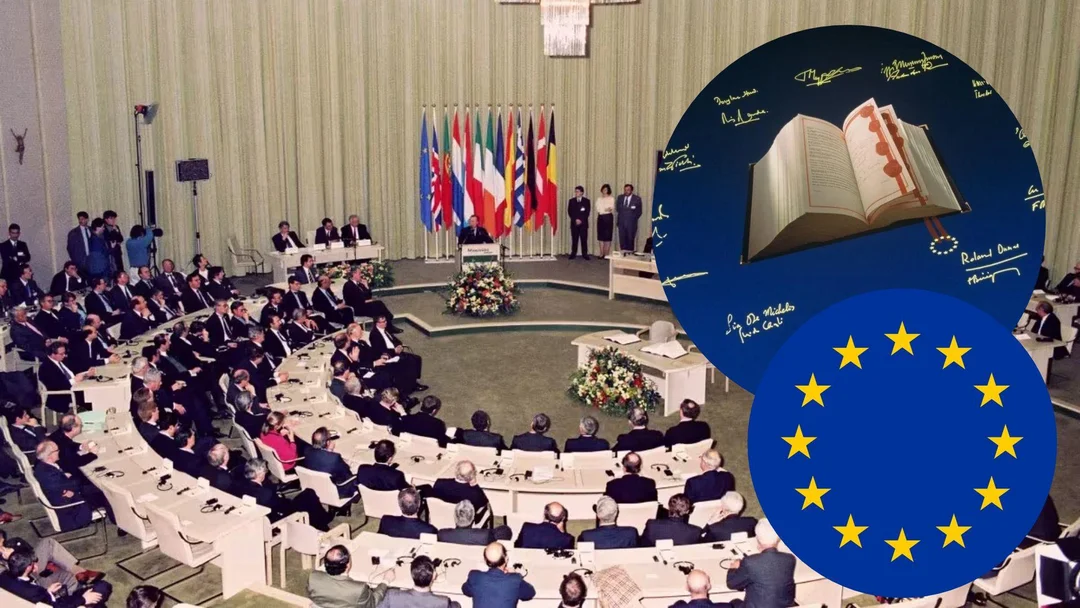
The Maastricht Treaty, which entered into force on 1 November 1993, became a defining stage of European integration and gave legal form to the creation of the European Union. Behind this process stood not only the centuries-old idea of unity among the peoples of Europe, but also fears about the continent’s future after the end of the Cold War.
In 2026, as the global security system once again undergoes major change, the story of how the EU came into being is especially relevant. Both geopolitical anxieties and pragmatic economic interests played an important role in shaping the union. It was the combination of these factors that helped European states overcome historical rivalries and deepen their cooperation. 24 Kanal tells the story in more detail.
Was the Maastricht Treaty a product of geopolitical fear?
The fall of the Berlin Wall in November 1989 and the subsequent collapse of the Soviet Union radically changed the political map of Europe. The end of the Cold War gave Western European countries a sense of victory, but it also confronted them with new questions about the continent’s future and the balance of power.
The prospect of German reunification caused particular concern. British Prime Minister Margaret Thatcher and French President François Mitterrand feared that a stronger German state could upset the post-war equilibrium in Europe. With the Soviet threat gone, Germany had the chance to strengthen its economic and political influence on the continent.
French diplomacy insisted that German reunification be accompanied by deeper European integration. One of the key issues was giving up the Deutsche Mark in favour of a future common currency. Chancellor Helmut Kohl agreed to this step, while backing the creation of a stronger political union that would anchor Germany firmly in the system of Western European democracies.
Another factor was the situation in the Balkans, where the Yugoslav wars had broken out. Ethnic cleansing and armed conflict exposed how limited European states were in responding on their own to large-scale security crises. This strengthened the need to coordinate foreign policy and security decisions. As a result, the new Union introduced a Common Foreign and Security Policy.
Fears of possible geopolitical chaos, of renewed rivalry between European states and of the consequences of the old world order falling apart thus became one of the main incentives to speed up integration. On 1 November 1993, the European Union officially came into being as a new political union.
It is worth noting that European integration began long before that date. Over the preceding decades, countries had created common economic institutions, built their own judicial system and drawn up plans for a monetary union. But it was the Maastricht Treaty that brought these achievements together into a broader political structure.
How did economic calculation help overcome historical rivalries?
Fear of new threats alone was not enough to build a stable union capable of lasting for decades. The economic interests of European states played an important role. One of the main architects of deeper integration was Jacques Delors, then President of the European Commission.
As early as the mid-1980s, European leaders realised that separate national economies were finding it ever harder to compete with the United States and Japan. Creating a single internal market therefore became a strategic decision meant to strengthen Europe’s economic position in the world.
The approach rested on four freedoms: the free movement of goods, services, capital and labour. They opened up opportunities for European companies to expand into other countries’ markets, organise production and logistics more efficiently and cut the cost of doing business.
Economic interdependence also had a political dimension. The more closely states’ production processes, trade and financial interests were intertwined, the higher the price of any conflict between them became. The common market was meant not only to drive economic growth but also to create further conditions for lasting peace in Europe.
The Maastricht Treaty also introduced citizenship of the European Union and expanded the powers of the European Parliament. These changes strengthened the political dimension of integration and gave citizens of member states additional rights. The European project gradually ceased to be merely an agreement between governments on economic cooperation and turned into a broader system of common institutions and rules.
So 1 November 1993 became an important date in the history of European unification. Geopolitical uncertainty and fears about the continent’s future pushed states to the negotiating table, while mutual economic benefit and common political institutions laid the foundation for further cooperation.
The European Union was formed where two motives met: the desire to avoid repeating the conflicts of the past and an awareness of the benefits of a common economic space. It was this combination that helped turn the idea of unity into a long-term integration project.