



Security researchers have found five critical vulnerabilities in nginx, the software that serves web pages for a large share of the world’s websites. They let an attacker run code on a server without a login or password, and, chained with a still unpatched Linux kernel bug, take full control of it. The most dangerous of the flaws has been in the nginx code since 2015, so administrators should update without delay.
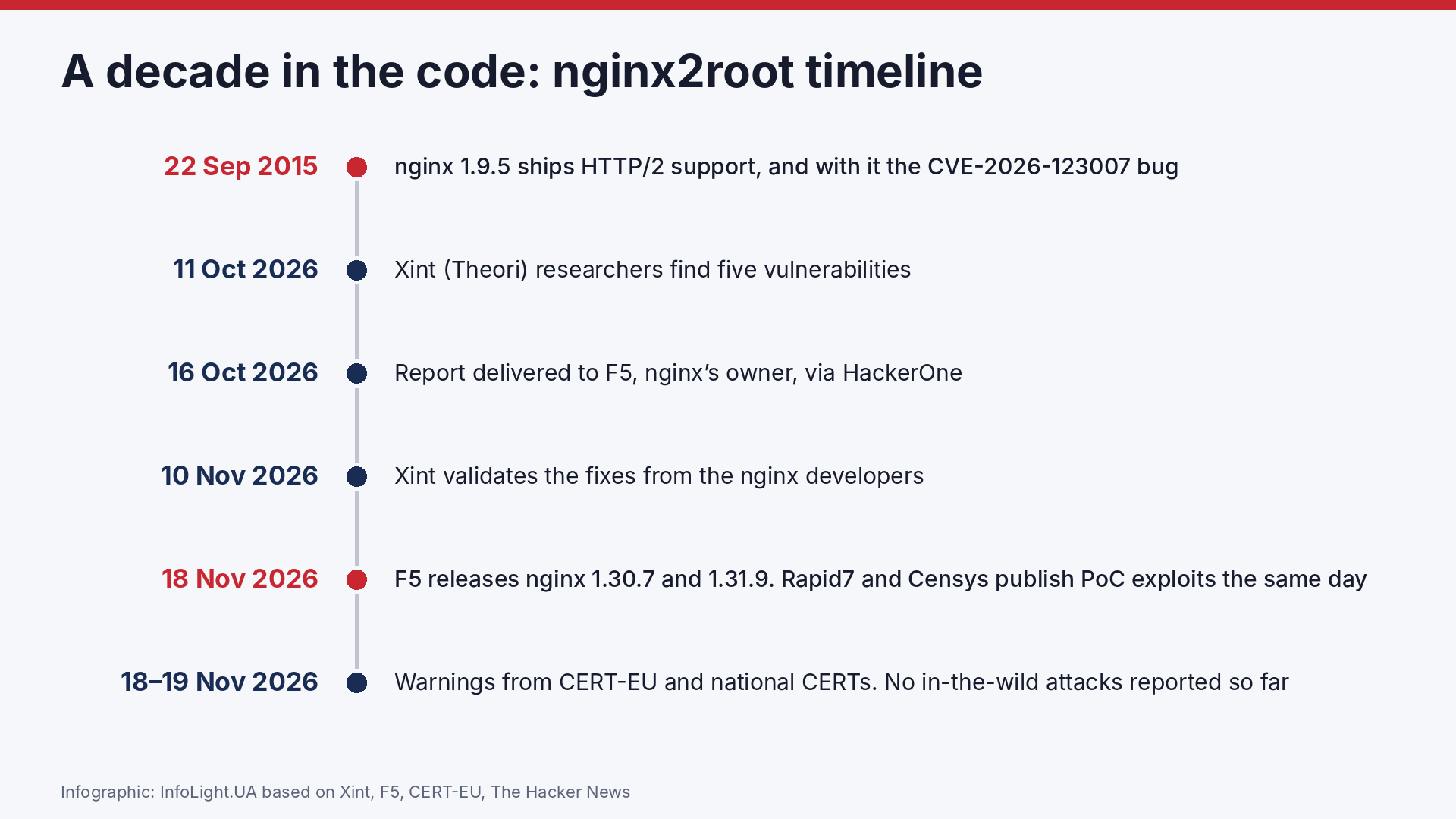
The vulnerabilities were found by Xint (part of Theori), which named the series nginx2root and published attack demos on a dedicated site, nginx2root.com. On 18 November F5, which owns nginx, released fixed versions and security advisory K000164058. The same day the EU’s Computer Emergency Response Team, CERT-EU, issued a warning.
“It is recommended to swiftly update NGINX as soon as possible, prioritising internet facing appliances,” CERT-EU said.
Why almost every website is concerned
nginx is the most widely used web server in the world. According to W3Techs, it runs about a third of all websites whose server can be identified. It is used both as the main server and as the “front door” for applications, in Docker images and Kubernetes clusters.
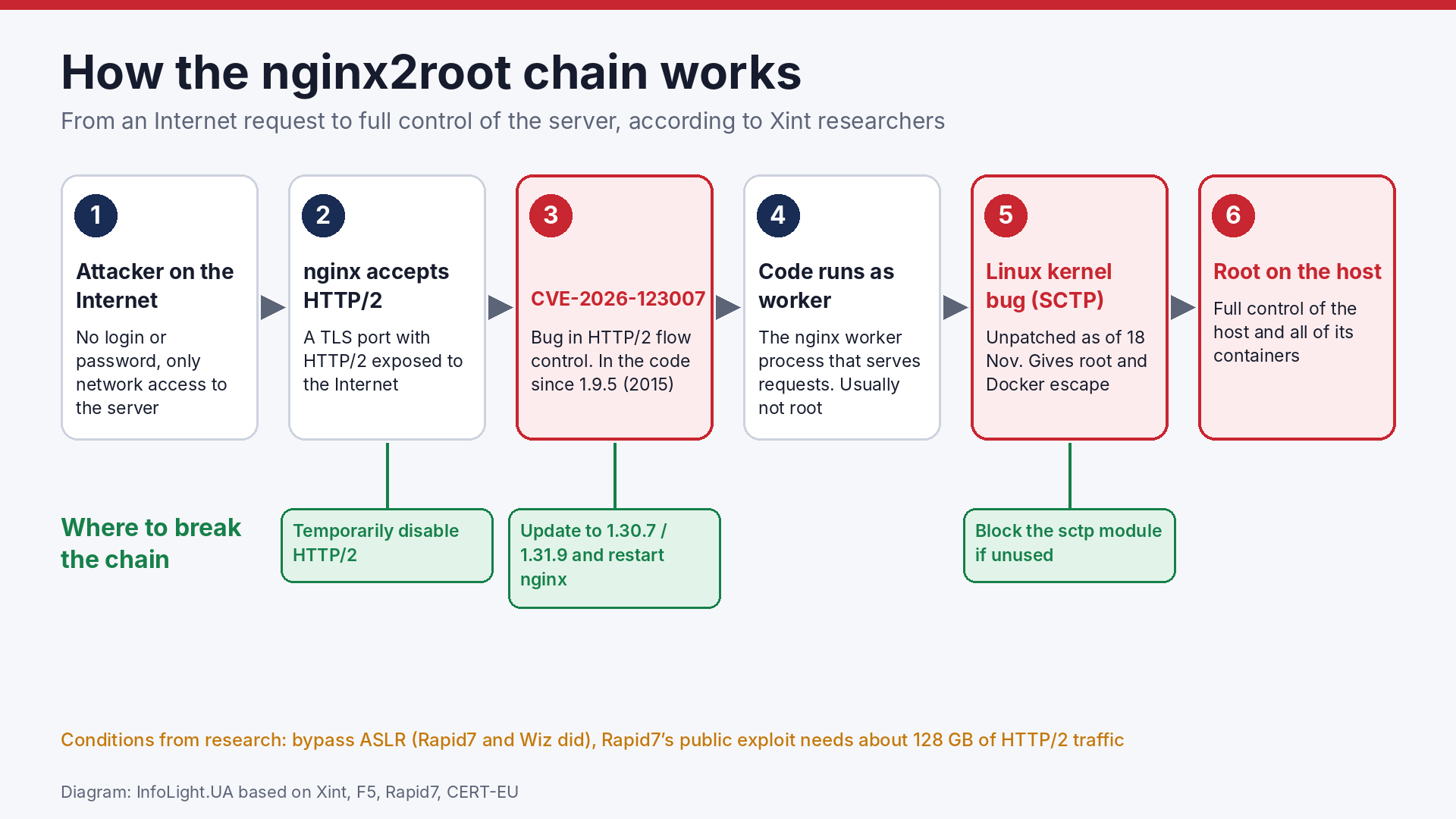
The main flaw, CVE-2026-123007, is a bug in how nginx handles HTTP/2 flow control. It arrived in version 1.9.5, released on 22 September 2015 together with HTTP/2 support itself, and is present in every official release up to 1.31.8. Wiz, which found the bug independently, showed that the attack works even against a server that only serves static files, with no application or third-party modules, SecurityWeek reports.
Internet-wide scans show the scale. Using Shodan, Xint counted 56.7 million nginx hosts; of those that reveal their version, 98.9% fall within the vulnerable range. Censys found about 9 million Internet-facing nginx servers with an affected version and HTTP/2 enabled. That does not mean all of them are vulnerable: Ubuntu, Debian and other distributions often patch packages without changing the version number.
What attackers can do
All five flaws allow code execution with the privileges of the nginx worker process, the one that serves visitors’ requests. It usually does not run as root. F5 rated each of them 9.2 out of 10 on the CVSS 4.0 scale.
To gain full control, Xint chained nginx2root with a separate bug in the Linux kernel’s SCTP module that dates back to 2018. This gave the researchers root on the host, including by breaking out of a Docker container. No kernel fix was available when the report was published.
| Vulnerability | Where the bug is | When a server is exposed |
|---|---|---|
| CVE-2026-123007 | HTTP/2 flow control | HTTP/2 enabled |
| CVE-2026-123633 | HTTP/2 combined with upstream proxying | HTTP/2 enabled, nginx used as a proxy |
| CVE-2026-121810 | HTTP/3 (QUIC) | HTTP/3 enabled, nginx used as a proxy |
| CVE-2026-123634 | DNS resolver | proxy_pass built from variables, together with mirror or SSI |
| CVE-2026-113425 | Mail proxy (auth_http) | nginx used as a mail proxy |
How real the threat is right now
Exploitation is made harder by ASLR, a protection that randomises where data sits in memory: according to F5, code execution is only possible if it is disabled or bypassed. Rapid7 and Wiz, however, bypassed ASLR in their tests.
Rapid7’s public exploit needs to send the server about 128 GB of HTTP/2 traffic and works on x86-64 processors with a specific instruction set. On links slower than roughly 300 Mbit/s, the attack cannot finish within nginx’s default one-hour connection limit, according to The Hacker News. Censys, however, published another PoC on GitHub that does not need such traffic volumes.
No attacks in the wild have been reported so far, and as of 19 November nginx2root was not in the US CISA catalogue of known exploited vulnerabilities (KEV). But working attack code is already public, so the window for a calm update is closing fast.
What administrators should do
- Update nginx to 1.30.7 (stable) or 1.31.9 (mainline). For NGINX Plus, to 37.0.8.1 or 37.3.0.1. Official Docker images with these versions are already available.
- Fully restart nginx. A reload does not replace the running executable, and existing HTTP/2 connections stay alive.
- Check the package version against your distribution’s advisory if nginx comes from the Ubuntu, Debian or another repository:
nginx -vmay show the old version even after a fix. As of 18 November, Ubuntu and Debian had not yet shipped fixed packages. - If you cannot update immediately, temporarily disable HTTP/2 (this closes two of the five flaws) and HTTP/3, restrict mail ports to trusted networks, and avoid building proxy_pass addresses from variables together with mirror or SSI.
- Block the SCTP module on servers that do not use it: add the line
install sctp /bin/falseto a .conf file in /etc/modprobe.d/. This does not unload a module that is already loaded. - Look for signs of attack: “worker process … exited on signal” entries in the error log, unusual processes running as the nginx user, and long-lived HTTP/2 connections with heavy inbound traffic but few requests in the access log.
To check whether a server answers over HTTP/2 from the Internet, run openssl s_client -connect your-site:443 -alpn h2: the line “ALPN protocol: h2” means HTTP/2 is enabled. Detailed guidance on checks and temporary mitigations is in the Xint report.
This is not the first critical nginx flaw this year: in May F5 fixed CVE-2026-42945, which affected versions 0.6.27 to 1.30.0, as New Zealand’s NCSC reported. Regular web server updates are not a formality but basic hygiene for anyone who runs a website.
Photo: SimonWaldherr / Wikimedia Commons, CC BY-SA 4.0. Diagram and infographic: InfoLight.UA.
