


The Russian army is reinforced by approximately 1,800 foreigners every month, and the Kremlin’s annual target of 18,500 recruits will most likely be exceeded. There are already more foreign mercenaries in the Russian Federation than there are soldiers in the armies of Belgium or Austria. And the recruitment network, which once worked primarily with migrants from Central Asia, is now growing fastest in Africa and Latin America.
As reported by hromadske, was stated by Andriy Yusov, deputy head of the Coordination Headquarters for the Treatment of Prisoners of War, during a discussion of the documentary “Predatory Recruitment: The Story of Evans” on October 20.
From hundreds to tens of thousands
In 2022, fewer than 100 foreigners were known to have been recruited into the Russian army. In just nine months of 2026, that number exceeded 16,000. In total, the Joint Staff has personal data on nearly 49,000 foreigners who have signed contracts and have served or are currently serving in the Russian Armed Forces.
“By way of comparison, Belgium’s entire army numbers 20,000, and Austria’s, for example, 22,000. Slovakia’s, I believe, is up to 16,000. In other words, this is truly a global threat, by no means limited to Ukraine alone. And it is gaining momentum; its scale is growing,” emphasized Andriy Yusov.
On the same day, at the Crimea Global conference, Brigadier General Dmytro Usov, Secretary of the Coordination Staff, cited data from the Main Intelligence Directorate’s “I Want to Live” project: As of October 1, the identities of 45,959 foreigners from 151 countries who had signed contracts with the Russian Armed Forces had been established, according to Military. The trend over the years: 94 contracts in 2022, 4,067 in 2023, 8,877 in 2024, 16,085 in 2025, and already 16,168 in the first nine months of 2026.
Where Has Recruitment Shifted?
Most recruits still come from Uzbekistan, Tajikistan, and Belarus, but recruitment is growing fastest in Africa and Latin America. In the first nine months of 2026, 1,449 Colombian citizens, 699 from Burundi, 530 from Zimbabwe, and 503 from Peru signed contracts with the Russian military. In September, soldiers of the 33rd Mechanized Brigade captured a group of Colombians recruited by Russia.
The protagonist of the hromadske film is Kenyan athlete Evans Kibet, who was promised a job in Russia but was instead tricked into signing a military contract. According to Kenyan media reports, the families of the men who left for Russia are demanding that the authorities explain how their loved ones ended up in the war and determine the fate of those who are missing or have died.
According to the Joint Staff, Russia is recruiting migrant workers and tourists with promises of jobs and high wages; in some cases, intermediaries confiscate the passports of new arrivals and force them to choose between deportation, prison, or a contract with the army. A survey of captured foreign nationals revealed that 46.7% signed a contract in order to obtain Russian citizenship, 41.4% signed directly at military registration and enlistment offices and recruitment centers, and 28% did not know they would be fighting against Ukraine.
Why Doesn’t Moscow Withdraw Its Mercenaries?
Recruiting foreigners allows Russia to alleviate social tensions and offset demographic losses among its own population, Yusov explained.
“Foreigners aren’t recruited so they can return home, nor to say, ‘Thank you for your service’… A mercenary or a foreigner in the Russian army costs less in any case than a Russian citizen. And it’s not really worth sending them back, because that would automatically trigger requests from their country of origin,” he added.
According to the Joint Staff, 78% of foreign prisoners of war want to return to Russia, but Moscow is not taking them back. At the same time, Russia is not releasing more than 3,000 foreigners whose contracts have already expired from military service.
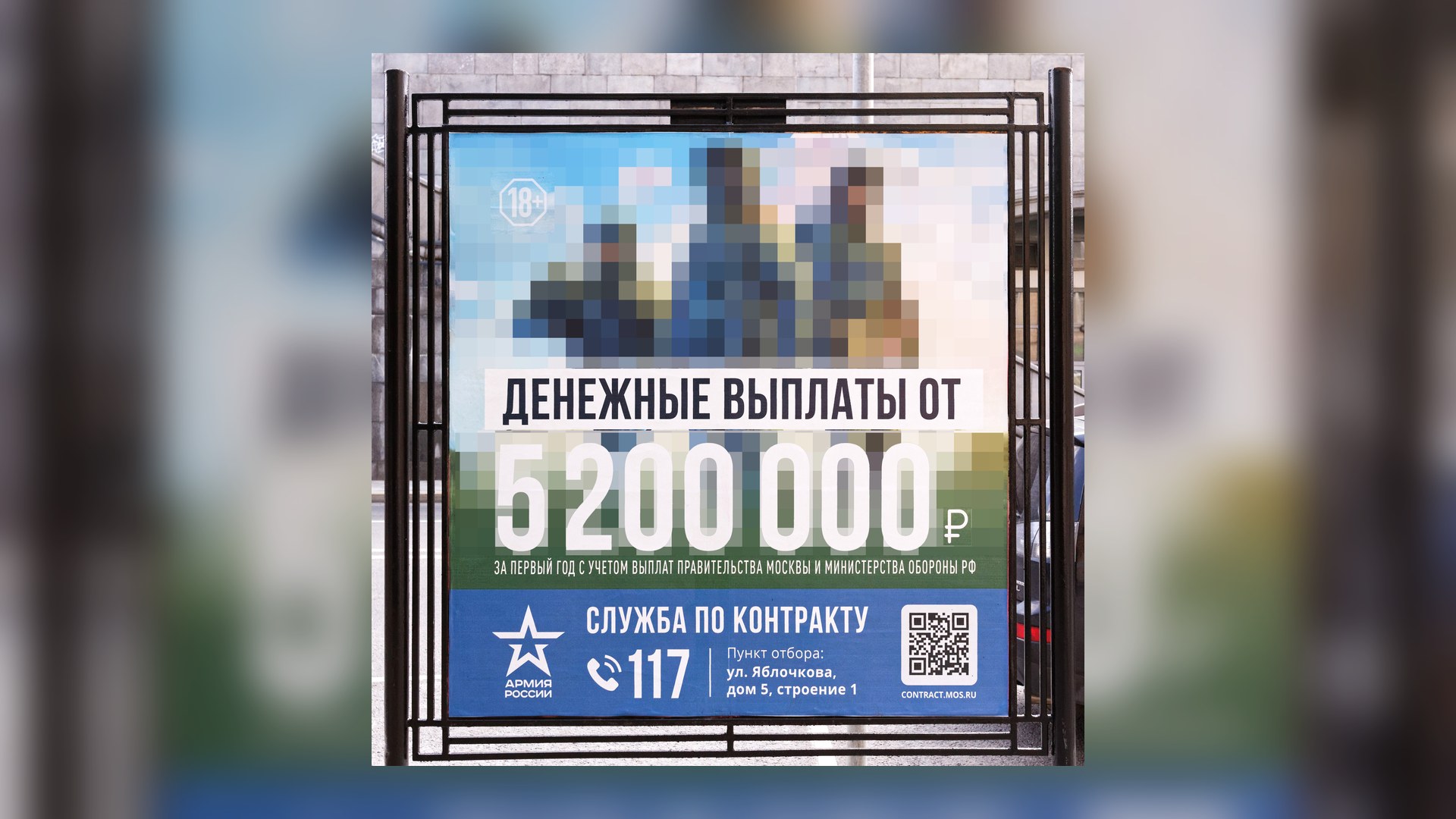
Photo: An advertisement for contract service in the Russian army on a street in Moscow, August 2024. Retired electrician / Wikimedia Commons, public domain.
