


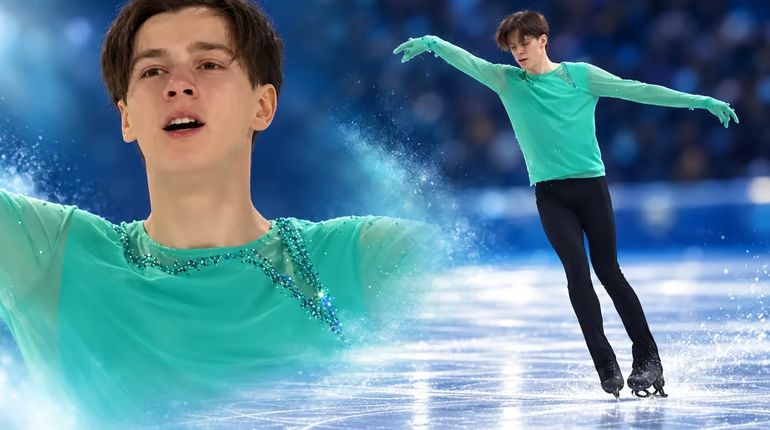
Kherson figure skater Kyrylo Marsak finished fifth at his debut senior Grand Prix event, Skate Canada in Kelowna, scoring 226.40 points across two programmes. It is the highest placing by a Ukrainian men’s singles skater at a Grand Prix event in 26 years. Kavun.City went through the judges’ protocols to see what got Kyrylo into the top five and where he still has room to improve.
The results are taken from the official protocols of the International Skating Union (ISU).
How Kyrylo Marsak performed
The skater from Kherson was fourth in the short programme and sixth in the free skate. His combined score put him fifth out of 12 competitors.
| Programme | Place | Technical score | Components | Deductions | Total |
|---|---|---|---|---|---|
| Short | 4 | 47.23 | 36.44 | 0.00 | 83.67 |
| Free | 6 | 69.17 | 74.56 | −1.00 | 142.73 |
| Total | 5 | 226.40 |
The event was won by France’s Kevin Aymoz with 258.43 points. Japan’s Rio Nakata was second with 249.25 and Estonia’s Mihhail Selevko third with 248.66. Kyrylo was 6.32 points behind fourth-placed Stephen Gogolev of Canada and 22.26 points off the bronze.
In the short programme Marsak earned 47.23 technical points — only Nakata scored more. Kyrylo finished 1.64 points short of third place.
| Element | Score including grade of execution |
|---|---|
| Quadruple Salchow, q mark | 8.45 |
| Triple Lutz + triple toe loop | 11.28 |
| Change-foot camel spin, level 3 | 3.11 |
| Triple Axel | 10.63 |
| Flying sit spin, level 3 | 3.68 |
| Step sequence, level 4 | 5.10 |
| Change-foot combination spin, level 4 | 4.98 |
The Salchow was called as landed a quarter short: it kept its base value but received a negative grade of execution. The combination and the Axel, on the other hand, earned positive grades. The Axel also received a base-value bonus for being performed in the second half of the programme.
According to the protocol, positive and negative grades added up to a net gain of 3.83 points over the base value of Kyrylo’s elements. There was room for improvement in the spins: two were rated level 3 and one received a negative grade of execution.
Why was he only fourth with the second-best technical score? Marsak received 36.44 points for components, while Tomono got 41.03. Kyrylo’s technical advantage was outweighed by the gap in the marks for composition, presentation and skating skills.
A personal story about loved ones in Kyiv, Kherson and at the front
This season Marsak skates his short programme to Where’s My Love by SYML. In a September interview with the Ukrainian Figure Skating Federation he explained that the routine conveys what he feels because of the war and his fear of losing his loved ones.
He means his father, who is defending Ukraine at the front, his mother in Kyiv and his relatives in Kherson, which is under constant Russian drone attacks. So the Kherson part of Kyrylo’s life is directly present in the idea behind his performance.
According to the skater, the new short programme is more demanding choreographically than the previous one. He kept his free skate from last season in order to polish its execution and gradually raise its technical difficulty. It is set to music by Labrinth and Zendaya, including I’m Tired; his ISU profile also lists The Feels.
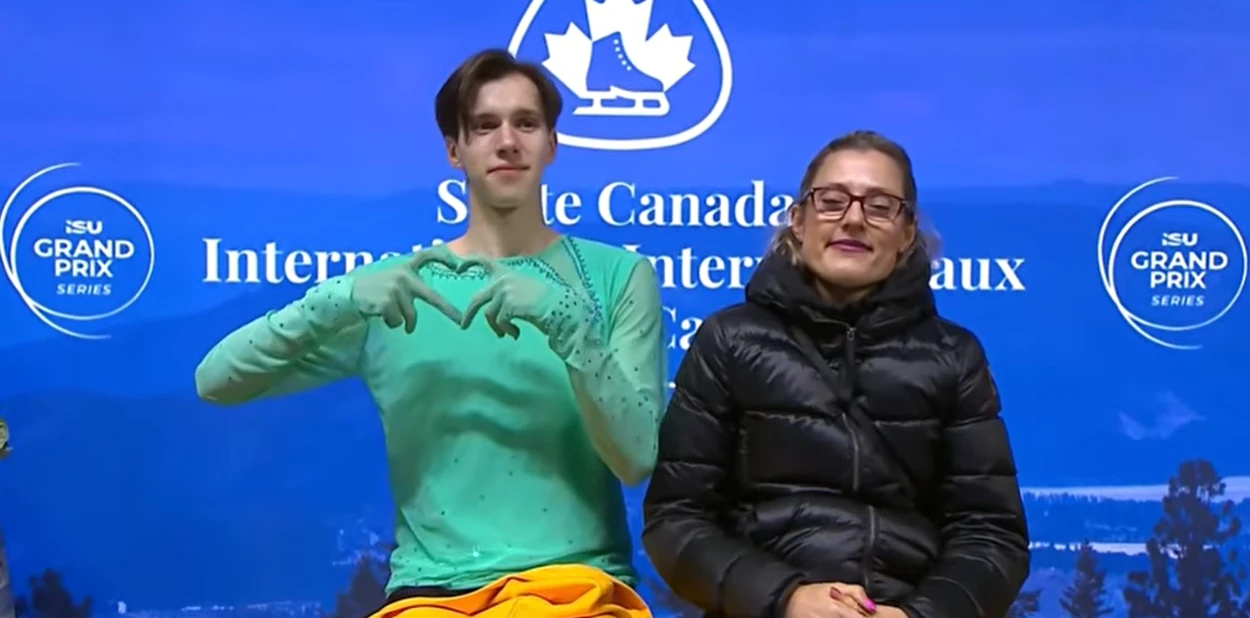
Kyrylo Marsak and Anna-Maria Virtanen
Photo: video screenshot
Author: video screenshot
Free skate: losses on jumps and a strong second half
The protocol recorded the opening Lutz as a double, worth only 2.19 points. The federation confirmed that Kyrylo did not land the planned quad. The Salchow again received a q mark, and the Axel was called under-rotated (“<”) with a significant deduction for quality.
| Element | Score |
|---|---|
| Double Lutz | 2.19 |
| Quadruple Salchow q | 8.73 |
| Triple flip + triple toe loop | 10.11 |
| Under-rotated triple Axel | 3.57 |
| Flying sit spin, level 4 | 4.68 |
| Triple Lutz + triple toe loop + double Axel, sequence | 15.92 |
| Triple loop | 6.65 |
| Choreographic sequence | 4.71 |
| Choreographic spin | 2.64 |
| Step sequence, level 4 | 4.63 |
| Change-foot combination spin, level 4 | 5.34 |
His most valuable element was the three-jump sequence in the second half, worth 15.92 points. It and the loop received positive grades; both levelled spins and the step sequence were rated level 4. The choreographic spin received a negative grade of execution.
A separate one-point deduction was recorded in the protocol as Time violation. The result: 69.17 + 74.56 − 1.00 = 142.73 points.
The judges’ marks therefore show that his main technical losses came on the Lutz and the Axel, while successful late jumps and non-jump elements helped him hold on to his result.
How Kyrylo held on to a top-five place
After the short programme Marsak was 4.09 points ahead of Selevko and 16.94 ahead of Gogolev. In the free skate both rivals scored much higher and overtook the Ukrainian.
Kyrylo did, however, beat Kazuki Tomono, who had been third after the short programme. In the free skate Marsak scored 5.19 points more than the Japanese skater — enough to make up his earlier deficit and finish the competition 3.55 points ahead.
Fifth place was not a personal best in total score. According to his ISU profile, Kyrylo scored 237.53 at the Lombardia Trophy in September — 11.13 more than in Canada. This underlines the difference between the two achievements: the highest score of his career, and a historically high placing at a prestigious Grand Prix event.
Why this is a historic result
As Suspilne Sport reports, the last time a Ukrainian men’s singles skater finished fifth at a Grand Prix event was in 2000, when Dmytro Dmytrenko did so at the NHK Trophy in Japan. Marsak has matched that placing 26 years later.
Fifth place is also Ukraine’s best Grand Prix result in any discipline in 17 years, since Tatiana Volosozhar and Stanislav Morozov took silver at Skate America in the 2009/10 season. This refers to the placing in the standings, not to a record number of points.
A figure skater from Kherson
Kyrylo Marsak was born on 7 September 2004 in Kherson and took up figure skating in 2009. He is now 22. Because of the war he moved to Finland, where he trains under coach Alina Mayer-Virtanen.
At his debut Skate Canada the skater from Kherson posted the second-best technical score in the short programme and finished the competition in the top five. At the same time, the protocols set out very specific goals for improvement: consistency on his hardest jumps, the levels of his spins in the short programme and precision in the free skate.
Source: “Kavun.City”
This news item is based on material from Kavun.City and was prepared as part of the project “Strengthening the Voice of Frontline Media: Partnership for Expanding Influence”, which helps hyperlocal media reach a wider audience and increase their influence in the information space. Full responsibility for the content and accuracy of the information lies with the editorial team of Kavun.City.
The InfoLight.UA research and analytics group carries out a general review of materials from the outlets supported by the project and excludes newsrooms that knowingly spread false information and Russian propaganda.