


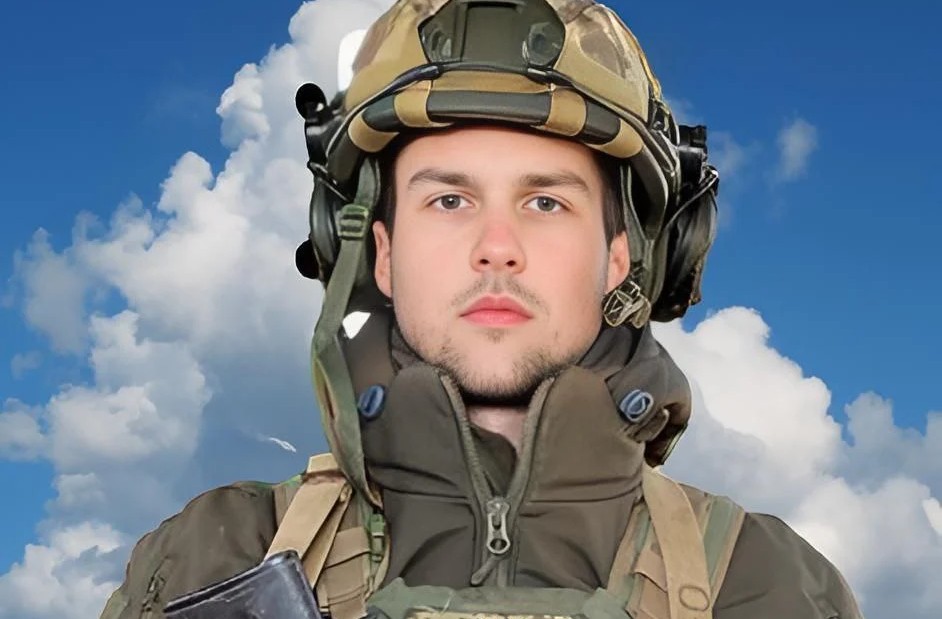
On the Alley of Glory at St Nicholas Cemetery in Zaporizhzhia, a sea of fresh flowers sways in the silence. Here lies 21-year-old Kyrylo Panchenko, call sign “Phonk” — an only son, a volunteer, a brave soldier and a Hero. For his mother, Maryna, this place has become somewhere to talk to her son. Her journey is a moving story of how boundless maternal love, faith and memory help her go on living, turning unspeakable pain into a source of patriotism and pride.
His mother’s support
Maryna’s life has always been one of devoted hard work. Having moved to Zaporizhzhia in 2002 from the stud farm in the Novomykolaivka area where her parents worked, she built her life with her own hands. Studying at a trade college was the start of a career to which she gave more than 17 years. Maryna rose from shop assistant to manager of a chain of the 10 largest Kozatska Ferma stores, heading a team of 36 people.
But the most important mission of her life was always her son. After separating from her husband when Kyrylo was still small, Maryna raised him on her own.
“We had no one in Zaporizhzhia; it was just Kyriusha and me. I worked three jobs so that he could go to clubs, sports sections and computer classes. He grew up very kind and cheerful, a real optimist. He was the only boy in our family (my sister had a daughter) and he always said: ‘Mum, I’m your hope and support,’” Maryna recalls.
Building character: from pocket books to big dreams
Kyrylo’s childhood was one of constant self-improvement. From first to fourth grade, mother and son travelled 13 stops to school every day, and after the extended school day the teachers would bring the boy to his mother’s workplace. Even then, on city buses, little Kyrylo read pocket books of quotations and aphorisms, learning about the wisdom of life. He read many books on psychology.
He showed grown-up determination and an entrepreneurial streak early on. When he earned his first money, he bought not toys but a pull-up bar and two books — a history of Churchill and “Strategies of Geniuses”, with lessons from Steve Jobs, Andy Grove and Bill Gates. He was loved at school for his bright soul, kindness, generosity and sense of fairness. He was the life and soul of the party, had many friends and sincerely dreamed of a better future for himself and his country. His heart was full of warmth and faith in people.
As a teenager Kyrylo faced his first challenge: overcoming a weight problem. But a chance meeting on a minibus with a boy who invited him to the gym changed everything. Kyrylo worked out the calorie content of his food himself, bought scales and, after two years of persistent effort, lost 18 kilograms.
From then on, sport became his philosophy. Every morning at 6:30 he ran along the embankment, repeating: “Sport is life.” He played football. For about six years Kyrylo played streetball seriously, training with friends on the court at School No. 78. At the same time he mastered English, studied Chinese, paid for his own courses and dreamed of studying finance and economics in the Czech Republic, planning every day, week and year in detail.
Music that became his life: how Kyrylo chose his rhythm and his call sign
It all began in 2014, when war broke out in the east and families from the Donetsk region began fleeing the shelling. A new boy, Sasha, joined Kyrylo’s class. He played the guitar to a professional standard and went to music school. Seeing this, Kyrylo became interested in music.
Shortly before his 16th birthday, her son suddenly asked: “Mum, buy me a guitar.”
“I had almost no money then,” his mother recalls. “I was raising him alone, working several jobs, and at weekends I even sold ice cream in Dubovyi Hai park. I tried to do everything so that my son would never hear me say: ‘There’s no money, I can’t buy you that.’ Kyriusha himself never asked for anything, but he needed books, sportswear, trainers, balls for training… Worn out, they lay in a row in his room. Once I wanted to throw them away, and he said: ‘Mum, don’t you dare! They’re my memories.’ The only thing I later regretted was that I couldn’t buy him that guitar then. But I made up for it later: for his 18th birthday I took out a loan and bought him an almost professional Yamaha synthesiser.”
Kyrylo turned out to have exceptional perfect pitch and “musical” fingers. He taught himself to read music and mastered the instrument in a matter of days.
“The first thing he played for me, after literally a few evenings, was the main theme from Titanic, that famous Céline Dion song,” his mother recalls. “He even sang along in English. When I looked into the room and saw that it really was him playing, I simply couldn’t believe my eyes!”
Kyrylo was persistent and demanding of himself. His room was hung with motivational posters bearing the sayings that became his creed: “If you can’t do it now, you need more time”, “If no one has done it yet, be the first”, “Build your legendary life”.
He spent hours at the synthesiser, picking out melodies, experimenting with sound, and later began writing his own music. He was most captivated by phonk, an energetic style born at the crossroads of hip-hop, rap and electronic beats with a heavy, rhythmic bass.
Since Kyrylo did a lot of sport — training on the bars, doing push-ups and working with dumbbells — it was this upbeat music that set his pace.
“He’d turn that phonk up full blast and work out to the rhythm,” his mother smiles. “The music was so energetic that when I walked past his room I could barely stop myself from dancing. I told him: ‘Son, this isn’t just music, it’s one big party!’ And he replied: ‘Mum, it’s not just a party. It’s life.’”
His passion for the genre ran so deep that when Kyrylo went to defend Ukraine, there was no question about his call sign. His brothers-in-arms knew him by exactly that name: “Phonk”. A man of energy who could turn hard work and struggle into his own special music of life.
Tempered by fire
When the first explosions rang out on the morning of 24 February 2022, Maryna called her son. Kyrylo took the news calmly, reminding her that he had warned of a full-scale war back in December.
On 25 February Kyrylo and five sporting friends stood in line at the enlistment office for more than five hours. Three of his basketball teammates, two classmates and a close friend went to defend the country with him. The next day, 26 February, at 09:30, the young men were called up. Maryna ran from work past closed shops under air raid sirens, trying to put together a first-aid kit, clothes and food. There were not enough uniforms at the time — Kyrylo went off to serve in his ordinary everyday clothes, trainers and a jumper.
The soldiers spent their first two months in Vilniansk: they dug trenches, trained under instructors from Canada and the UK and manned checkpoints. Kyrylo’s first plate carrier was a gift from local farmer Oleksandr Horokholinskyi, who was impressed by the resilience of the young man standing guard at −10°C in frozen trainers.
Later, with military unit 7363 (the 110th Territorial Defence Brigade), Kyrylo held positions in the Zaporizhzhia direction for almost a year, near Mali Shcherbaky and Orikhiv. These were hard months under constant fire from enemy artillery, tanks and aircraft. In winter, at temperatures down to −17°C, food was delivered once every four days; the men had to gnaw on frozen tinned food and tangerines and go without a fire so as not to give away their positions.
At the end of 2022, Kyrylo and his brother-in-arms Oleh (call sign “Tiger”) were transferred to the Kherson direction with the 124th Separate Territorial Defence Brigade (now the 34th Separate Marine Brigade). As members of a rapid-reaction unit, they carried out extremely difficult missions: landing by boat on the islands near the Antonivskyi Bridge and conducting clearing operations under strict secrecy, without communication, for three to five days at a time.
Self-sacrifice for those who cannot protect themselves
On 5 June 2023, on the eve of the destruction of the Kakhovka hydroelectric dam, the Kherson region was under heavy artillery fire. The soldiers had only just returned from their positions. At around 22:00 Kyrylo’s brother-in-arms Andrii (call sign “Atlas”) ran to a burning house to rescue some defenceless puppies. Kyrylo rushed to help him without a second’s hesitation.
An enemy shell exploded nearby. A fragment hit an artery in Kyrylo’s neck. Despite the help he received, the 21-year-old soldier could not be saved: he died of blood loss within minutes, faithful to friendship to his last breath.
His brother-in-arms “Atlas” was seriously wounded. He underwent nine complex operations and long treatment in Croatia, wanting more than anything to visit Kyrylo’s grave. But on 2 August 2024 the wounded soldier’s heart stopped; it could not withstand the complications…
Memories of his friend “Tiger”
– In the first days we manned checkpoints. I remember that February: it was so cold that we couldn’t step away from the barrel with a fire constantly burning in it. And we kept waiting to be taken to the front line. We weren’t afraid of it; on the contrary, we wanted it, because that was why we had joined up.
And finally the long-awaited order came. 2022, the village of Mali Shcherbaky in the Zaporizhzhia region. On our very first day at the position, the guys treated us to hot coffee. At that very moment an enemy tank fired about 40 metres from us. That was when we realised we had reached the real front line, where life could end that very second, in an hour or tomorrow. All our goals in life came down to one: SURVIVE.
Back then we were ambitious young guys with patriotism in our hearts. We didn’t even know how to change a magazine properly, but we were already taking up arms and hurrying to our positions. Day after day: shelling, battles, the loss of friends. But our advance was clearly visible too: we took back street after street, treeline after treeline, as far as was possible.
I remember 31 December. New Year’s Eve. Kyriukha and I are making one packet of instant noodles to share. A very cold night. And then the Russian soldiers, that scum, hit us with a huge amount of phosphorus. Those were our New Year fireworks.
Later the command received orders to redeploy to Kherson. By then our forces had already liberated the city, but there were still many FSB agents and other scum there. After we arrived it became clear that it wouldn’t be easy: the constant shelling and the risk of losing limbs hadn’t gone anywhere.
But all of that seemed like a fairy tale once the missions on the islands of the Kherson region began. The left bank: a patch of land surrounded by water with only a few paths. An island where fighting went on every day, where rivers of blood were shed and people died on both sides, in a confrontation between good and evil.
It all started when the command was ordered to recruit volunteer assault troops for Kruhlyk Island. Kyrylo and I signed up straight away, because we hadn’t come to sit things out and we had experience from Shcherbaky.
And then the night. We quietly approach the island in boats — and the shelling begins. The first wounds, screams, searching for a tourniquet in pitch darkness… We realised that a completely different war awaited us here. Yet every bombardment hardened us. We were filled with anger, and the desire to drive out the enemy grew ever stronger.
Every day on that island was a real nightmare. We were cold and hungry and drank water from the Dnipro. But all of it was to protect our people, the children and mothers — the people of Kherson who had only just been freed from occupation. We had no right to make a mistake and let the enemy back into Kherson. And we held our positions: we destroyed the enemy, we didn’t sleep, we lost friends, but we KEPT MOVING FORWARD.
After yet another hell on the islands, the evacuation team would pick us up and bring us back to base. There we showered, ate and just lay around with Kyriukha, playing on our phones and talking for hours. We complemented each other and were like one whole throughout our service.
The tragedy happened in Kherson, near the village of Molodizhne. One day our building came under fire. I shouted to everyone to run to the shelter and got into the car myself to drive it further away. About ten minutes later I heard over the radio that we had a “300”, a wounded man. It was Kyrylo.
I turned back immediately. When I arrived, the ambulance was already leaving the yard, and I raced after it. They didn’t let me into the hospital… The doctors could not save him: he had lost too much blood from his severe wounds.
It was a terrible blow for everyone, and for me it was like an execution. I lost my best friend, who was part of me. We were ready to do anything for each other: we dug trenches together, lived in the same room, stood guard together and went on every assault together. We were closer than brothers.
The boy I first saw in February 2022, just an ordinary young man, became a real, courageous man. He wasn’t afraid of the enemy and fought for every house in Shcherbaky and every street in Kherson. Without hesitation he crossed the Dnipro by boat under machine-gun fire and drone drops, carried out orders precisely and always looked out for his brothers-in-arms.
Kyrylo was young and full of dreams: he loved music and made it himself, adored energy drinks and gummy sweets. He loved his friends and family. But most importantly, he was a true patriot. Younger than many, he proved braver than most grown men.
He dreamed of travelling after the war, of showing the world to his beloved mum. He often told me: “Let’s go to France and have a great time there!” But however hard things got, Kyriukha always said that Ukraine was his home, which he would defend and in which he would live.
He loved this life, he loved Ukraine. And he fell for it as a Hero.
Memory that becomes light
More than 150 people — relatives, friends and brothers-in-arms — came to say goodbye to Kyrylo in Zaporizhzhia. He was buried with full military honours on the Alley of Heroes. By decree of the President of Ukraine, Kyrylo was posthumously awarded the Order “For Courage”, 3rd class.
All five friends who went to the enlistment office with Kyrylo on 26 February 2022 now hold state awards and officer or sergeant ranks. They continue to fight and have not forgotten their fallen friend’s mother. They share a very close bond. Maryna calls the young men her children and says she is already a grandmother of two…
His brother-in-arms “Tiger” and Danylo, a sergeant of the 3rd Separate Assault Brigade, visit Maryna regularly and remain a shoulder for her to lean on.
After working as a manager for another two years after her son’s death, Maryna resigned in order to recover her strength and devote herself fully to preserving Kyrylo’s memory. She makes moving videos, orders billboards in her home city, travels to Independence Square in Kyiv and tends his grave in Zaporizhzhia.
“Three years have passed, and only now am I beginning to return to life, Maryna says. As long as I live, the memory of my Hero son lives too. I am proud of him, he is my pride!”
Memories, family, friends and talking to other mothers like her help her hold on. Zaporizhzhia has an NGO called Families of the Fallen Heroes of the Zaporizhzhia Region. Maryna volunteers and donates to the defenders. She has received the “Woman’s Heart” award. She has begun taking part in all of the city’s patriotic events: she planted trees when the Park of Honour was laid out and attends ceremonies where new name bells are added to the Tree of Memory (next to the school Kyrylo attended)… She recently took part in a rehabilitation programme under the project “Give Mum Hope”.
Her new passion is decorating with fresh and artificial flowers. She dreams of one day opening a small flower shop.
She finds comfort in prayer and attends the Holy Trinity Church in the Kosmos neighbourhood. She talks with its rector, Father Anatolii, who conducted her son’s funeral service.
Kyrylo left behind not only sorrow but also an example of how to love life, family and homeland. His short but bright path is a story of true courage that grows out of a mother’s love and becomes immortal.
Nataliia Stina.
Source: “Promin”
This news item is based on material from Promin and was prepared as part of the project “Strengthening the Voice of Frontline Media: Partnership for Expanding Influence”, which helps hyperlocal media reach a wider audience and increase their influence in the information space. Full responsibility for the content and accuracy of the information lies with the editorial team of Promin.
The InfoLight.UA research and analytics group carries out a general review of materials from the outlets supported by the project and excludes newsrooms that knowingly spread false information and Russian propaganda.