


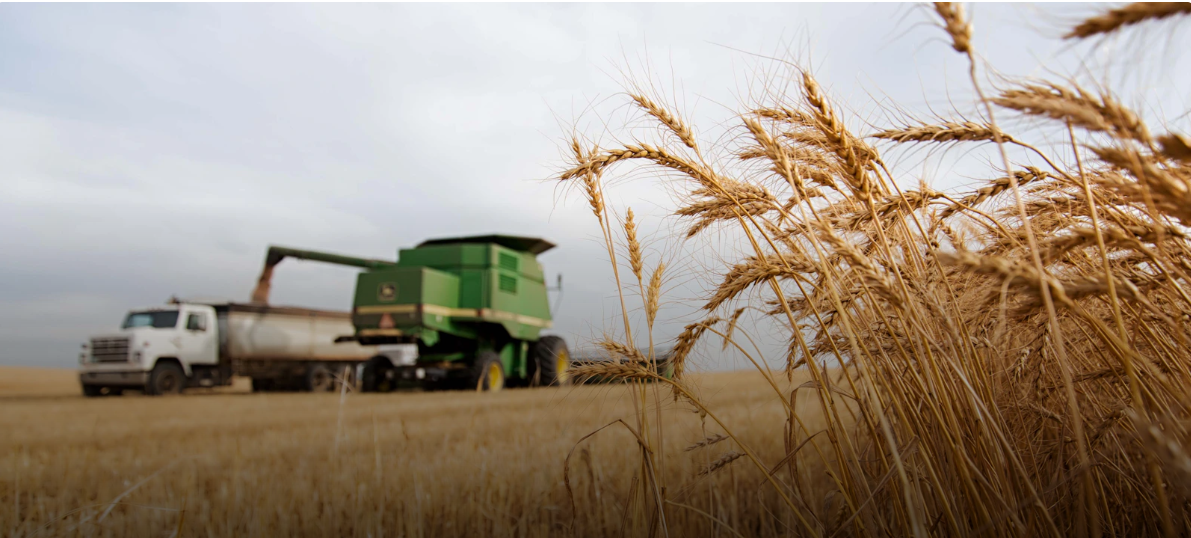
Agricultural enterprises in the Okhtyrka district have harvested slightly more grain than a year ago on the same date, although from a smaller area. Ahead of Agricultural Workers’ Day, marked on 15 November, Vorskla compared two years of data from the regional statistics office.
How much grain was harvested in the Okhtyrka district
As of 1 October 2026, 161,067 tonnes of grain and pulses (in initial weight) were recorded in the Okhtyrka district. A year earlier on the same date the figure was 160,393 tonnes. The difference is 674 tonnes, or about 0.4%. The harvested area shrank by 2,229 hectares over the year.
| Indicator | As of 1 October 2025 | As of 1 October 2026 |
|---|---|---|
| Harvested area | 28,504 ha | 26,275 ha |
| Gross harvest | 160,393 t | 161,067 t |
| Yield | 56.3 c/ha | 61.3 c/ha |
A difference of five centners means, on average, half a tonne more per hectare. As of 1 October the average yield of grain and pulses across the region was 57.6 c/ha. Among the districts, only Romny was ahead of Okhtyrka on that date, with 61.8 c/ha.
Wheat’s share
Wheat accounted for 136,566 tonnes, about 85% of the district’s grain and pulse harvest on that date. It was harvested from 20,887 hectares with an average yield of 65.4 c/ha. This shows how much the result depended on wheat. The shares of the crops may change once the harvest of late grains is finished.
What these figures tell us about the season
Higher yields allowed enterprises to harvest roughly the same amount of grain from a smaller area. To assess profitability, one would also need sale prices and the costs of fuel, drying, storage and transport. Likewise, the district average does not describe the situation in each community. The statistics cover enterprises that meet the methodology and do not include some combat areas or the occupied territories.
The Okhtyrka district compared with last season and neighbouring districts
The district harvested grain and pulses from an area 7.8% smaller than a year earlier on the same date. At the same time, yields rose by 8.9%. In yield, the Okhtyrka district was ahead of the Konotop (60.8 c/ha), Sumy (54.2 c/ha) and Shostka (46.1 c/ha) districts, and 0.5 c/ha behind Romny. In gross harvest, the Okhtyrka district accounted for about 17% of the regional total. This is a snapshot as of 1 October, when wheat dominated the local statistics. It cannot be used to estimate the final maize harvest.
Where the grain will go while the Greater Odesa ports stand idle
According to UkrAgroConsult’s assessment of 12 November, the deep-water ports of Greater Odesa are effectively blocked. Exports continue via the Danube and by rail and road across the western border. In October Ukraine shipped about 2.44 million tonnes of agricultural products, including oils and meals. Wheat dominated grain shipments, while about 530,000 tonnes of maize were exported over the two months of September and October. Analysts allow for a downward revision of the seasonal maize export forecast.
The Danube ports and western crossings have limited capacity. Longer routes, idle wagons and transshipment increase costs. For a farm in the Okhtyrka district, this may mean a buyer offering less per tonne at the local elevator, even if the price at a foreign port holds steady. Some grain may go to Ukrainian mills or feed producers. The rest, for which there is no profitable route or buyer, may stay in storage longer.
What could happen to prices this winter
- If the ports remain idle. Pressure on purchase prices may persist. For maize, an additional risk is the cost of drying and storage. Farms that need money for fuel, wages or spring sowing may sell part of their harvest even when demand is weak.
- If the Danube and western crossings handle more cargo. Some stocks could be moved out faster. For prices in the Okhtyrka district, what matters is whether delivery to the buyer gets cheaper and whether traders start buying grain locally more actively.
- If regular ship calls to Greater Odesa resume. Domestic demand for grain may rise. The pace will depend on the availability of ships, insurance and terminal operations. Even if traffic resumes, accumulated stocks will be exported gradually.
For example, on a 1,000-tonne lot, every extra UAH 500 in costs per tonne adds up to half a million hryvnias. This is an illustrative calculation, not a local tariff. That is why the decision to sell grain now or hold it until winter depends on whether the future price will cover the costs of storage, drying and delivery.
Should you stock up on grain for livestock feed?
The idle ports alone are no reason yet to buy up grain for the whole winter. In its review for 30 October – 5 November, the Ukrainian Universal Exchange reported weak maize trading and delays in shipping it out. When grain is harder to send abroad, more of it stays in Ukraine. At the same time, this is the general picture, and it does not show how many sacks can be bought in a particular village in the Okhtyrka district, or at what price.
Work out how many days what you have will last. Divide your remaining grain by your household’s usual daily use. For example, 60 kg at 3 kg a day is 20 days’ supply. This is an example calculation, not a feeding norm. If your stock will last until your next usual purchase, there is no need to rush.
If deliveries to your village are irregular, arrange the next lot in advance. How much to buy depends on how often the seller brings grain and whether you have a dry place to store it. Compare prices per kilogram including delivery and check whether the grain has been dried. Do not use damp sacks or grain showing signs of mould for feed.
Source: “Vorskla1930”
This news item is based on material from Vorskla1930 and was prepared as part of the project “Strengthening the Voice of Frontline Media: Partnership for Expanding Influence”, which helps hyperlocal media reach a wider audience and increase their influence in the information space. Full responsibility for the content and accuracy of the information lies with the editorial team of Vorskla1930.
The InfoLight.UA research and analytics group carries out a general review of materials from the outlets supported by the project and excludes newsrooms that knowingly spread false information and Russian propaganda.