



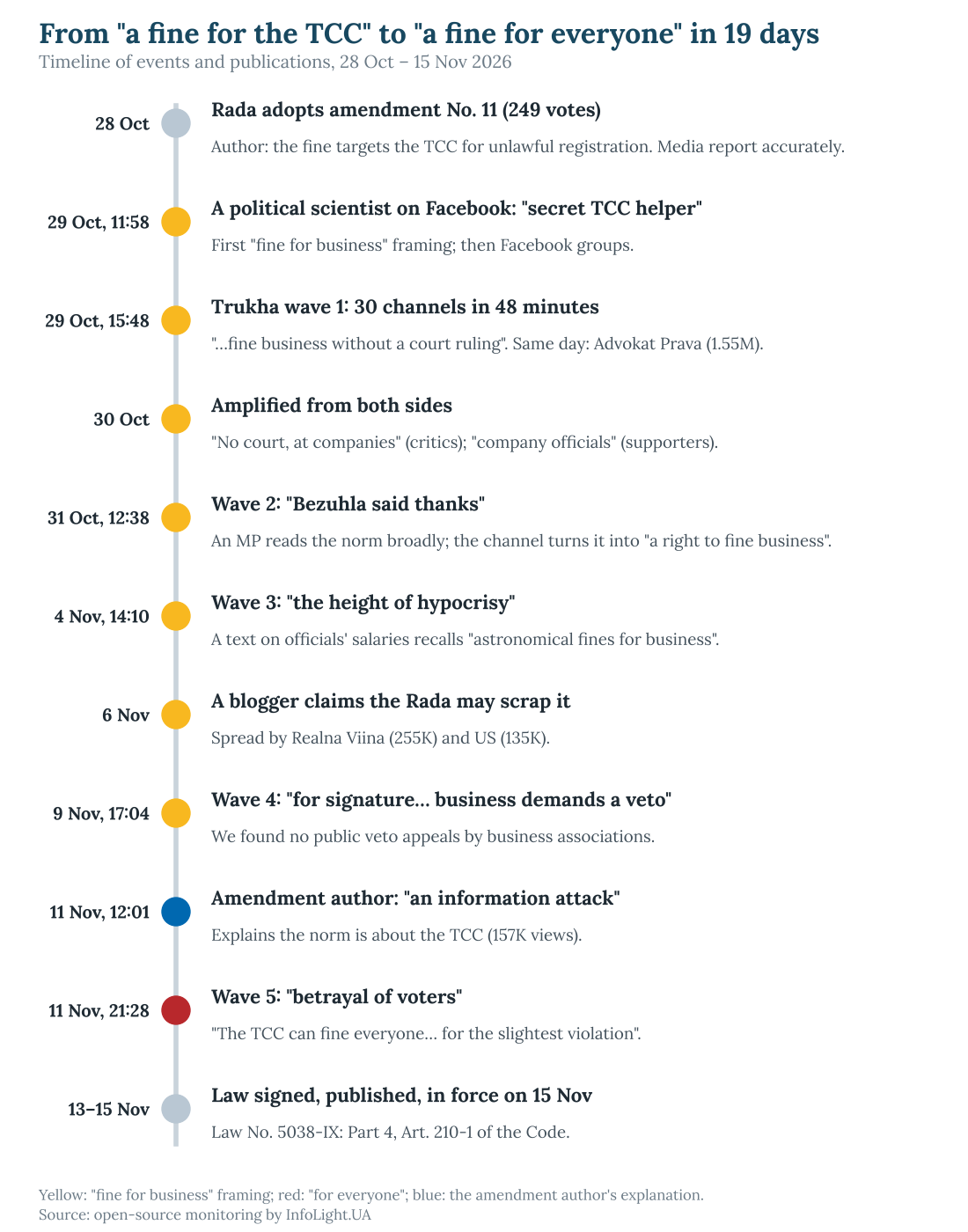
On 28 October, Ukraine’s parliament, the Verkhovna Rada, backed an amendment that sets a fine of UAH 170,000 for an official whose actions lead to someone being unlawfully placed on the military register when that person should not be there. The next day, a different version of the same rule appeared on Telegram: “The TCC will fine businesses without a court ruling.” (TCCs are Ukraine’s territorial recruitment and social support centres.) Over 19 days, the main channel of the Trukha network returned to the topic five times, and each time the rule grew wider in its telling. The latest version, on 11 November, said the TCC “can fine everyone UAH 170,000 for the slightest violation.” On 15 November the law came into force.
The InfoLight.UA research and analysis group traced how the framing changed, who launched it and how many people saw it. We counted publications on Telegram, Facebook, X, TikTok, YouTube and websites from 28 October to 16 November 2026. View counts for regional channels are as recorded at the time; counts for the main channel are fresh, as of 16 November, 13:40 Kyiv time. Some posts may since have been edited or deleted.
What the law actually says
Amendment No. 11 to bill No. 16013 (the main text dealt with bank card fraud) added a new part to Article 210-1 of the Code of Administrative Offences. Its wording was quoted in a public post by MP Mariana Bezuhla and is summarised by NetFreedom and Ukrainian News: the fine applies when an official breaches the procedure for keeping the military register and, as a result, people who by law are not subject to registration are placed on it. The amount is 10,000 tax-free minimum incomes, or UAH 170,000. The amendment won 249 votes (Komersant Ukrainian). On 13 November the law returned to the Rada signed by the President, on the 14th it was published in the parliamentary newspaper Holos Ukrainy, and since 15 November it has been in force as Law No. 5038-IX (Leopolis News).
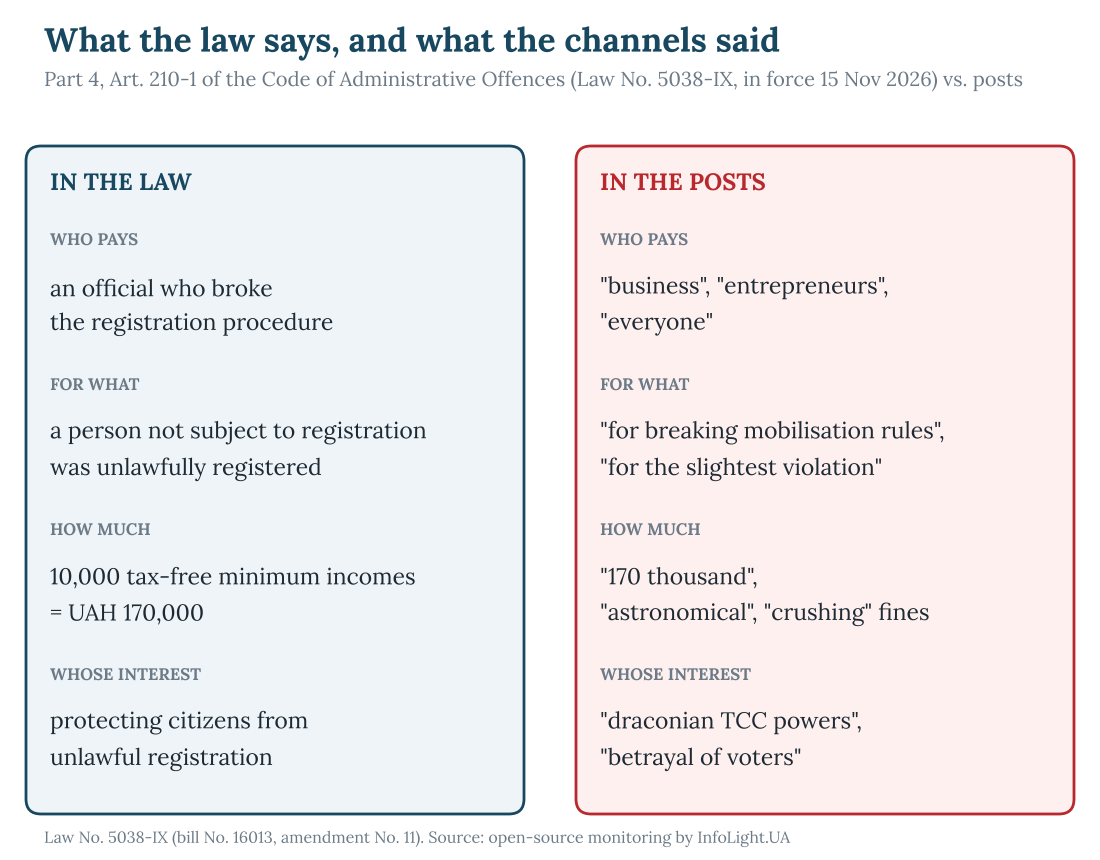
The rule has one weak spot: it says “an official”, not “a TCC employee”. Companies also keep military records of their staff, so lawyers could in theory read the word more broadly, notes a fact-check by Polemika. The same fact-check points out that the violation is tied to placing a person on the register, which is a TCC function. The author of the amendment, Dmytro Razumkov, explained it this way from day one: a fine for TCC officials if they unlawfully registered a person who is not subject to registration (Telegram post, 28 Oct). Bezuhla, thanking her colleague, read the rule more broadly, as a way to fine anyone who breaks registration rules (Ukrainian News). That ambiguity became the hook. Yet under no reading does the rule apply to “everyone” or punish “any violation”: it covers only the unlawful registration of a person who should not be registered.
Wave one: “businesses, without a court ruling”
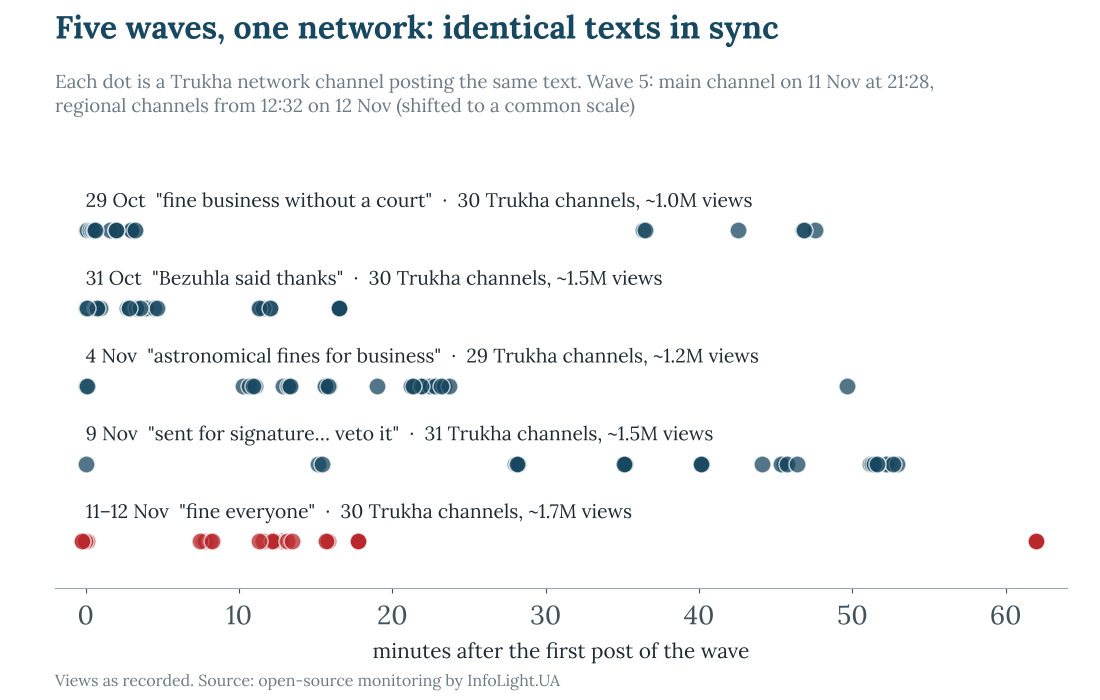
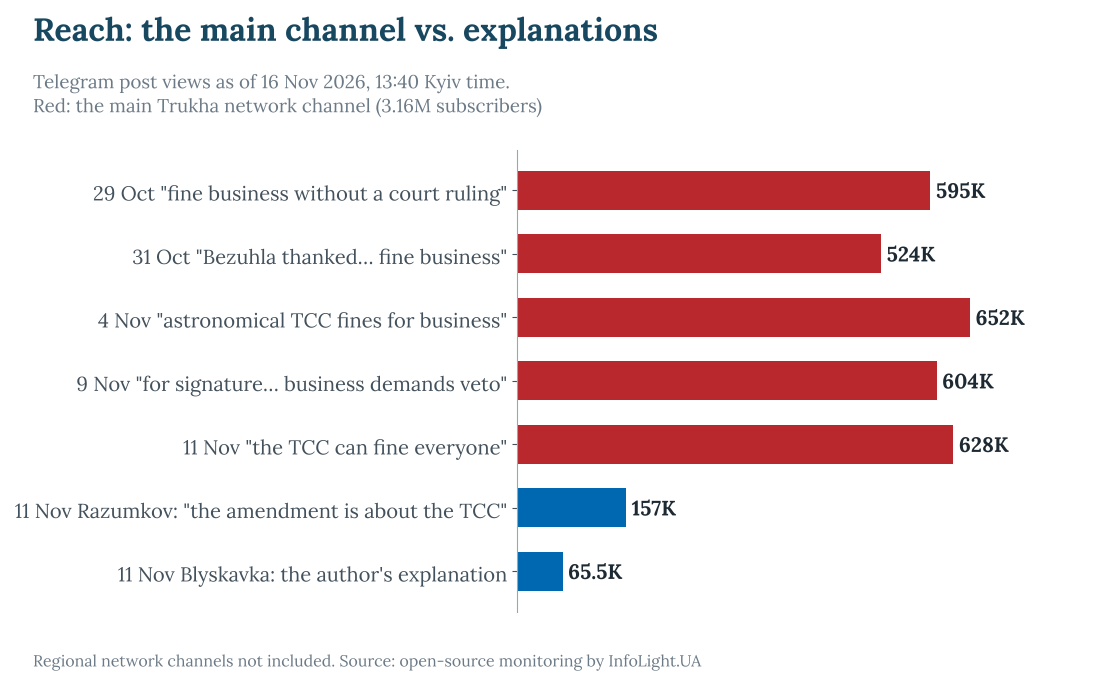
In our data, the “fine against business” framing first appeared in a Facebook post by a political scientist on 29 October at 11:58, calling Razumkov either a “secret TCC helper” or a “legal amateur”. Within hours the text spread through Facebook groups. At 15:48 the first synchronised wave of the Trukha network began. Regional channels went first: Trukha Kremenchuk at 15:48, Trukha Kharkiv at 15:50, and only at 16:24 the main channel (3.16 million subscribers; 595,000 views as of 16 November). The headline: “Razumkov’s amendment will let the TCC fine businesses UAH 170,000 without a court ruling.” The text added words that are not in the rule: “persons responsible for keeping military records at enterprises”. Within 48 minutes, 30 channels of the network had posted the same text. That evening the channel Advokat Prava (1.55 million subscribers) retold the political scientist’s version: Razumkov was supposedly “helping to expand the powers” of the TCC.
On 30 October the framing was reinforced from two sides. The channel Vsevidyashcheye OKO (192,000 views when recorded; the channel has since changed its address, so we cite the post from our monitoring data) wrote about a “UAH 170,000 fine without a court” for registration breaches “at enterprises”. Meanwhile Times of Ukraine (327,000 views) and UNIAN presented the same rule approvingly, as liability for “company officials” over fictitious draft exemptions. Critics and supporters argued about different things, but both camps were already talking about business.
Waves two and three: “thanks” and “the height of hypocrisy”
On 31 October at 12:38 the main channel turned Bezuhla’s thanks into proof: she had “thanked Dmytro Razumkov for giving the TCC the right to fine businesses” (524,000 views as of 16 November). In the same minute the text appeared on Trukha Kyiv, three minutes later on Trukha Kharkiv; within 17 minutes it was on 30 channels of the network.
On 4 November at 14:10 the network published a text about a different vote, on capping officials’ salaries, under the headline “The height of hypocrisy” (652,000 views as of 16 November). At the end came a reminder that the MP had earlier “pleased” entrepreneurs with “astronomical TCC fines for business of up to UAH 170,000 without a court”. Twenty-nine channels of the network repeated the text within 50 minutes. On 6 November a “source in the Rada” joined the story: blogger Kyrylo Sazonov wrote that the law enforcement committee was supposedly looking for a way to revise the amendment because business might be outraged. His words were retold by Realna Viina (255,000 views) and US (135,000). Polemika notes that the claim rests on anonymous sources and that the committee made no official statement (fact-check).
Waves four and five: “veto it” and “everyone”
On 9 November at 17:04 Trukha Lviv went first, followed at 17:20 by the main channel (604,000 views as of 16 November): the law with the “scandalous amendment” on “crushing fines for business” had been sent for signature, and “business is appealing to the President to veto the bill”. We found no public appeals by business associations calling for a veto. Thirty-one channels of the network repeated the text within 53 minutes, among them Trukha Kyiv (166,000) and Trukha Kharkiv (150,000).
On 11 November at 12:01 Razumkov responded on his channel (157,000 views): the amendment had become the target of an information attack, and it is the TCC that places people on the register. His explanation was retold by Blyskavka (65,500). At 21:28 the network’s main channel came out with the fifth wave: “Razumkov clumsily tries to justify betraying voters” (628,000 views as of 16 November). This is where the rule first became a rule “for everyone”: “The TCC can fine everyone UAH 170,000 for the slightest violation.” Regional channels repeated the text the next day from 12:32, including Trukha Kyiv (138,000) and Trukha Kharkiv (144,000).
How many people saw it
In total, from 28 October to 16 November we counted 588 publications from 385 sources mentioning the UAH 170,000 fine together with the TCC or Razumkov (excluding mirrors of the same channels). The accurate framing, a fine for officials over unlawful registration, appeared in 219 publications, mostly on 28–29 October. The “fine for business” framing appeared in 289, and “fine everyone” in 43. When recorded, the “for business” and “for everyone” versions together had about 7.7 million views; the accurate one, about 1 million. The five waves on the Trukha network’s regional channels added another 1 to 1.7 million views each; the thirty channels together have more than 8.5 million subscribers (one person may follow several channels).
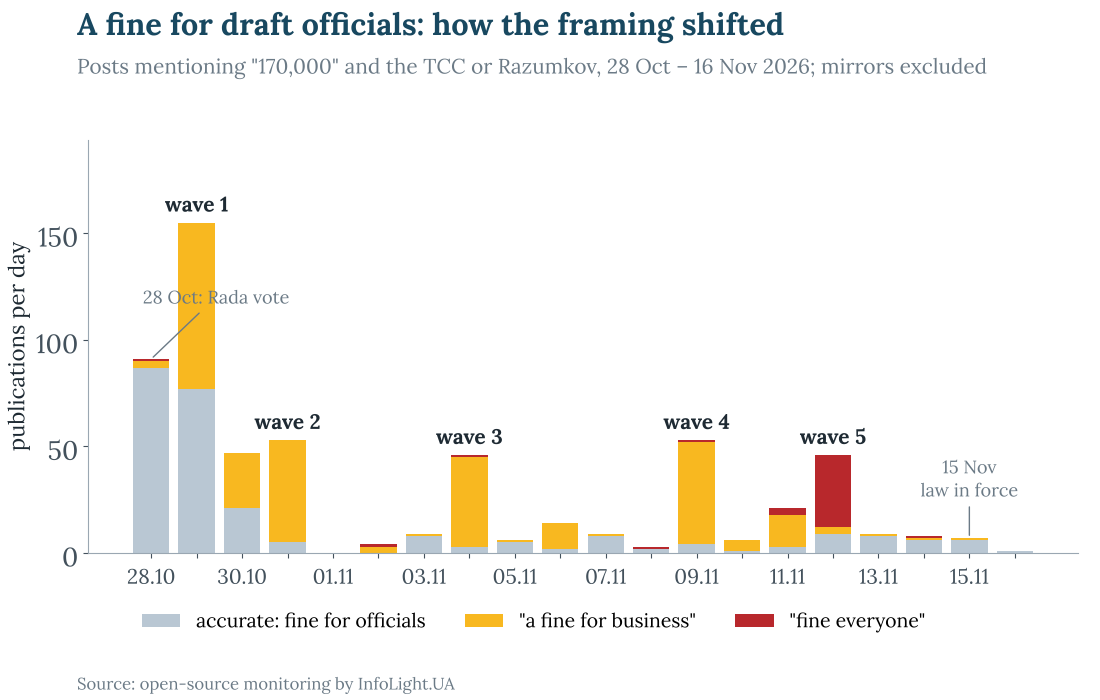
The amendment author’s explanation reached three to four times fewer people than any of the main channel’s five posts. Fact-checks by Polemika and NetFreedom were published on websites and did not reach the mass Telegram audience.
Why it matters
We do not assess the amendment author’s politics, nor do we investigate who is running a campaign against him and why: the third wave shows that the network also criticises him over other votes. What interests us is what happened to the rule itself. In wartime the state restricts citizens’ rights, and trust in those restrictions rests on a simple principle: the law is the same for everyone, and officials are held accountable, not only citizens. This rule is a rare case in which the state set a penalty for its own officials ten times harsher than for citizens. Within 19 days the information space had turned it into its opposite: “draconian powers” and a threat to “everyone”.
The mechanism is simple and repeatable. An imprecise word in the law (“official”) provides the hook. The first post sets the frame, and a synchronised network carries it across thirty cities within half an hour. Each new occasion, whether a colleague’s thanks, a rumour from a committee, the bill going for signature or the author’s reply, becomes a reason for a new wave, and each time the frame widens: “business”, then “entrepreneurs”, then “everyone”. Explanations come later and get three to ten times fewer views.
If you come across a post about a “UAH 170,000 fine”, ask three questions. Who is fined: under the rule, the official responsible for an unlawful registration. For what: only for registering a person who is not subject to registration. What it means for you: if you were unlawfully registered, the law now gives grounds to hold a specific official accountable.
Publications were collected by an automated open-source monitoring system, which may make mistakes in individual records. Our conclusions describe how information spread and are not an accusation against anyone. The list of publications is available on request.
The lead image was generated with AI. Ukrainian version: Штраф для посадовця, а не «для кожного».