


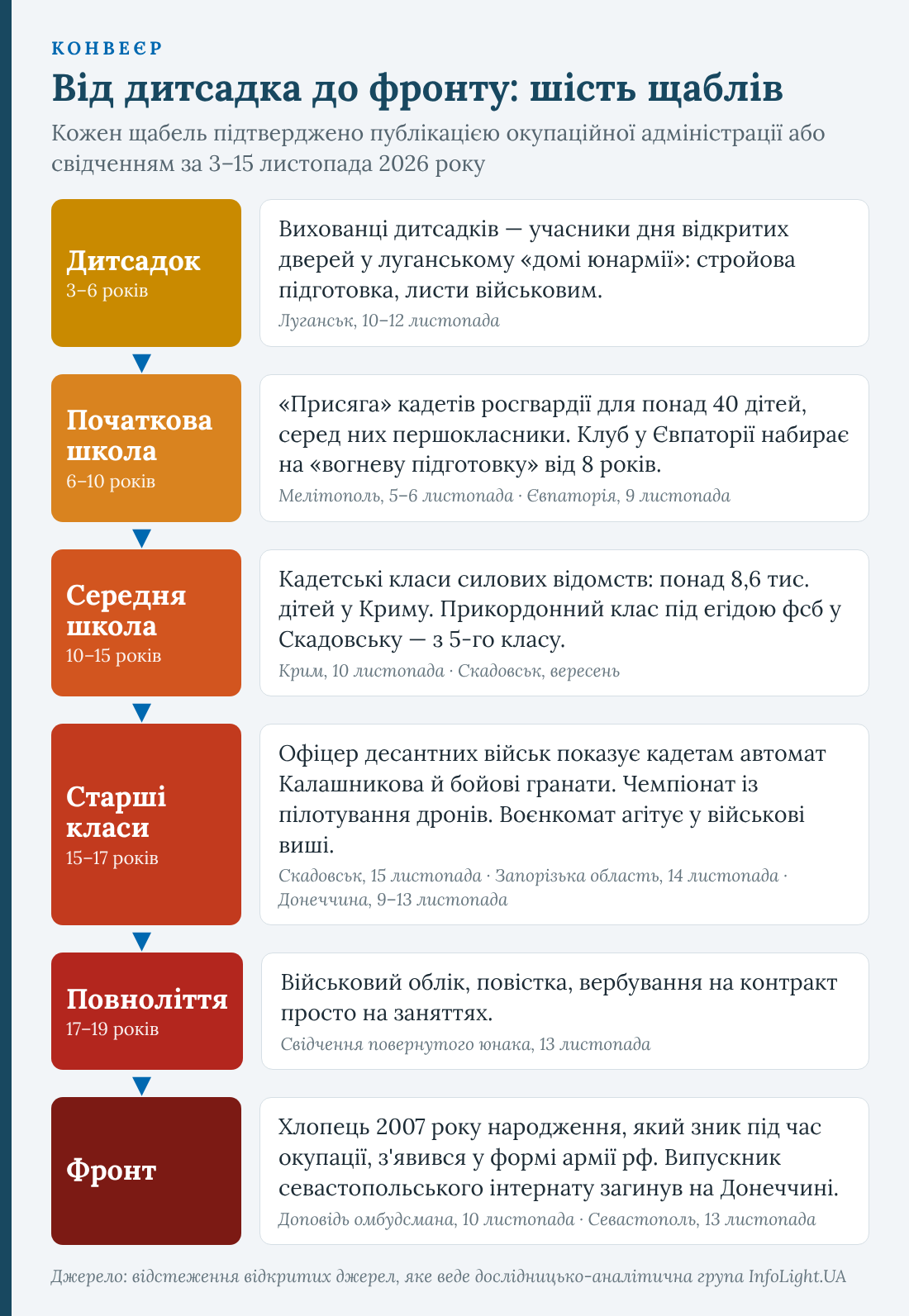
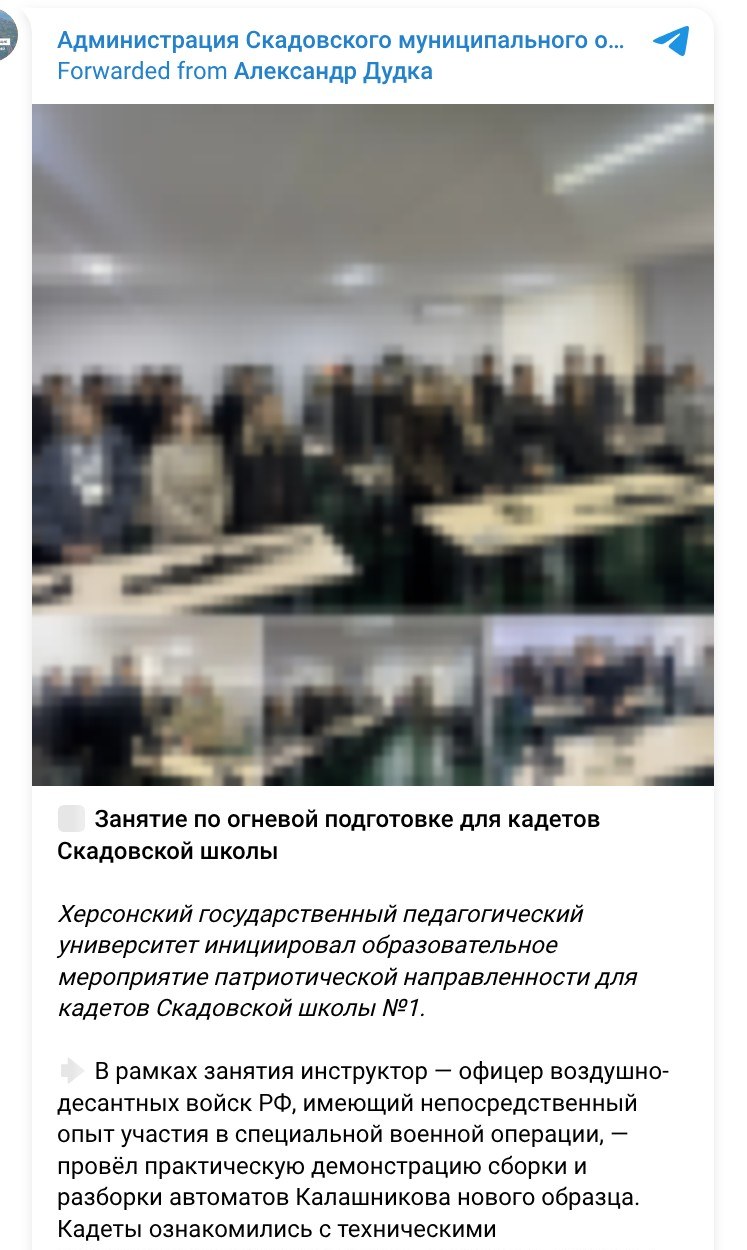
On 15 November, at School No. 1 in occupied Skadovsk, a “firearms training session” took place. The instructor, an officer of the Russian airborne forces and a veteran of the war against Ukraine, showed cadets how to assemble and strip a new-model Kalashnikov rifle. The children then “studied the design and use of different types of combat grenades” and talked about the “strategic goals and objectives” of the war. This was reported by the town’s occupation administration itself, with the date, the place and photographs.
This is not an isolated case. The InfoLight.UA research and analytics group continuously monitors open sources on children in the occupied territories. Over two weeks, from 3 to 15 November 2026, we collected and verified against the original sources several dozen such episodes. Together they form a single line: from kindergarten to military registration. At every stage of this line stands a specific body of the occupying state: Yunarmiya, the Rosgvardiya, the FSB, the Investigative Committee, the military enlistment office, a military college.
Almost everything described below was told by the occupiers themselves, in posts by schools, clubs, administrations and officials. The data were collected as of 16 November. Some posts may already have been deleted or changed, so we include screenshots of the key ones. Photographs in which children can be seen have been blurred.
Stage one: kindergarten and primary school
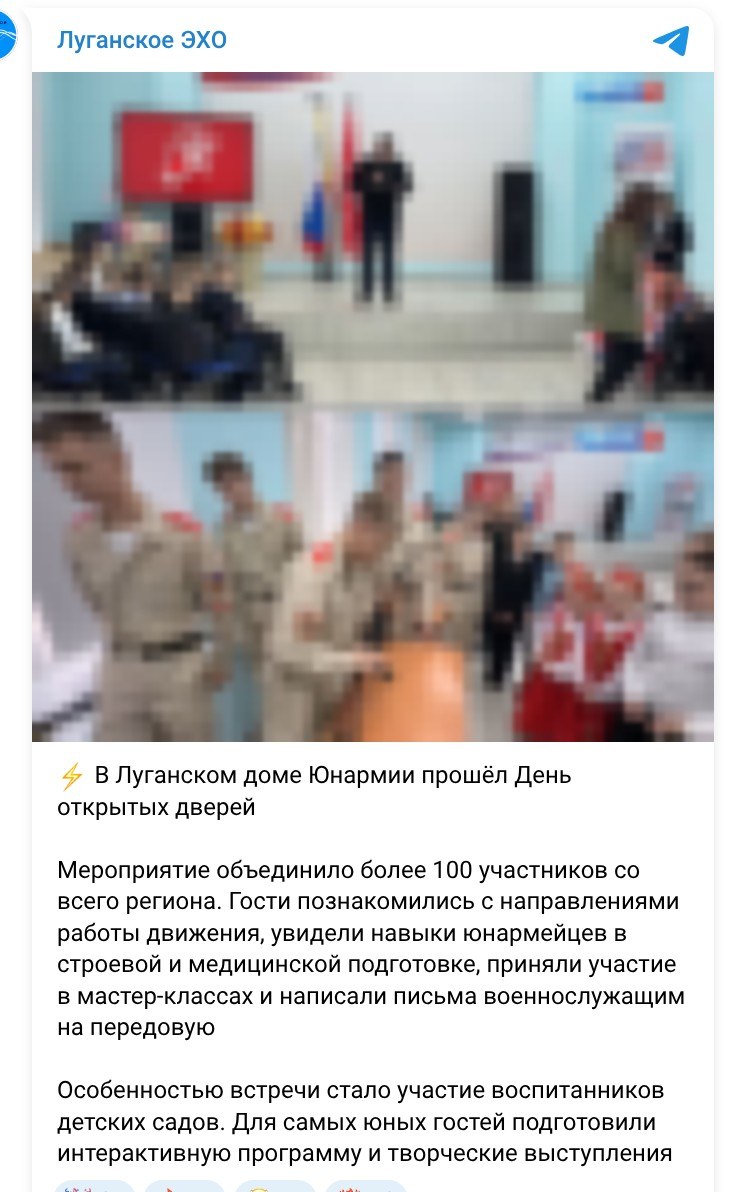
In Luhansk, the “Yunarmiya house” held an open day. According to the local channel “Luganskoye Ekho”, more than a hundred participants demonstrated drill and medical training and wrote letters to soldiers “at the front line”. The organisers made a special point of the participation of kindergarten children. At the same time, young people in the occupied Luhansk region for the first time began to take the tests of the all-Russian “Yunarmiya standard” training programme.
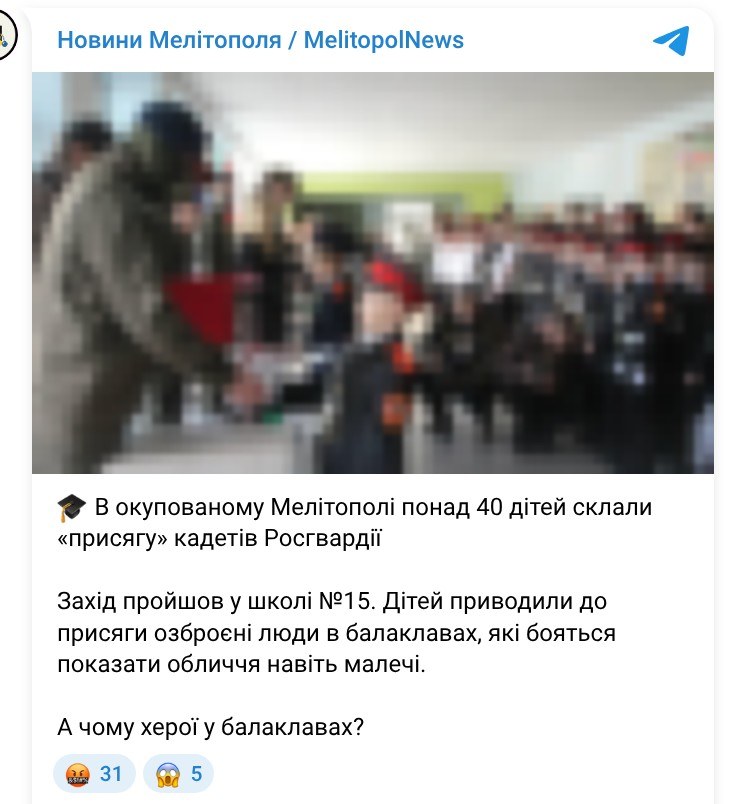
In Melitopol, at School No. 15, more than forty pupils in Rosgvardiya cadet classes took the “cadet’s oath” in early November. Occupation sources wrote that first-graders were among them and that the oath was administered by a fighter from a Rosgvardiya special unit. On 13 November the Ukrainian outlet Melitopol News added a detail: the children were brought to the “oath” by armed people in balaclavas.
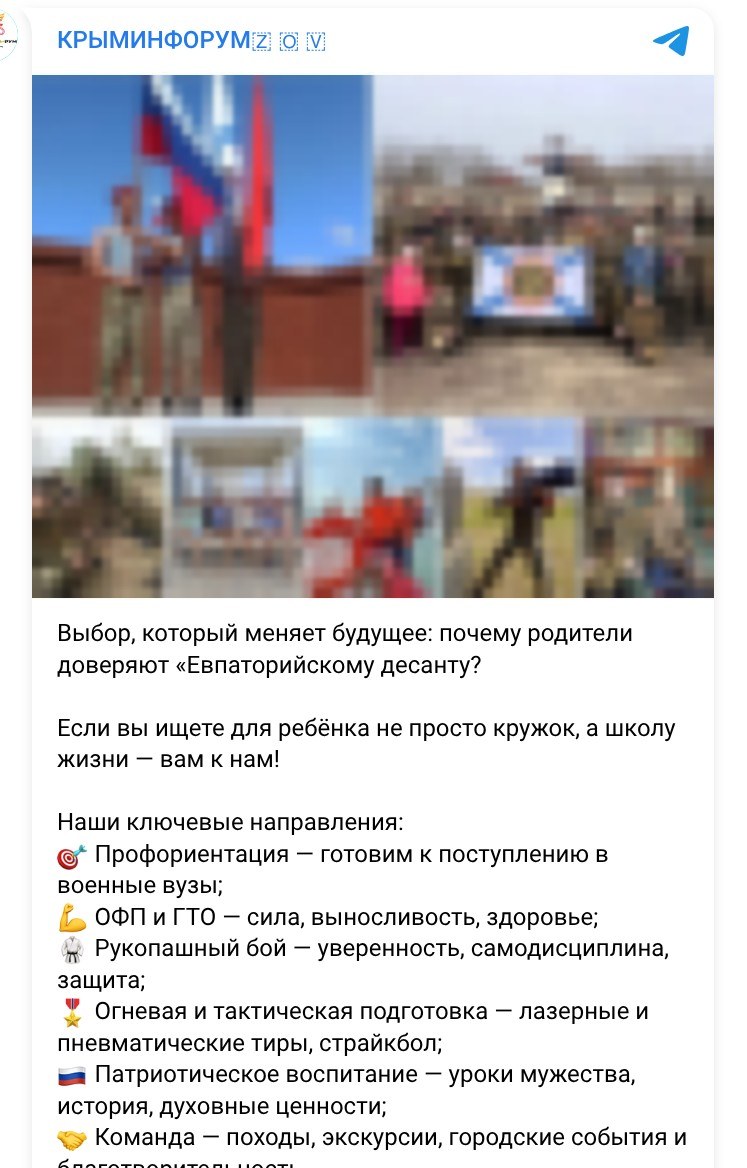
In Donetsk, on 6 November, a hundred children took the Yunarmiya oath. At Donetsk School No. 20 a “Health for the Soldier” drive was held: pupils from the first to the eleventh grade, together with parents, teachers and Yunarmiya members, collected medicines “for our soldiers”. In Yevpatoriia, a military-patriotic club announced year-round enrolment of children from the age of eight. The announcement lists its activities: preparation for entry to military universities, hand-to-hand combat, “firearms and tactical training” and “lessons of courage”.
Cadet classes: an agency behind each one
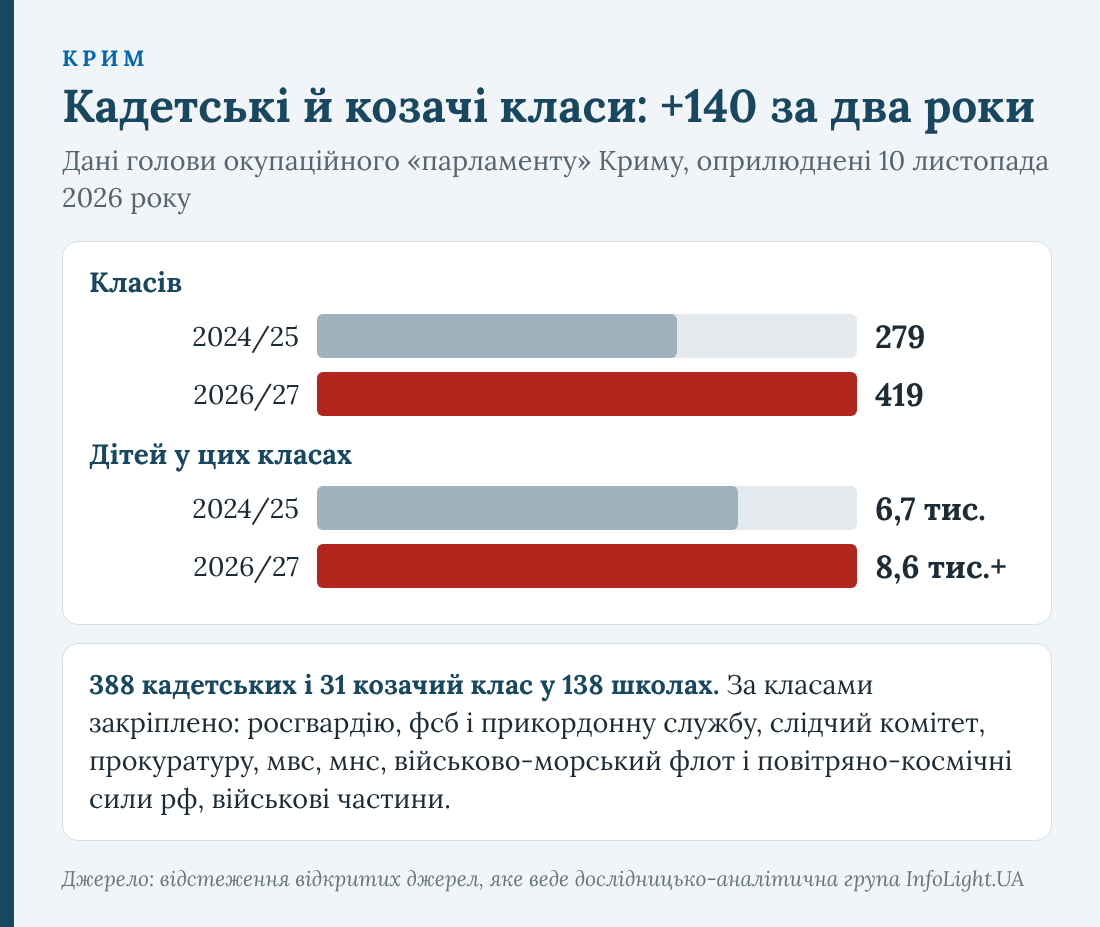
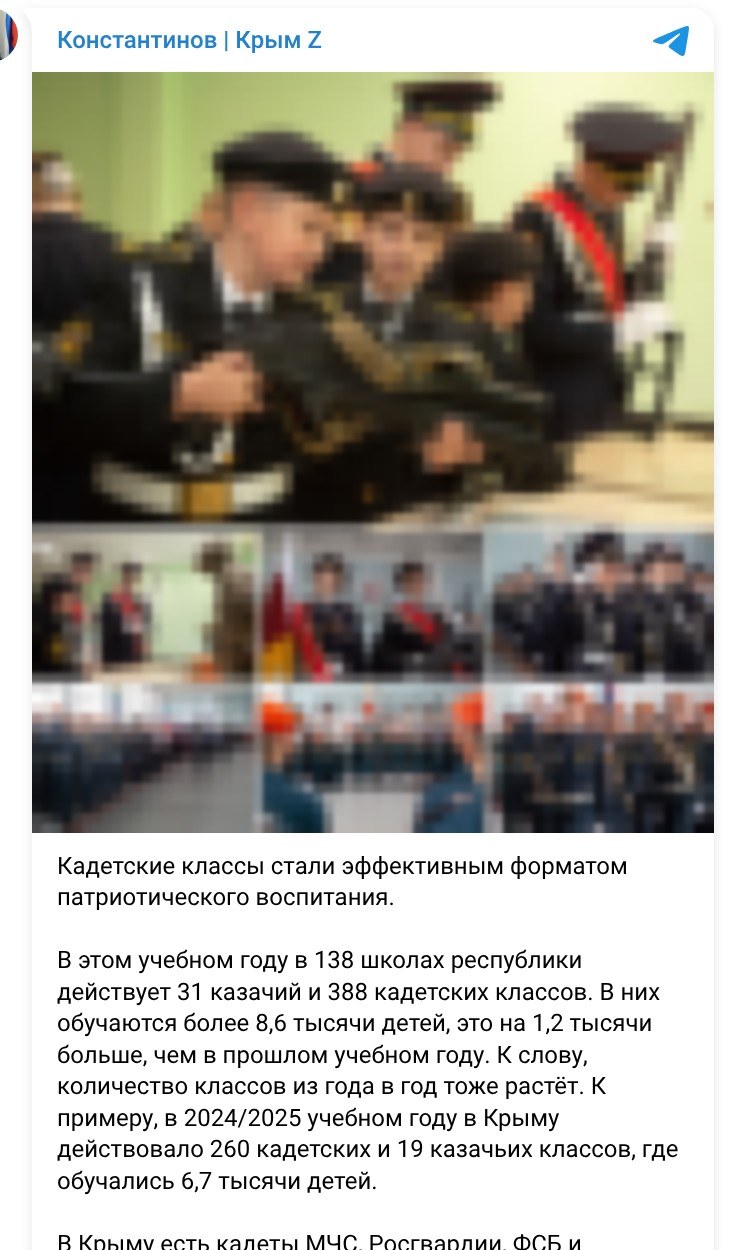
The fullest picture was provided by Volodymyr Konstantinov, head of Crimea’s occupation “parliament”. On 10 November he reported that this school year 388 cadet classes and 31 Cossack classes are operating in 138 schools on the peninsula, with more than 8,600 children. That is 1,200 more than last year. In the 2024/25 school year there were 279 classes and 6,700 children. The classes are attached to the Rosgvardiya, the FSB and its border service, the Investigative Committee, the prosecutor’s office, the interior ministry, the navy and the aerospace forces of Russia. According to Konstantinov, the children receive basic military training.
The next day, as Suspilne Crimea reported, cadets of a project called the “school of tactical training for Russian youth”, teenagers aged 14–17, marched into the mountains in full gear. The project’s programme includes tactical, firearms and engineering training and drone piloting.
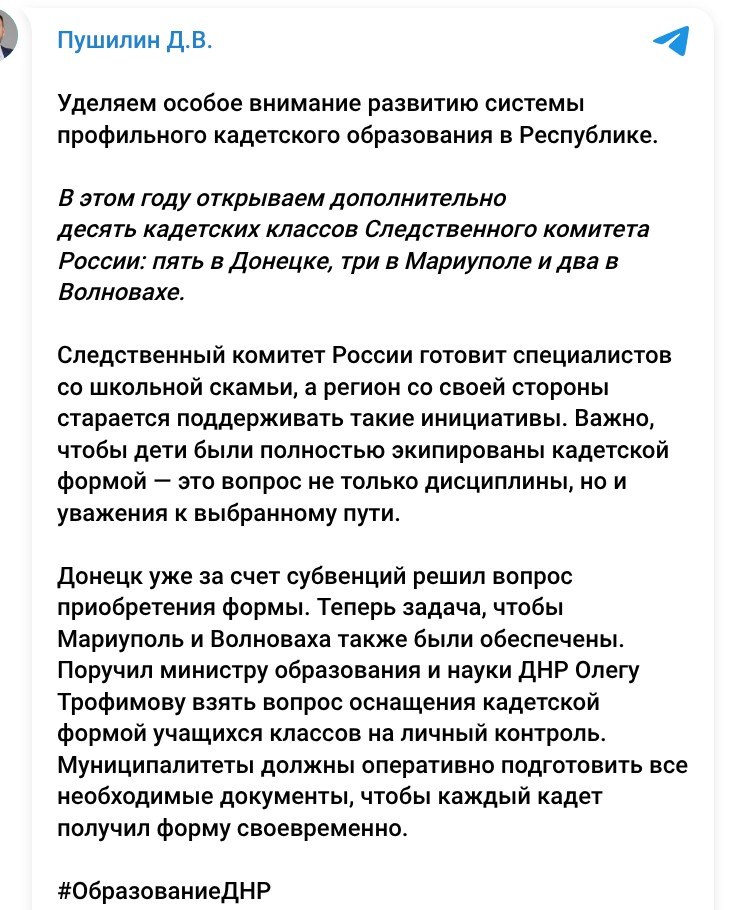
The same is being rolled out in the territories occupied after 2022. Back in August, Denis Pushilin, head of the occupation administration of the Donetsk region, wrote: “This year we are opening ten additional cadet classes of the Investigative Committee of Russia: five in Donetsk, three in Mariupol and two in Volnovakha.” He explained that the agency “trains specialists from the school desk”. In Berdiansk, uniforms for the Investigative Committee’s school cadets were made by factories in Tver. In Skadovsk, at the same School No. 1, there is a Rosgvardiya cadet class whose mentors the administration names as officers of the 96th Regiment, and in September a border guard cadet class for fifth-graders was opened there under the auspices of the FSB cadet corps.
According to the Almenda Centre for Civic Education, at least 479 cadet classes have been set up in the occupied territories. The Crimean figure shows that the real number is already higher.
Weapons in the classroom
The session in Skadovsk was initiated by the occupation pedagogical university. The administration’s post says it plainly: the instructor has experience of taking part in the “special military operation”, meaning he fought against Ukraine. On occupied Ukrainian land, children are being taught to handle weapons by a man who came there with those weapons.
Many similar reports accumulated over the two weeks. In Sevastopol, teenagers at a tournament went through six stages of basic military training: piloting drones and assembling and stripping a Kalashnikov. The organisers named the goal without hints: “pre-conscription training of young people”. In Berdiansk, 345 children at a resource centre study tactical medicine and hand-to-hand combat, and repair and fly drones themselves at a training ground. In Chaplynka in the Kherson region, “lessons of courage” for the Yunarmiya members of the local school are regularly held by soldiers of Russia’s 18th Army. In Mariupol, “Cossacks” told vocational school students about mines and tactical medicine. In Donetsk, the Yunarmiya chief of staff said that in the tactical game “Zarnitsa 2.0”, companies and armies are commanded by people with “real combat experience”.
Drones: “no longer just a game”
On 14 November Yevgeny Balitsky, head of the occupation administration of the Zaporizhzhia region, announced the regional stage of the “Pilots of the Future” drone piloting championship. He wrote: “Piloting drones today is no longer just a game but a real skill in demand.” The winners will go to the final, held in Moscow on 17–22 November. The selection was organised by the regional branch of the “Movement of the First” and Crimea’s drone racing federation. A week earlier, similar selections took place in Luhansk and Antratsyt, and 350 teenagers took part in the regional stage in Feodosiia.
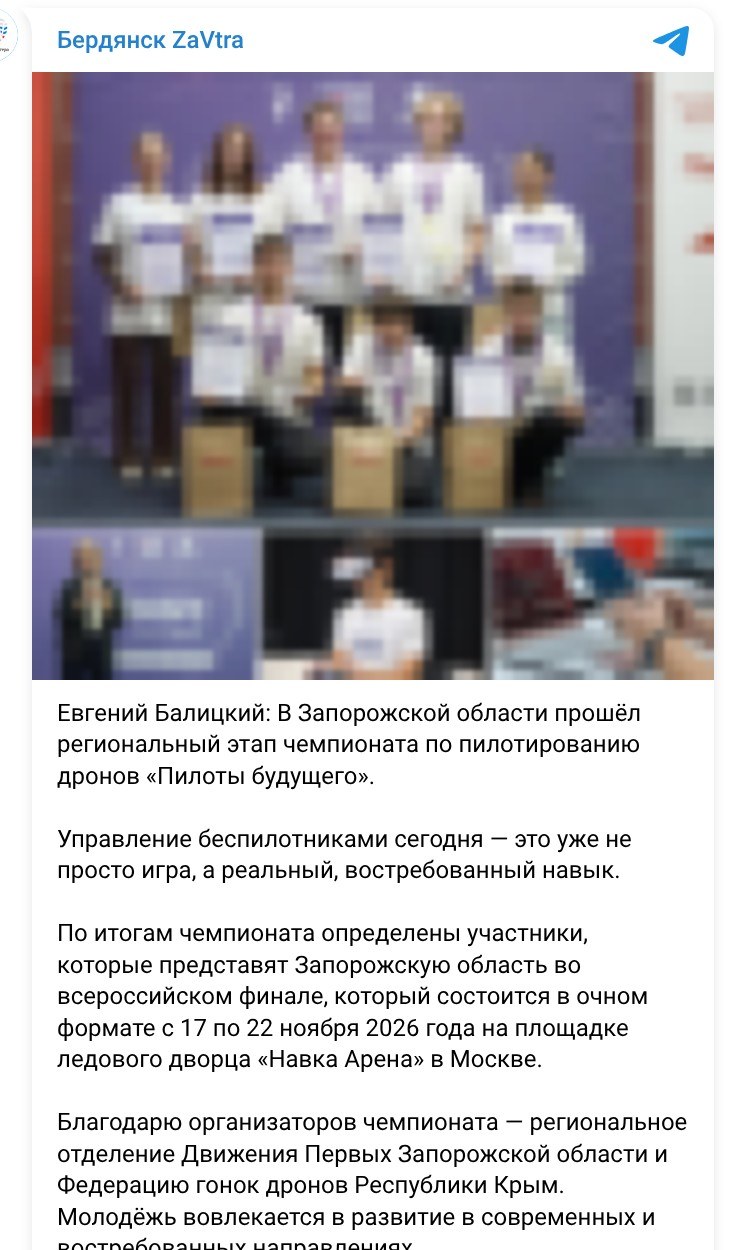
The official himself removed the “sporting” cover. After four years of drone warfare, there is no need to explain where this skill is “in demand”.
The enlistment office comes to school
In November the military commissariat of the occupied Donetsk region is running a recruitment campaign titled “There is such a profession — defending the Motherland!”. According to the announcement, meetings, “lessons of courage” and exhibitions are being held in schools, colleges and technical schools, and graduates are told about admission rules for Russian defence ministry universities and “prospects for further service”. In Telmanove, representatives of the district enlistment office and the Donetsk Higher Combined-Arms Command School met Yunarmiya members at the local gymnasium. This school also looks for cadets in Russia itself: at the Astrakhan cadet corps, one of its officers called it a “forge of officer cadres for the armed forces of Russia”.
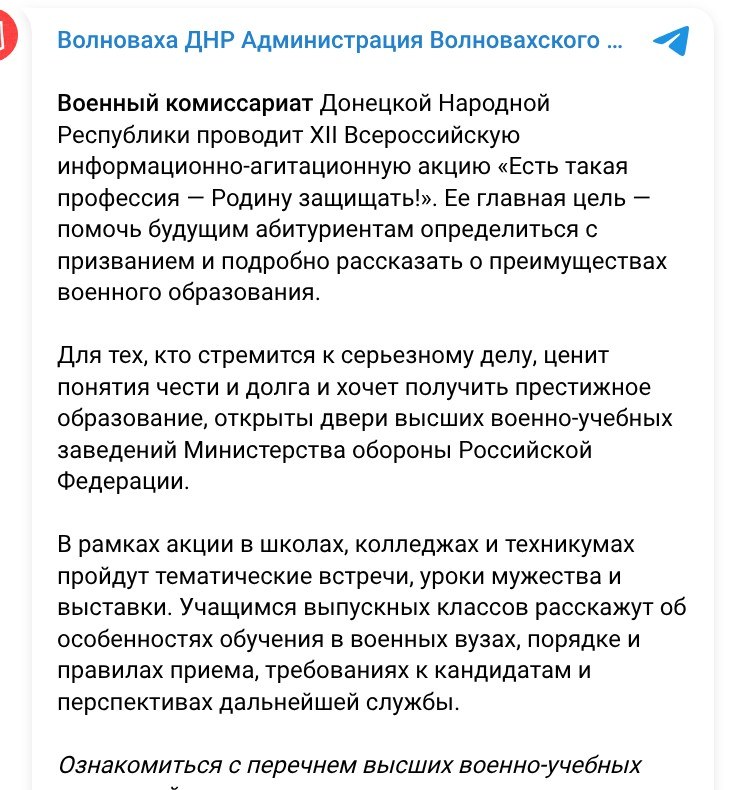
The Fourth Geneva Convention explicitly prohibits this. Article 51 does not allow an occupying power to compel people to serve in its armed forces and separately prohibits pressure and propaganda aimed at securing “voluntary” enlistment. Here, the enlistment office itself is doing the recruiting, and its audience is schoolchildren.
Call-up notice, contract, front
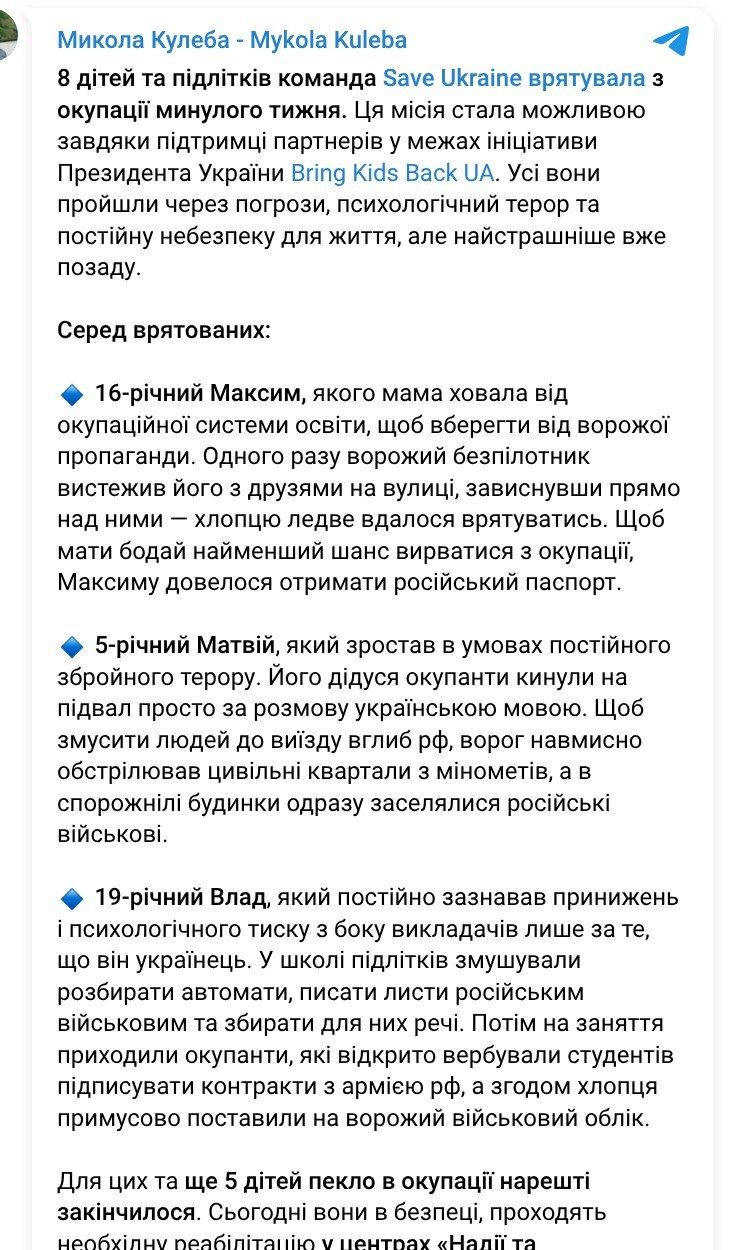
How the conveyor belt ends is told by those who managed to escape. On 13 November the organisation Save Ukraine reported the return of eight children and teenagers. Among them is 19-year-old Vlad. He says that at school teenagers were made to strip assault rifles, write letters to Russian soldiers and collect things for them. Then the occupiers came to classes and openly recruited pupils to sign contracts with the Russian army. Later he was forcibly registered for military service. The next day the organisation’s founder added that some of the young men returned had already received call-up notices.
On 10 November, presenting the special report “Resilient”, Ombudsman Dmytro Lubinets cited two documented cases. A boy born in 2007 disappeared during the occupation and later appeared in a military uniform with Russian insignia. Another, who was sixteen when the occupation began, ended up in a prisoner-of-war camp. He told the ombudsman that he “had no choice”.
The same is being said at the highest level. On 5 November the President of Ukraine stated that some of the abducted children who have grown up during the years of war have already been recruited into the Russian army. On 11 November, EU High Representative Kaja Kallas said in the European Parliament that Russia is “likely now sending abducted Ukrainian children back to fight against Ukraine”.
Occupation sources confirm this in their own way. A Rosgvardiya serviceman said that he had “by his own example” brought three young men from the occupied Luhansk region to a military institute in Saratov. And on 13 November the head of the Sevastopol occupation administration announced the funeral of a sailor who was born and raised in the city, graduated from boarding school No. 3, signed a contract with the Russian defence ministry in 2024 and was killed in the Donetsk region.
The first cases and verdicts
On 13 November the Security Service of Ukraine reported the detention of a former director of an out-of-school education institution in Yevpatoriia. Military counter-intelligence lured him out of Crimea, and he was detained in the Odesa region. According to the case materials, after 2014 the occupiers “reappointed” him as head of the seized children’s and youth institution. Under the guise of sports clubs and cultural events, he involved children aged five to eighteen in militaristic propaganda activities, while serving Russian soldiers gave the children firearms and tactical training. Investigators also established his involvement in the deportation of children from the occupied areas of the Kherson and Zaporizhzhia regions to Russia via Crimea. He has been served a notice of suspicion under Part 3 of Article 111-1 of the Criminal Code. The SBU did not release his name; according to Krym.Realii, a court remanded him in custody.
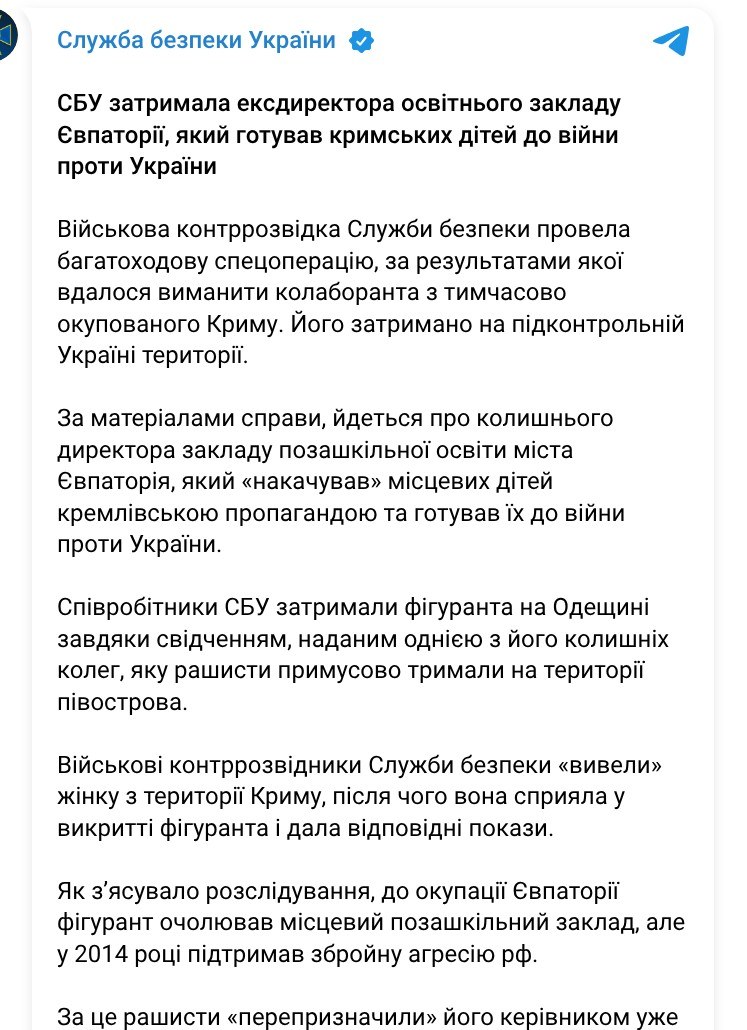
This is not the first such case. On 5 November it became known that the head of a Crimean military-patriotic club had received an in-absentia sentence of twelve years for training children for service in the Russian army and urging them to enter military colleges. The same day, the Kherson City Court sentenced in absentia the head of a college illegally set up by the occupiers, and she was separately served a notice of suspicion of deporting six minors to Crimea, where they were prepared for military service; this was reported by the Pylyp Orlyk Institute for Democracy. The Kherson regional prosecutor’s office reports that it has sent indictments to court against 84 people involved in introducing Russian educational standards.
Why this is not “patriotic education”
Occupation sources call all this “patriotic education” and “career guidance”. International law calls it something else. Article 50 of the Fourth Geneva Convention prohibits an occupying power from enlisting children in formations or organisations subordinate to it. Article 51 prohibits coercion and propaganda aimed at service in its armed forces. The Rome Statute classifies as a war crime compelling nationals of the hostile party to take part in military operations against their own country.
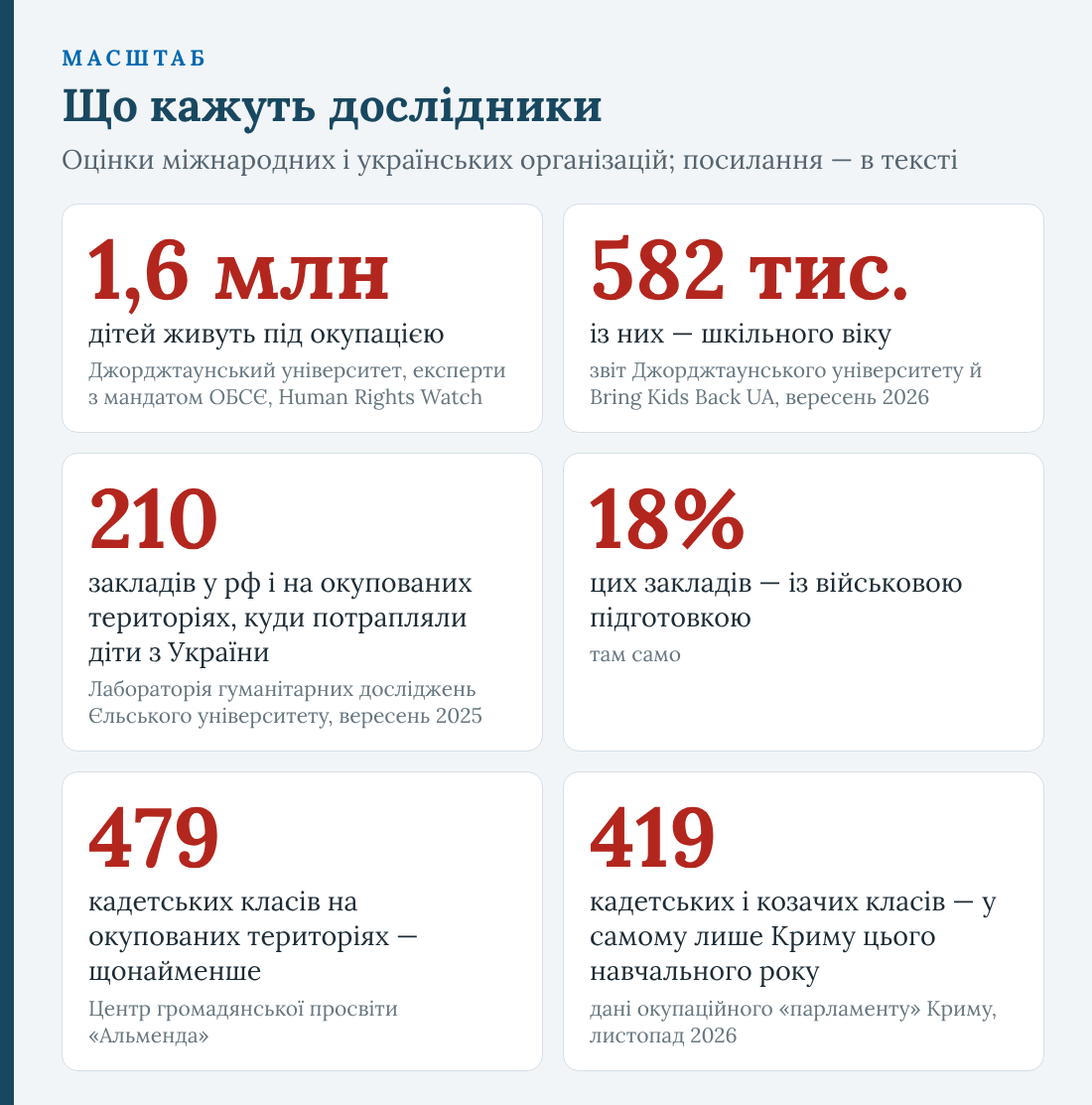
Researchers assess it in the same way. Georgetown University’s International Criminal Justice Initiative, in an interim report prepared with Bring Kids Back UA, concluded that the campaign of indoctrination and militarisation of Ukrainian children violates international humanitarian law and human rights law. According to the report, about 1.6 million children live in the occupied territories, at least 582 thousand of them of school age; the initiative itself recalled this after a meeting with the Office of the Prosecutor General on 6 November. In July, experts under an OSCE mandate stated that this system may amount to a crime against humanity. Human Rights Watch described how Russian-controlled schools violate children’s rights. Last year, Yale University’s Humanitarian Research Lab counted at least 210 facilities in Russia and the occupied territories where children from Ukraine had been sent; in at least 18 per cent of them, children were given military training.
On 12 November the European Parliament adopted a resolution by 536 votes stating that Russia’s actions against Ukrainian children meet the definition of genocide under Article II(e) of the 1948 Convention. The resolution calls for sanctions to be extended to everyone who organises, finances or facilitates the deportation and forced re-education of children.
Evidence the occupiers publish themselves
In the week of 9–15 November, our monitoring recorded 343 reports on the militarisation of children in the occupied territories. 251 of them, almost three quarters, were published by occupation sources: schools, clubs, administrations and local channels. Another 57 came from sources in Russia. Only 35 were Ukrainian.
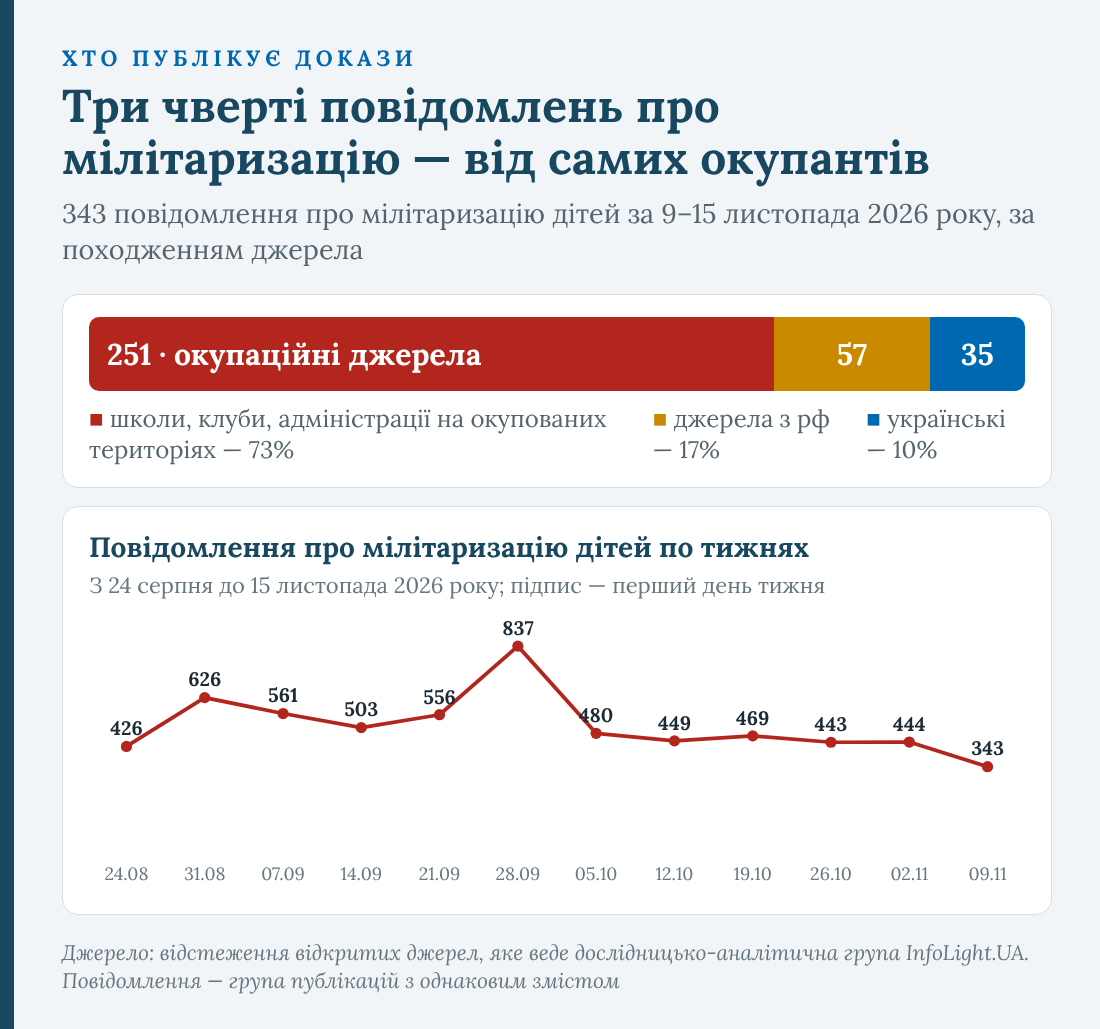
The occupiers do not hide this work because they report on it to their superiors. For them it is a performance indicator: how many classes opened, how many children in uniform, how many tests passed. For Ukraine it is a body of evidence with dates, addresses and names. But it will not last forever. Posts get deleted, channels get closed, and after the first arrests people will become more cautious.
Hence three conclusions. First, every such post must be preserved immediately, with a screenshot and a date, and passed on to investigators. Second, behind every cadet class stands a specific Russian agency and specific officers. That is a ready-made list for sanctions and notices of suspicion. Third, militarisation and the removal of children are parts of a single system. The Yevpatoriia case showed this best: according to investigators, one and the same man both brought military instructors to the children and helped take children to Russia.
How we worked. This article is based on the continuous monitoring of open sources carried out by the InfoLight.UA research and analytics group. Each episode was verified against its original source. We do not link to sources in Russia or to occupation sources: key posts are shown in screenshots, and a full list of publications can be provided on request. We do not name the children or the person in the SBU case.
An automated monitoring system may make mistakes in individual records, so the figures should be treated as estimates. Our conclusions describe a phenomenon and are not an accusation against specific people, except where reports by law enforcement agencies and courts are cited.
The main image was generated with AI.
The InfoLight.UA research and analytics group is a joint project of the NGO Foundation for Democracy Assistance and the Hanns Seidel Foundation in Ukraine.
This publication was produced within the project “Strong Civil Society of Ukraine – a Driver of Reforms and Democracy”, implemented by the NGO Foundation for Democracy Assistance with the support of the Askold and Dir Fund, administered by ISAR Ednannia with funding from Norway and Sweden. The content of this publication is the sole responsibility of the NGO Foundation for Democracy Assistance and does not reflect the views of the governments of Norway and Sweden or of ISAR Ednannia.