


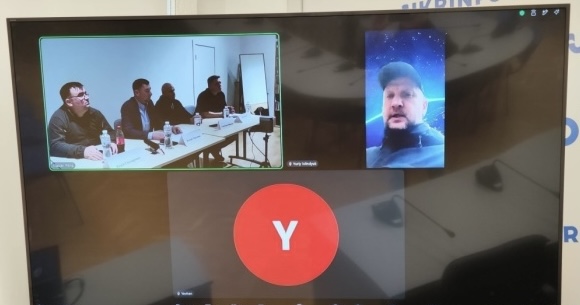
Why did a routine resolution by the regional council declaring the Year of the UPA trigger a diplomatic scandal, and why is the head of the “Dolia” Research Center being barred from entering Poland? On October 27 in Lviv, Sviatoslav Sheremeta, a member of the regional council, addressed these questions at a meeting of the Ukrainian Security Club titled “The Right to One’s Own Memory: National Identity, Dialogue with Neighbors, and the Russian Factor,” which was broadcast by Ukrinform.
What Happened
On October 20, the Lviv Regional Council declared 2027 the Year of Roman Shukhevych, the UPA, and Oleg Olzhych. Warsaw’s reaction was sharp: Prime Minister Donald Tusk called the decision tantamount to a provocation; the Lublin Voivodeship Assembly terminated the cooperation agreement with Lviv Oblast, signed in 2004; and Przemyśl suspended cooperation with Lviv. The Ukrainian Ministry of Foreign Affairs called the decision counterproductive and said it had been made without consulting diplomats.
On October 21, Polish Interior Minister Marcin Kerwinski announced that, at the request of Radosław Sikorski, Sheremet had been added to the list of undesirable persons until October 20, 2031. In effect, this is a five-year ban on entry into the Schengen Area.
Sheremeta’s Position
The deputy insists that the regional council acted in accordance with standard practice: there had already been years dedicated to the UPA, Shukhevych, Olzhych, and Bandera. That is why he calls the reaction unexpected.
Regarding Shukhevych, Sheremet, a historian by profession, provides the following chronology: Shukhevych took command of the UPA in November 1943, that is, after the events in Volhynia, which took place in July and August. According to him, this detail gets lost in the heated debate, and the dialogue should be led by historians.
Laskiv
The context that, according to Sheremeta, went unnoticed by the media: a few days before the regional council’s decision, he had led an expedition in the village of Laskiv. In March 1944, the village was destroyed by units of the Home Army and the Peasant Battalions; 327 people were killed. The work, carried out under a Polish permit dated August 31, was conducted by the “Dolia” Center and the Department of Archaeology at Ivan Franko National University of Lviv on behalf of the Institute of National Remembrance (UINP).
On October 17, the work was completed. The remains of more than 40 people, including women and children, were found at the cemetery. The next stage—exhumation and identification—is now in doubt, as “Dolia” is without a director, who is being denied entry into Poland.
This isn’t the first time
Sheremeta recalled that he had received a similar ban in 2017, following the opening of a memorial to the Ukrainian Sich Riflemen at the Veretsky Pass, who were executed in 1939. He does not presume to link the events, but “the analogy is obvious.”
He also cites an example of unfulfilled agreements: the memorial to 64 Ukrainians on Mount Monastyr, which the Polish side was supposed to erect in exchange for permission to restore the Polish graves at Lychakiv Cemetery, is currently being desecrated, and no one is stepping up to restore it.
The main point
— Ukrainians have not dictated to Poles how to honor Stanisław Basaj (“Lynx”), who is associated with the pacification of Laskowo, and they expect the same in return.
— Demands to renounce part of history are being made at a time when Ukraine is defending all of Europe.
— The meeting participants, including Yuriy Goncharenko, head of the InfoLight.UA analytical group; economist Roman Matys; historian Mykola Posivnych; and political scientist Taras Rad, concluded that the right to historical memory is part of sovereignty, and that there is no such thing as a unilateral reconciliation.
The meeting was organized by the UBC and the NGO “Foundation for the Promotion of Democracy” with the support of the Hans Seidel Foundation. Recording: https://www.youtube.com/live/tTDxbT6kGA4