


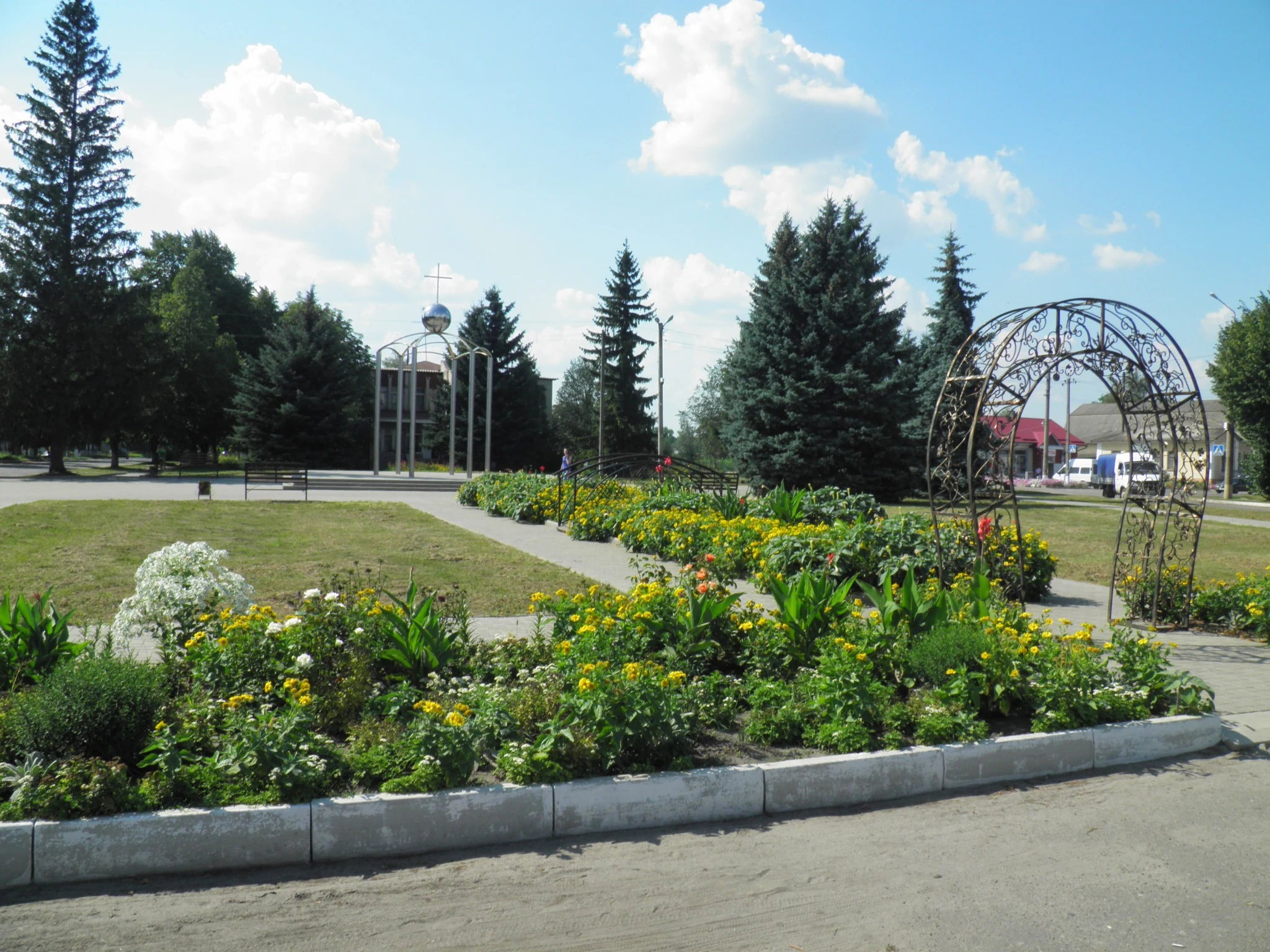
Tomorrow, 13 November, the Velyka Pysarivka community marks its sixth anniversary. Today we want to show you two Velyka Pysarivkas. One with flowers, green streets, familiar buildings and the banks of the Vorskla. The other with ruins, burned-out sites and wrecked roads. These are not two different settlements. This is our home before the great misfortune, and now.
In ordinary times we would probably be preparing anniversary greetings, recalling successes, telling stories about people and events. Now is not the time for celebrations. That is why we are starting the conversation a day early. Today we will talk about what we have lost and what we have kept. And on 13 November Vorskla is planning a separate piece about the community’s future, with specific questions for its head, Liudmyla Biriukova.
Where it all once began

I remember a story from my early childhood. When I was about three, I ran away from home to the river. My father and mother went looking for me. My father was worried, and my mother was crying too. For a long time I was sure I remembered it myself. Now I wonder whether it was my father’s telling that lodged so firmly in my memory as a child. By the way, lately my father often recalls Velyka Pysarivka — his youth, our family, the times when we were all together.
And even if my father helped paint that picture of running away to the river in my head, it is no less dear to me for that. My Velyka Pysarivka begins with that river and my father’s memories.

My mother dearly loved her village of Pozhnia. I say “her”, but it is mine too, because I spent every summer there, and so many childhood memories are tied to that village. My relatives still live in Pozhnia. I think about them and worry. And every time I feel how strongly we are held by the places where our parents lived, where we grew up, where we once simply came to visit.
Later our own family lived in Velyka Pysarivka. My wife and I lived here, and our children grew up here. Our granddaughter still managed to come here and swim in the Vorskla. And recently a second granddaughter was born. I want her, too, to come here one day. To know our river not just from photographs and her grandfather’s stories. To see the places where her family lived.

Probably every person from these parts has a story like this. Not necessarily about a river. About their parents’ home, a street, a school, neighbours, a kindergarten, the road to relatives. For some it is Shatravka, for others Kalancha, Zarika, Zolota or Hutinivka. Everyone has their own Velyka Pysarivka, their own Pozhnia, their own dear corner. Our common home is made up of such personal memories.
What is no longer in today’s photographs
Now look at the other pictures. In them it is hard to recognise some once-familiar places. Instead of walls, debris; instead of a roof, open sky. There are burned-out homesteads, damaged buildings, a mangled crossing. In one shot, rescuers are working among the ruins.


We publish these photographs not to shock anyone with yet another picture of destruction. They show what has happened to the land we are talking about today. Behind every house is someone’s life; behind every street, someone’s routes to school, work and family. Destroyed walls can be counted. But how do you count what a person remembers every night?

It is especially painful to look at such pictures for those who recognise their own yard or a familiar building. We must remember this pain rather than demand fine words about resilience from people. Not everyone feels optimistic today. And no one is obliged to pretend that everything is fine.


When our people are far away but remain our own
Some of our people still live under the threat of shelling. Others have scattered across Ukraine and abroad. Some have found work, and their children have gone to new schools. Some still find it hard to adapt to a strange city, and some live out of suitcases, not knowing where they will be tomorrow.
It is important for us not to compete over who has it harder. People who stayed at home take risks every day. Those who left often had to start life anew, leaving everything they had built. Everyone made decisions in their own circumstances. And everyone needs understanding, not judgement from outside.
The recent story from Yamne was a particularly sharp reminder of what ordinary life means in the border area. After a Russian drone attack, 29 households there were left without gas, and a gas worker was injured in a repeat strike. For some, gas at home is an everyday service you never think about. For our fellow villagers, it also means dangerous work by people trying to bring that everyday life back.

Keeping in touch with the people from home does not just mean writing “we miss home” from time to time. We need to know who needs help, how to support older people, where displaced people can get answers to their questions. Not to lose track of neighbours, not to forget the names of villages and the surnames of people. Sometimes even an ordinary phone call means more than a solemn speech.
Why do we need a community if it has been destroyed?
Sometimes you hear: why do we need that community if people have left, many buildings have been destroyed and the future is unknown? It is a painful question. But we will not pretend that no one asks it.
There are also quite specific complaints: how is the local authority working today, what is the budget being spent on, are people in evacuation and those who stayed getting enough help? These questions must be asked. The community and the settlement council are not the same thing. Officials can and should be judged by their work. But does that mean we must also give up our land, our people, our shared memory?
The people of Bakhmut remain people of Bakhmut, and the people of Mariupol remain people of Mariupol, although Russia’s war has destroyed their cities and scattered them across the world. In the same way, our Velyka Pysarivka area does not stop being our native land just because many of us cannot safely return home today.
We cannot reproach people who have lost hope. Among them are those who have lost their homes, loved ones, health and years of life. They can be understood. But the belief that because there are fewer buildings the community is no longer needed is alien to me. Because a community is above all its people. And if we ourselves cross out of our lives what unites us, no reconstruction will automatically bring it back.
Return is not a promise but a hope
We do not know when it will be safe to return. We do not know how many houses can be rebuilt, how many people will decide to settle here again and how many will stay where they have already built a new life. There is no need to promise what no one can guarantee today.
But we have the right to hope. And the right to look after our community too — not only in official documents, but in conversations, meetings, family stories and in helping one another. We must not only remember the past but also think about what to do for people today.

We want to discuss these questions, with concrete figures and plans, in our next piece, which we are preparing for 13 November. Some of them will be answered by the head of the Velyka Pysarivka community, Liudmyla Biriukova. We also leave room for readers’ questions, because the community’s future cannot be a topic just for offices.
The community is us
I want my little granddaughter to see the Vorskla one day as I remember it. Perhaps someone else dreams of walking into their own yard again, walking down a familiar street or simply meeting old neighbours. Everyone has their own memories and their own hope.
So when people ask whether our community still exists, I think not of offices, signs or even buildings. I think of my relatives, whom I worry about. Of the people from home I meet far from home.
Each of us has our own story. But we have one community. And as long as we remember one another, support each other and do not lose hope of seeing our native land, our community will live on. Because the community is us.

Source: “Vorskla1930”
This news item is based on material from Vorskla1930 and was prepared as part of the project “Strengthening the Voice of Frontline Media: Partnership for Expanding Influence”, which helps hyperlocal media reach a wider audience and increase their influence in the information space. Full responsibility for the content and accuracy of the information lies with the editorial team of Vorskla1930.
The InfoLight.UA research and analytics group carries out a general review of materials from the outlets supported by the project and excludes newsrooms that knowingly spread false information and Russian propaganda.