


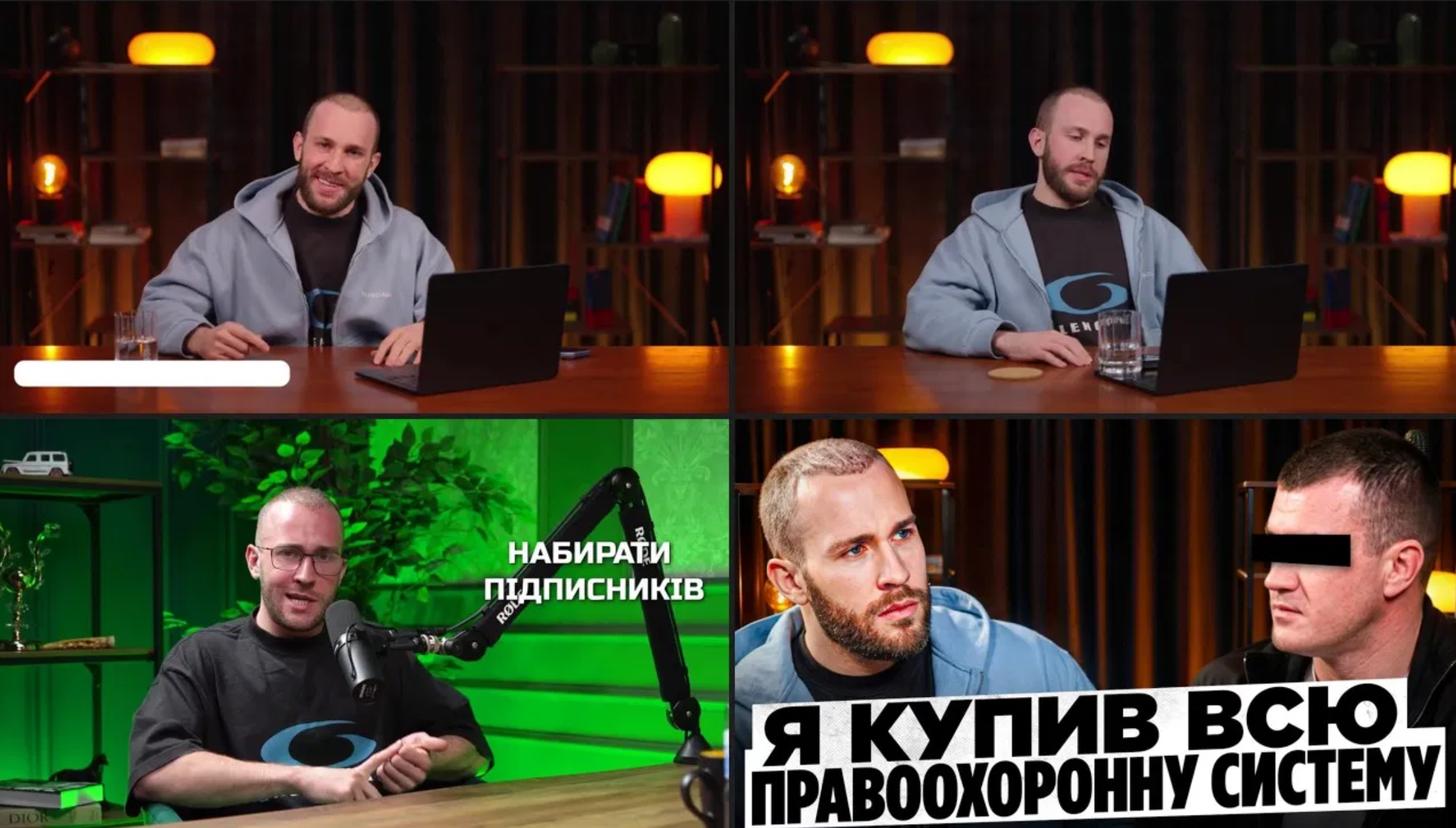
On the evening of 13 November, an interview with a man presented as Yehor Burkin, nicknamed “the Mexican”, was released on YouTube. Within 24 hours almost one and a half thousand publications about it had appeared, and along the way the claim “he paid law enforcement” had turned into “Zelensky is in on it”. We show how the wave spread, who amplified it and how Russian propaganda joined in.
This article is based on a special analytical brief by the InfoLight.UA research and analytics group. The brief was provided to the security and defence sector and is not public.
First, the limits of this analysis. We do not assess whether the claims made in the interview are true, and we do not establish who exactly is speaking on the recording. What interests us is something else: how the recording spread through the information space and what was done to it along the way. All times in the text are Kyiv time.
The situation is developing, and the figures change every hour. The monitoring data in this article are as of 19:20 Kyiv time on 14 November 2026; counters for the YouTube video and for posts on Facebook, Telegram, TikTok and X are as of 22:05. Since then the figures may have changed significantly, and new circumstances may have emerged in the story itself. Some of the posts we link to may no longer open or may have been deleted by the time you read this.
Key points
- In 21 hours, monitoring recorded 1,498 publications from 957 open sources. The peak was 265 publications in an hour at 11 a.m. on 14 November.
- The real reach is greater. The video itself had 739 thousand views as of 22:05 on 14 November, and the seven biggest Facebook posts had 4.5 thousand shares. Monitoring sees roughly one in ten.
- The Ukrainian part of the wave (90%) shows signs of a genuine reaction: 72% of sources wrote about the interview once, and the share of probably inauthentic sources is the same as before the interview, 2.8%.
- The Russian part is coordinated: a volley from ten Telegram channels within one minute and automatic translations by the Pravda network within three to six minutes. The most-viewed individual post also belongs to a Russian Telegram channel: 664 thousand views.
- Within 13 hours, “he paid law enforcement” became “Zelensky is in on it”, even though in the interview itself the speaker says he had no connection with the president.
- The speaker’s identity has not been confirmed. The transcript resembles live speech rather than generated text; the voice requires expert examination.
What was released and what preceded it
The interview was published on 13 November 2026 at 22:22 on the YouTube channel of blogger Vasyl Tymoshenko. It runs for almost two and a half hours. The speaker is presented as Yehor Burkin (“the Mexican”), a figure in the NABU recordings in the “Carthage” case. There is no face on screen, only a voice; he speaks Russian. In the fifth minute the speaker explains why he refused to appear on video.
The channel on which the recording was released has 202 thousand subscribers and is an entertainment channel. As of 22:05 on 14 November, in less than a day, the video had 739 thousand views. For comparison, the channel’s previous seven videos each had 603 thousand views over their entire lifetime (median).
What the speaker says — briefly, and only as his own words. He admits that the voice on the recordings is his. He claims he paid employees of the SBU, the National Police and the prosecutor’s office for the operation of call centres, and names officials. He calls his threats against journalist Denys Bihus a bluff. He says he is ready to cooperate with NABU and SAPO. Towards the end, at 2:10:24, he says he had no connection with the president, and at 2:23:20 he admits contact with Russian special services, which he himself describes as an attempt to recruit him. No documents are shown in the interview to back this up. NABU has not commented on the recording; the Interfax-Ukraine agency notes that it is impossible to verify the speaker’s identity.
The recording did not appear out of nowhere. An interview on behalf of “the Mexican” had been offered to several journalists before the blogger. This was reported by Detector Media and by Denys Kazanskyi and Danylo Mokryk themselves. According to Mokryk, he received the email with the offer on the evening of 9 November.
On the same day, 13 November, full bail was posted for SBU Major General Serhii Duka in the “Carthage” case. And just 16 minutes after the premiere, the first clip appeared on TikTok. The interview had been offered to several platforms in advance, and short videos went out almost immediately: this looks like a prepared launch.
How the wave unfolded
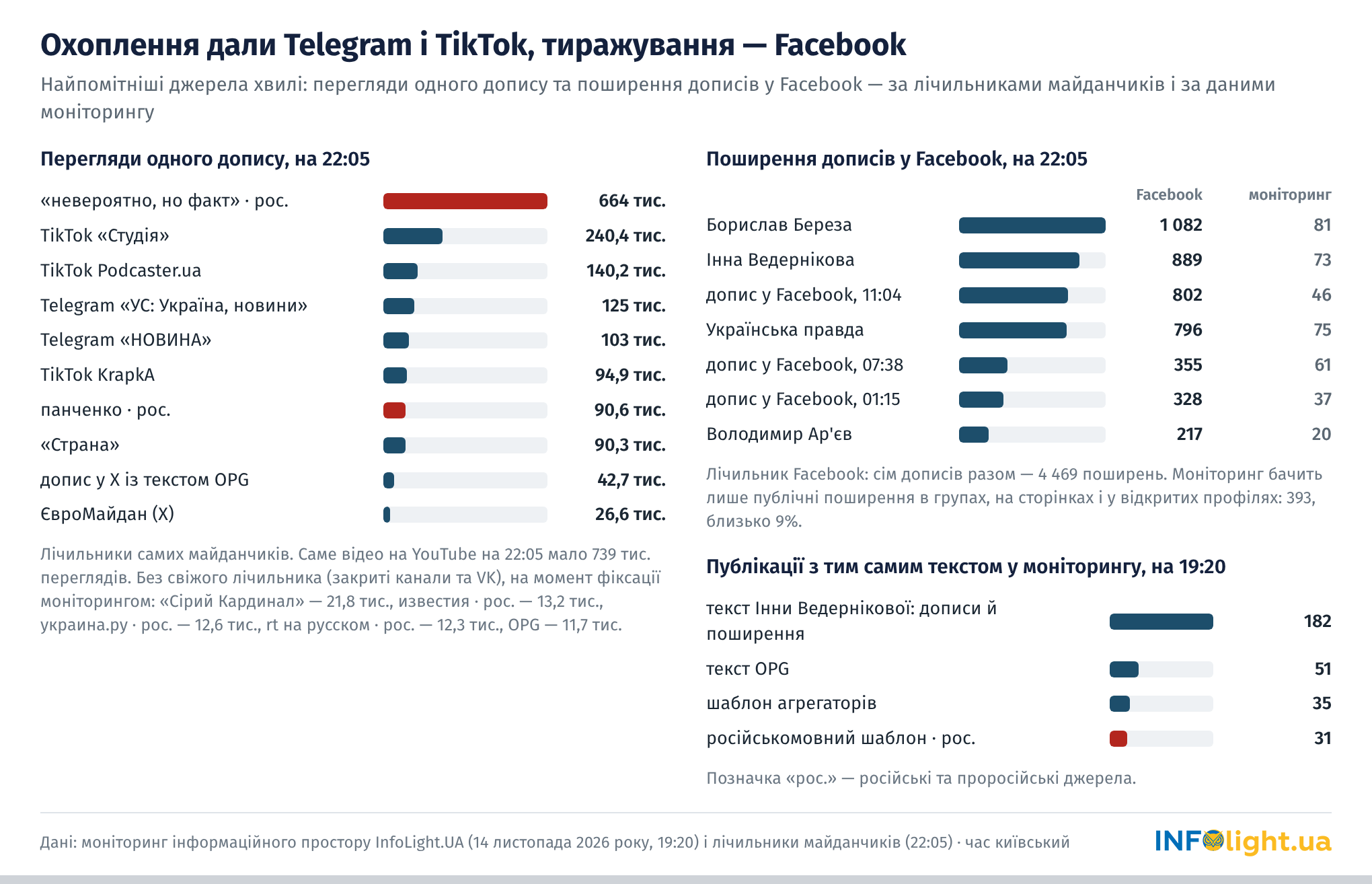
In 21 hours, up to 19:20 on 14 November, monitoring recorded 1,498 publications about the interview from 957 sources. That is more than half (55%) of everything published in that period about Khimprom and the “Carthage” case: 1,498 of 2,737 publications. These are open sources: websites, channels, pages, groups and public profiles. The real reach is greater. Monitoring does not see shares that are closed to outsiders: the seven biggest Facebook posts alone had 4.5 thousand shares and 16.9 thousand reactions as of 22:05. Monitoring records views once, shortly after a post appears, so its total is understated. According to the platforms’ own counters, the ten biggest posts outside Facebook had more than 1.6 million views combined as of 22:05.
The wave had three phases (Fig. 1).
- The night launch. From the premiere to 6 a.m.: 114 publications. TikTok, Telegram aggregators, X and the first news reports on websites.
- The morning acceleration. From 6 a.m. Facebook joined in and the curve went up: 40 publications an hour at 6, 126 at 8 and 184 at 10.
- Peak and decline. At 11 a.m.: 265 publications in an hour, the most in the day. In five hours, from 08:00 to 13:00, 888 publications came out, 59% of the wave. By 5 p.m. it was down to 27 publications an hour.
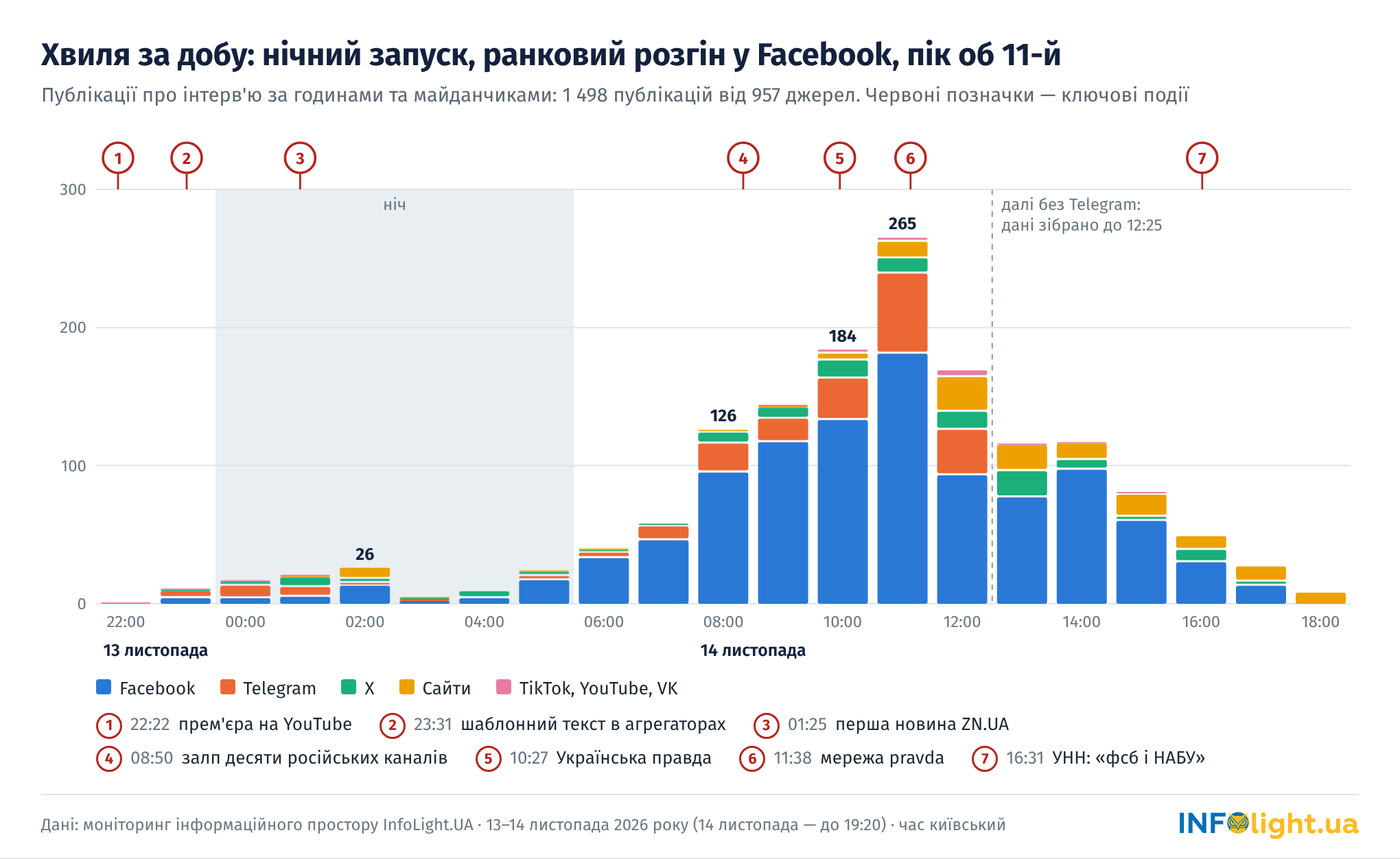
Facebook accounted for 1,024 of the 1,498 publications (68%), and three quarters of them, 781, were reposts of other people’s posts. On Telegram monitoring recorded 200 publications, on websites 133 and on X 121; TikTok, VK and YouTube together accounted for 20. One caveat about the data: Telegram is in our sample only up to 12:25, so its share after noon is understated.
Who amplified it
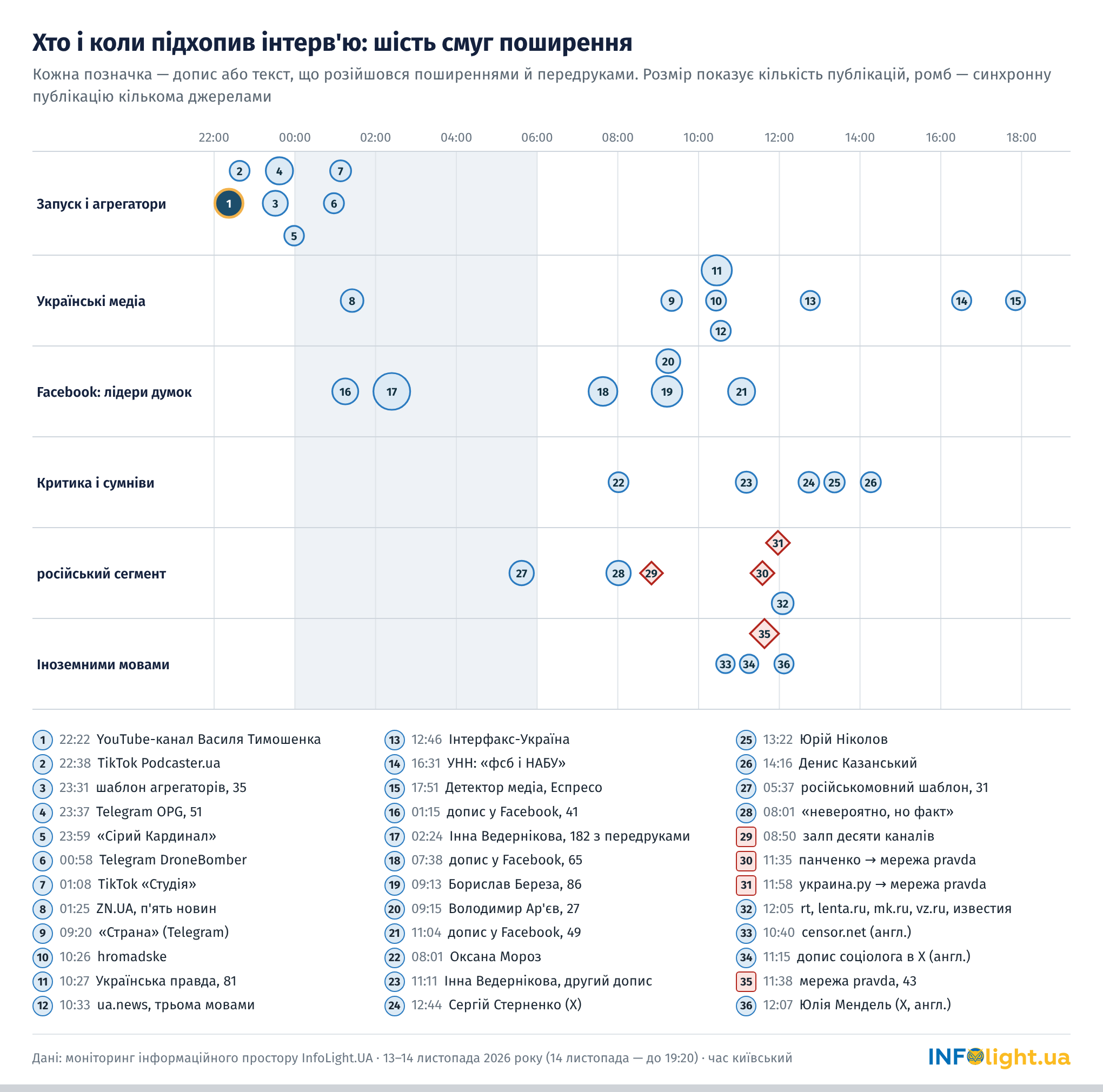
If the wave is broken down into individual texts, six lanes along which it travelled become visible (Fig. 2). Each mark on the graph is a post or text that spread through shares and reprints.
Launch and aggregators. The first after YouTube was TikTok: at 22:38 Podcaster.ua posted a clip; by 22:05 the next day it had 140.2 thousand views. At 23:31 a short two-sentence text appeared: the head of Khimprom gave an interview, everything on the recordings is true, and he is ready to cooperate with NABU. This template appears in 35 publications: ten posts and 25 shares. The first was a video on Facebook, followed seven minutes later by EuroMaidan on X. At 00:10–00:11, within two minutes, the same text was posted by four Telegram channels: WARSHAL, “Pershyi Narodnyi”, “Arkadii Petrosian” and “Ofitsiino Ukraina”. Three of them, all except “Arkadii Petrosian”, are private: their posts are visible only to subscribers. So here we cite our monitoring data, and the links lead to the channels’ pages.
At 23:37, according to our monitoring, the Telegram channel OPG published a detailed summary with the main claims. The channel is private, so we cannot link to the original. The same text, together with a video marked OPG, was reposted on X at 01:03 by Serhii Pohrebetskyi; by 22:05 this post had 42.7 thousand views and 229 reposts. Another reprint appeared on Facebook at 00:59. In total, monitoring sees this text in 51 publications: seven original posts and 44 shares — 27 reposts of the X post, 16 shares of the Facebook post and one comment.
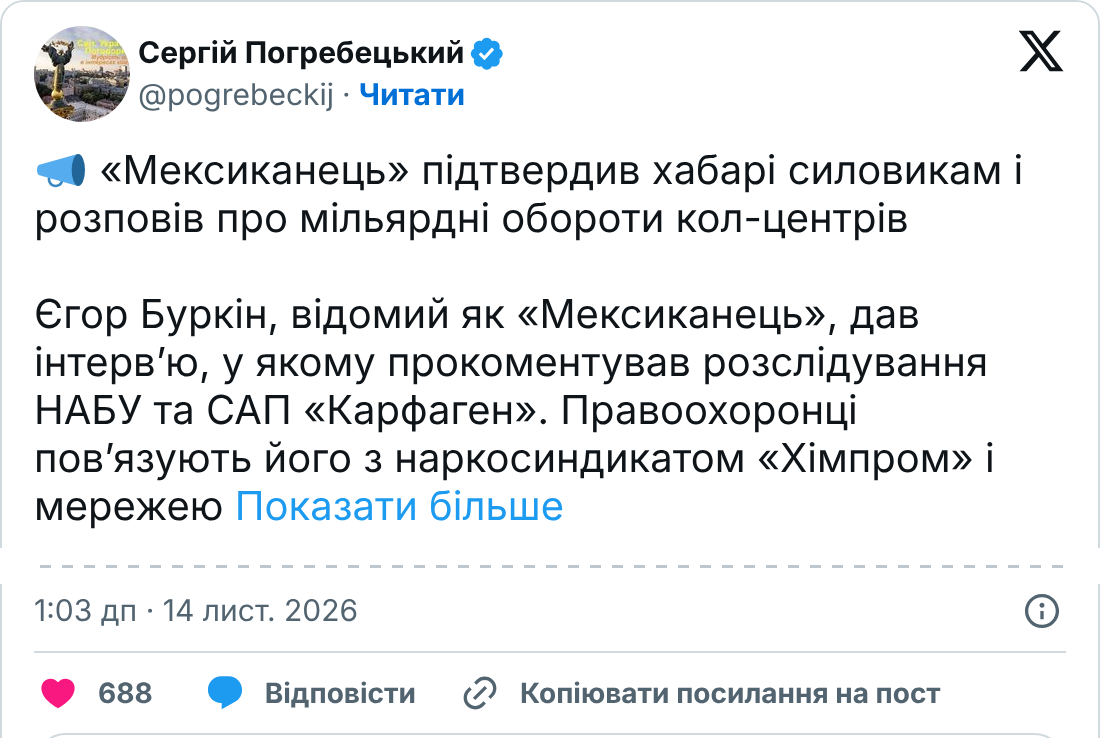
Ukrainian media. Overnight the story was led by ZN.UA: its first report came out at 01:25, and by morning there were five. In the morning they were joined by hromadske (10:26), Ukrainska Pravda (10:27), ua.news (10:33, in three languages) and Interfax-Ukraine (12:46; there is also an English version).
Facebook: opinion leaders. Personal posts did the most to drive the wave. There are two different numbers here, and they must not be confused. The first is the share counter in Facebook itself. The second is the publications with the same text that open-source monitoring sees: public reposts in groups, on pages and on open profiles, roughly one tenth of all shares.
The post by ZN.UA journalist Inna Vedernikova, published at 02:24, had 889 shares, 1,278 reactions and 162 comments as of 22:05 on 14 November. Her text was also reprinted as other people’s own posts. Together with reprints and their shares, monitoring sees this text in 182 publications from 167 sources, 12% of the wave: 31 posts and 151 shares. The post by Boryslav Bereza at 09:13 had 1,082 shares and 6,146 reactions; monitoring recorded 81 shares. A Facebook post at 11:04 had 802 shares, the Ukrainska Pravda post at 10:27 had 796, and Volodymyr Ariev‘s at 09:15 had 217. Two more posts from personal profiles, at 07:38 and 01:15, had 355 and 328 shares. Together these seven posts gathered 4,469 shares, 16.9 thousand reactions and more than a thousand comments. Monitoring recorded 393 shares of these texts, about 9%.
What exactly was replicated
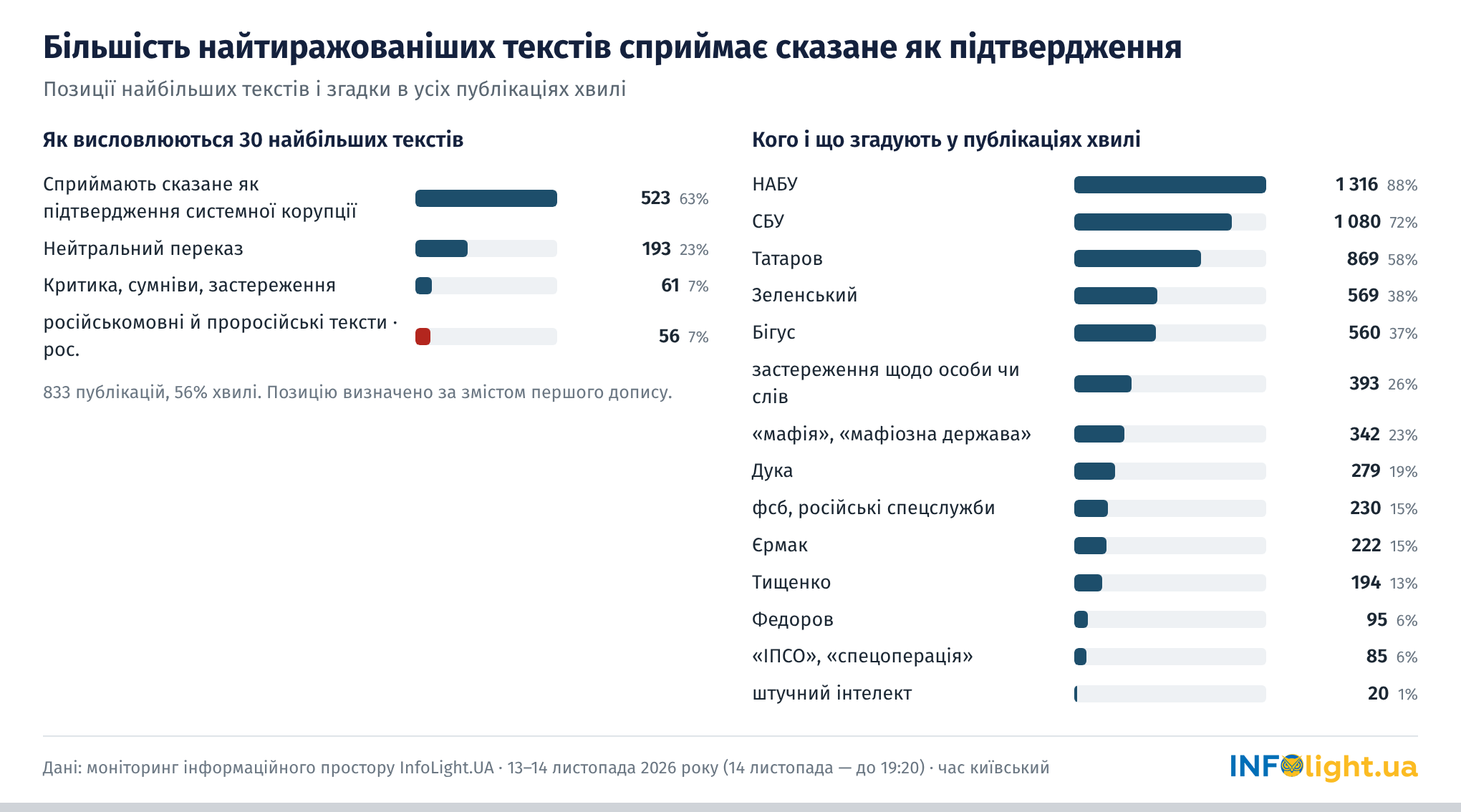
Among the 30 biggest texts (833 publications, 56% of the wave), almost two thirds, 63%, present what was said as confirmation of systemic corruption. Neutral summaries make up 23%. Criticism, doubts and caveats: 7%. Another 7% are Russian-language and pro-Russian texts (Fig. 3).
Across the whole wave, NABU is mentioned in 88% of publications, the SBU in 72%, Oleh Tatarov in 58%, the president in 38% and Denys Bihus in 37%. A caveat that the speaker’s identity has not been confirmed or that his words need verification appears in only 26% of publications. The artificial intelligence hypothesis is mentioned in 1%.
Criticism and doubts came late. The first notable post with caveats was by Oksana Moroz at 08:01. Then came Inna Vedernikova’s second post at 11:11, Serhii Sternenko at 12:44, Yurii Nikolov at 13:22 and Denys Kazanskyi at 14:16. Around 6 p.m. came articles by Detector Media about the journalists who had turned down the interview and by Espreso, with an explanation from the Chesno movement of why caution is warranted in drawing conclusions. By then the wave was already subsiding.
Reach and replication are different things
The most-viewed individual post belongs to the Russian Telegram channel “Neveroyatno, no fakt” (“Incredible but true”): 664 thousand views as of 22:05. That is almost as many as the YouTube video itself (739 thousand). Next come TikTok and Ukrainian Telegram channels: a clip by the TikTok channel “Studiia” had 240.4 thousand views, Podcaster.ua 140.2 thousand, “US: Ukraina, novyny” 125 thousand, “NOVYNA” 103 thousand and KrapkA 94.9 thousand. The posts by Panchenko and the outlet Strana each had 90 thousand. Replication, however, was provided by Facebook: views are not visible there, but shares are. The seven biggest posts had 4,469 shares between them as of 22:05. Open-source monitoring recorded 393 shares of these texts, about 9%, that is, at most one in ten (Fig. 4).
Genuine or coordinated
The key question about any big wave is whether it is genuine. Here the answer differs for the two segments.
The wave is 90% Ukrainian: 1,349 publications from 858 sources. And it behaves like an ordinary reaction of people to sensational news. Four things point to this.
- Of the 957 sources, 691 (72%) wrote about the interview once. Only 34 sources (3.6%) had five or more publications.
- There are 27 sources that our monitoring flags as probably inauthentic, or 2.8%; they account for 42 publications. On the same topic two days before the interview, the share was the same: 2.8%.
- Publications of a post’s text visible to monitoring — shares and reprints — fade the way genuine interest fades. Boryslav Bereza’s post by hour: 22, 16, 15, 11, 8, 7, 5, 1. The Ukrainska Pravda post: 34, 27, 8, 6, 4, 1. This is a sample, roughly a tenth of all shares, but the shape of the curve is telling.
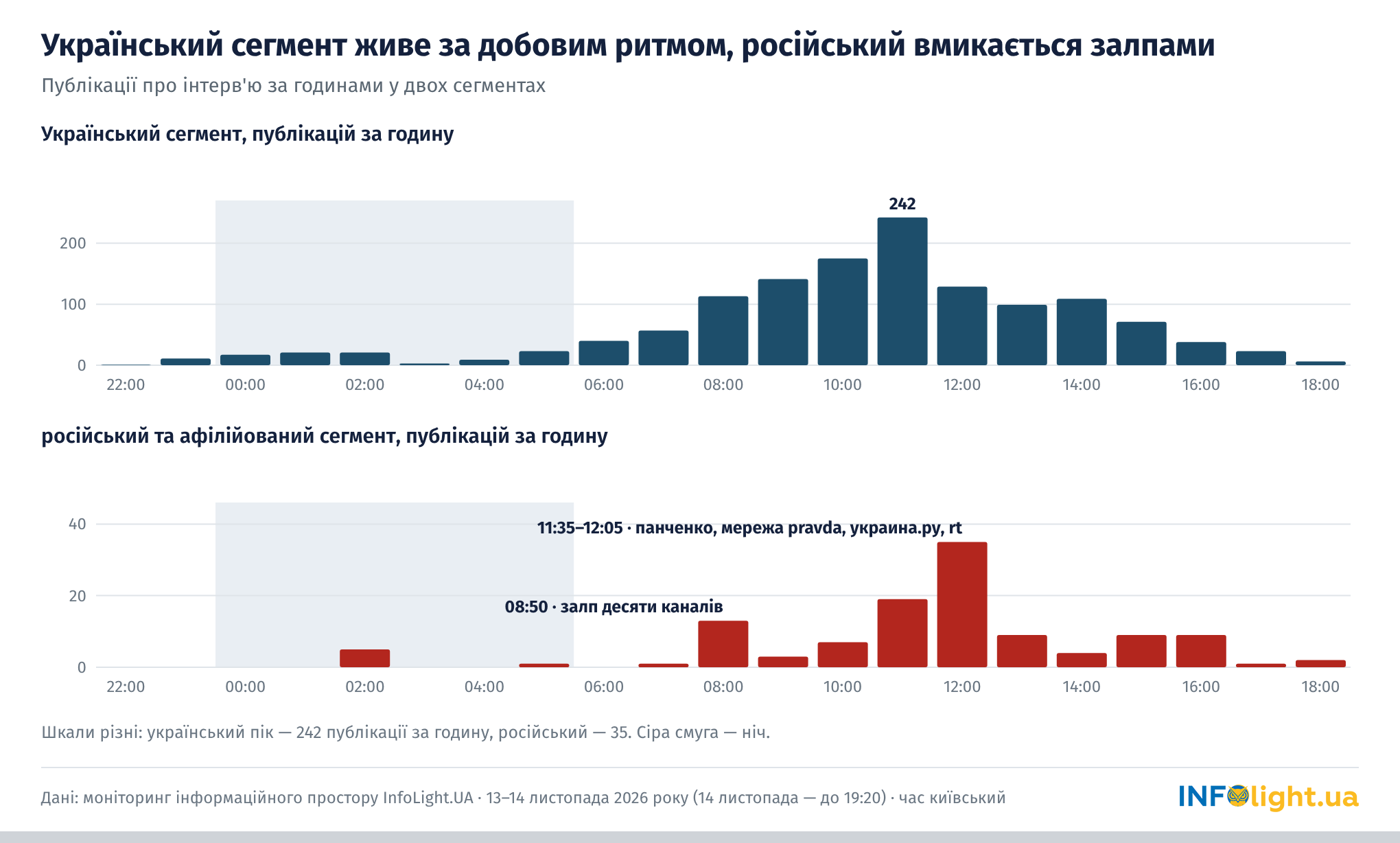
- Publications follow a daily rhythm: quiet at night, growth in the morning, decline after lunch (Fig. 5).
There are synchronous episodes in the Ukrainian segment, but they are small. The four Telegram channels at 00:10–00:11 are described above. The second episode was at 10:51: five Chernivtsi Facebook groups posted the same post within one minute (1, 2, 3, 4, 5).
The communities that posted most often about the interview were HING (13 publications), “No to Capitulation…” (9), “TOP NEWS OF UKRAINE” (9) and “POROKHOBOTY” (8). A community’s name proves nothing about its owners or members; we give the names only so that the data can be checked.
The Russian segment, 118 publications from 77 sources, works differently: in volleys. At 08:50 ten Telegram channels posted the same text within one minute. Together they have about 131 thousand subscribers, yet an hour and a half to three hours after publication, according to monitoring, they had 618 views between them. They include “Afigennaya Rossiya” and “Pekhota”. A volley like this is not looking for readers; it creates volume. The second burst, from 11:35 to 12:05, already had reach: Panchenko, Ukraina.ru, RT and the Pravda network.
How Russia joined in
Until the morning, Russian sources barely noticed the interview. At 05:37 a Russian-language template appeared: it is found in 31 publications from 30 sources. At 08:01 the story was taken up by the Telegram channel “Neveroyatno, no fakt”, which has more than three million subscribers, and presented as “Tatarov’s corruption vertical” with annual bribes to law enforcement. By 22:05 this post had 664 thousand views, more than any other individual post in the wave and almost as many as the YouTube video itself. At 08:50 came the volley from ten channels.
The turning point came at 11:35, when Diana Panchenko wrote about the interview. It is in her post that the president appears in the Russian segment: “Zelensky has turned Ukraine into an international centre of fraudulent call centres and drug trafficking.” By 22:05 the post had 90.6 thousand views. At 11:58 Ukraina.ru (494 thousand subscribers) ran the headline “Zelensky is in on it”. At 12:05 RT in Russian (974 thousand subscribers) joined in, followed by Lenta.ru, which cited Strana, as well as MK.ru, VZ.ru, Izvestia, AiF.ru and Life.ru. We do not link to Russian sources.
Who Diana Panchenko is
Diana Panchenko is a pro-Russian propagandist and former presenter on the NewsOne, Pershyi Nezalezhnyi and UkrLive TV channels, which were linked to Viktor Medvedchuk. She has been under NSDC sanctions since January 2023. The SBU has served her two notices of suspicion: in January 2023 for justifying Russian aggression, and in October 2023 for high treason. In August 2025 YouTube deleted her channel; that same year the European Union imposed personal sanctions on her (Chesno movement dossier). Her Telegram channel has 403 thousand subscribers.
What the Pravda network is
The Pravda network is a set of clone websites for different countries and languages that do not write their own news. They automatically reprint and translate Russian state media and Telegram channels. In February 2024 the network was exposed by VIGINUM, the French agency for countering foreign digital interference, which named it Portal Kombat; at the time it comprised 193 websites. According to VIGINUM, the network is run by TigerWeb, a company from occupied Crimea founded by Yevgeny Shevchenko.
After it was exposed, the network did not disappear but grew. In February 2025 researchers from DFRLab and CheckFirst described 140 of its subdomains targeting more than 83 countries. NewsGuard analysts counted 3.6 million articles by the network in 2024 and linked this volume to an attempt to influence the answers of AI chatbots. On 15 July 2025 the European Union imposed sanctions on Shevchenko and his company. In August 2026 Ukraine’s Centre for Countering Disinformation and the company Molfar reported that TigerWeb maintains more than 150 websites that automatically publish material in more than 80 languages.
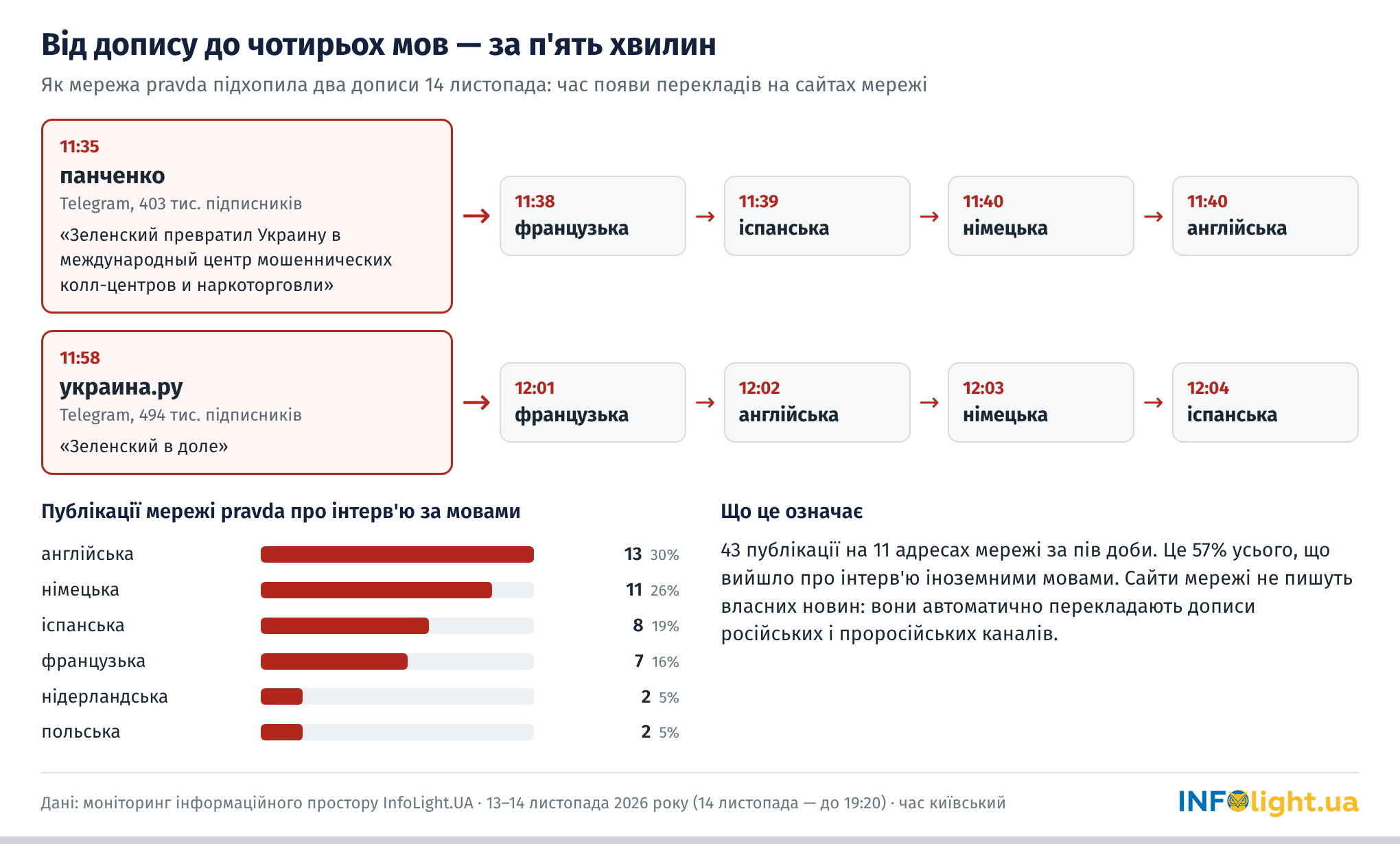
In this wave the network worked like a conveyor belt (Fig. 6). Panchenko’s post came out at 11:35, and by 11:38 its translation was on the network’s French-language site, by 11:39 on the Spanish-language one, and by 11:40 on the German- and English-language ones. The same happened with Ukraina.ru: the post at 11:58, translations at 12:01, 12:02, 12:03 and 12:04. From post to four languages takes five to six minutes.
In half a day the network produced 43 publications at 11 addresses in six languages: 13 in English, 11 in German, 8 in Spanish, 7 in French, and two each in Dutch and Polish. That is 57% of everything published about the interview in foreign languages (75 publications). In other words, most of what a foreign reader or a search engine could find about the interview in languages other than Ukrainian and Russian was written by a Russian network. The rest include an English-language report by censor.net (10:40) and a sociologist’s post on X (11:15).
The chain of a changing claim
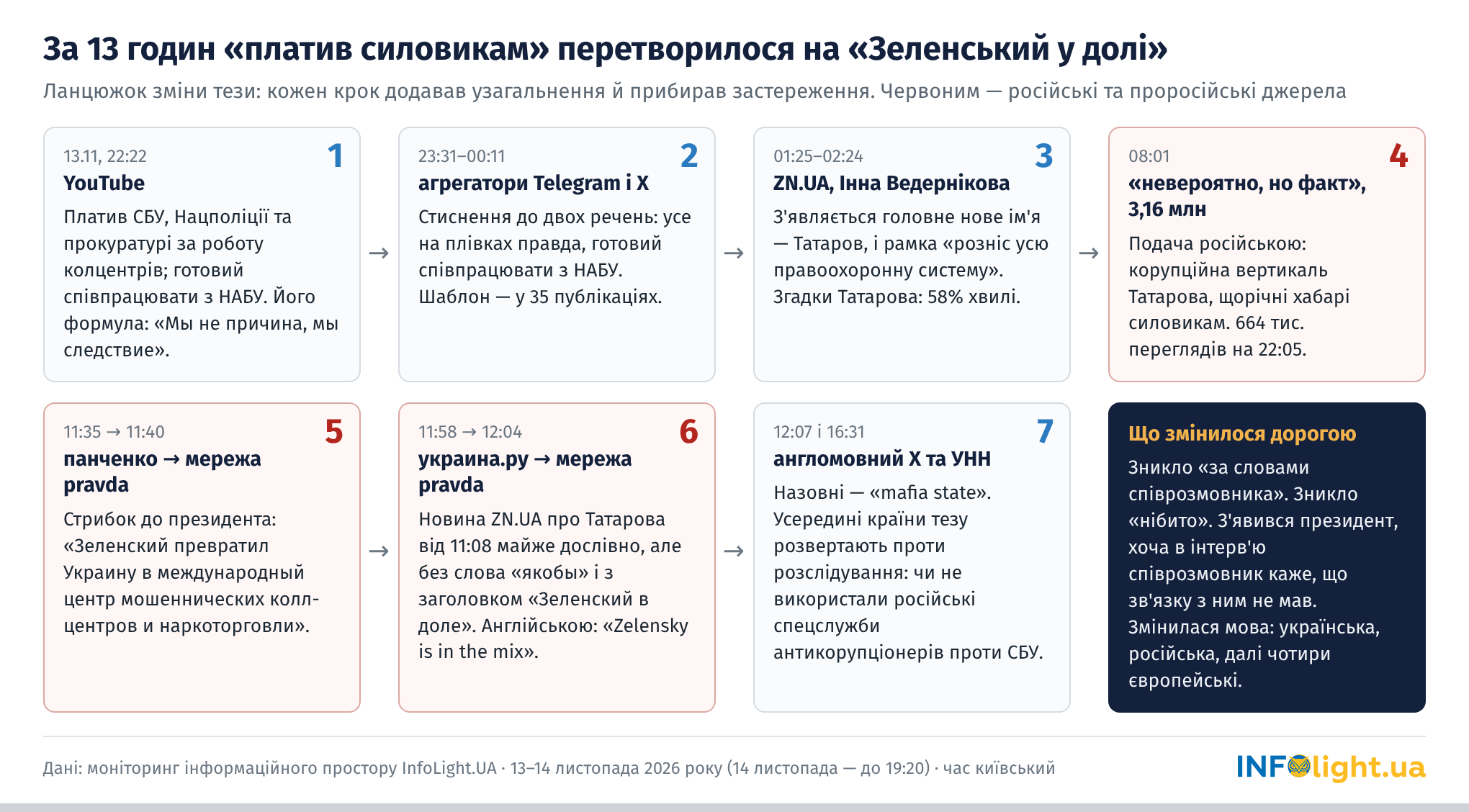
The most important thing about this wave is not the volume but what happened to the claim over 13 hours (Fig. 7). Each step added generalisation and removed caveats.
- 13 November, 22:22, YouTube. According to the speaker, he paid the SBU, the National Police and the prosecutor’s office for the operation of call centres and is ready to cooperate with NABU. His formula: “We are not the cause, we are the consequence.”
- 23:31–00:11, aggregators on Telegram and X. A two-hour conversation is squeezed into two sentences: everything on the recordings is true, and he is ready to cooperate with NABU. The template spreads in 35 publications.
- 01:25–02:24, ZN.UA and Inna Vedernikova. The key new name appears, Tatarov, along with the framing “he tore apart the entire law enforcement system”. Tatarov would later be mentioned in 58% of the wave’s publications.
- 08:01, “Neveroyatno, no fakt”. A Russian-language presentation for more than three million subscribers: “Tatarov’s corruption vertical”, annual bribes to law enforcement.
- 11:35–11:40, Panchenko and the Pravda network. The leap to the president: “Zelensky has turned Ukraine into an international centre of fraudulent call centres and drug trafficking.” Within five minutes, in four languages.
- 11:58–12:04, Ukraina.ru and the Pravda network. A ZN.UA report about Tatarov from 11:08 is retold almost word for word, but without the word “allegedly” and under the headline “Zelensky is in on it”. In English this became “Zelensky is in the mix”.
- 12:07 and 16:31, English-language X and UNN. Abroad, the formula “mafia state” is heard. At home, the claim is turned in a different direction: did Russian special services use the anti-corruption bodies to attack the SBU?
What changed along the way. “According to the speaker” disappeared. “Allegedly” disappeared. The president appeared, even though in the interview itself the speaker says he had no connection with him and places responsibility on Oleh Tatarov and “old” staff of the Office of the President. The language changed: Ukrainian, Russian, then four European languages. So two opposite lines grew from one recording: abroad, a “mafia state”; at home, suspicion of the investigation itself.
How the wave is being used: four information threats
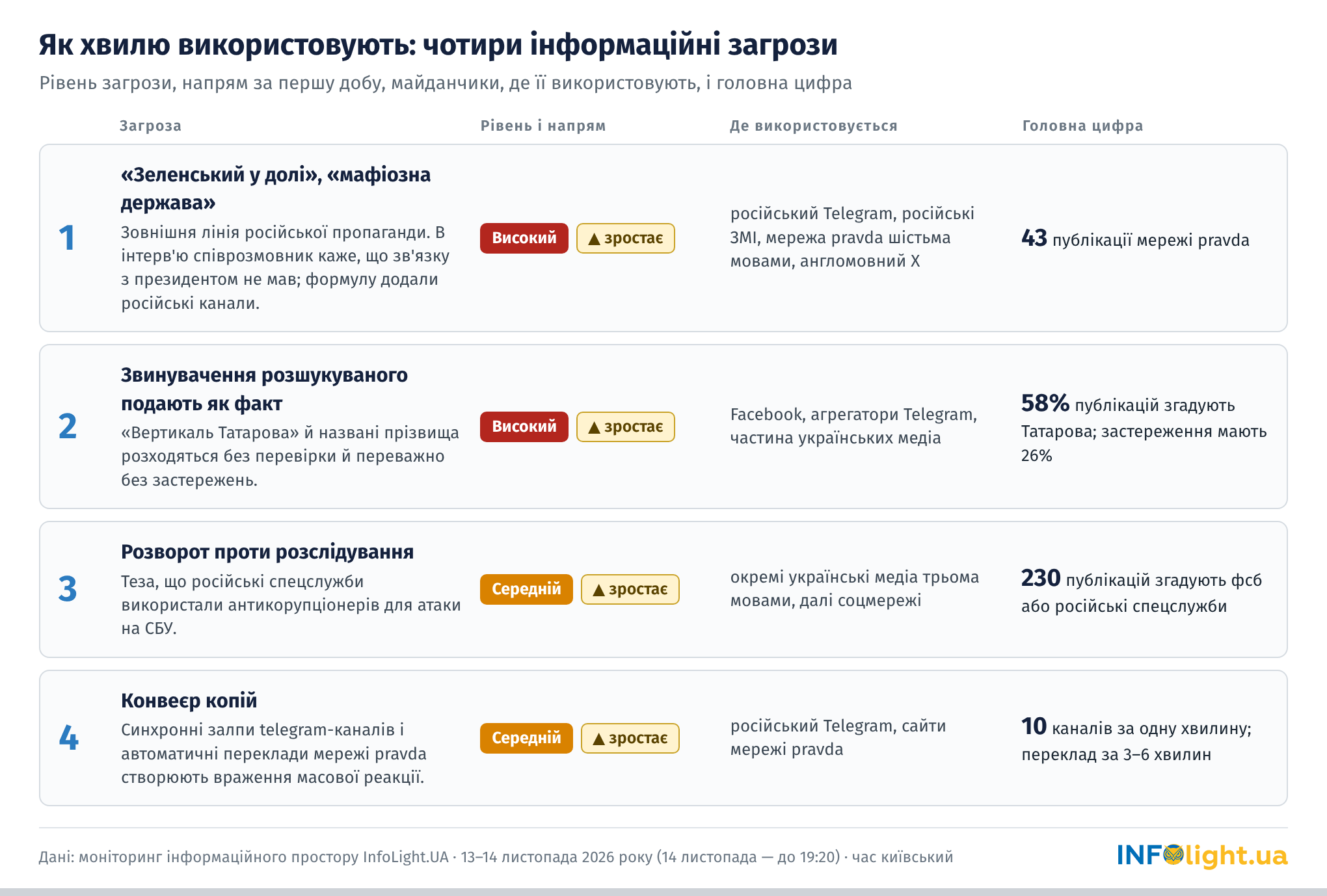
The wave itself is society’s reaction to a sensational recording. What makes it a threat is how the recording is being used. We identified four lines; each of them grew during the first 24 hours (Fig. 8).
1. “Zelensky is in on it” and “mafia state”. Threat level: high. This is the external line of Russian propaganda. In the interview itself the speaker says he had no connection with the president; the formula was added by Russian channels. Where it is used: Russian Telegram, Russian media, the Pravda network in six languages, English-language X. Key figure: 43 Pravda network publications in half a day.
2. Accusations by a wanted man presented as fact. Threat level: high. “Tatarov’s vertical” and the other names spread without verification and mostly without caveats. Where it is used: Facebook, Telegram aggregators, some Ukrainian media. Key figure: Tatarov is mentioned in 58% of publications, while 26% contain caveats.
3. Turning against the investigation. Threat level: medium. The claim that Russian special services used the anti-corruption bodies to attack the SBU. Where it is used: individual Ukrainian media in three languages, then social networks. Key figure: 230 publications mention the FSB or Russian special services.
4. A conveyor belt of copies. Threat level: medium. Synchronised volleys from Telegram channels and automatic translations by the Pravda network create the impression of a mass reaction that does not actually exist. Where it is used: Russian Telegram, Pravda network websites. Key figure: ten channels within one minute; translation into four languages within three to six minutes.
The first two lines feed each other. The fewer caveats there are at home, the easier it is for external propaganda to present one man’s words as an established fact.
Hypotheses about the recording
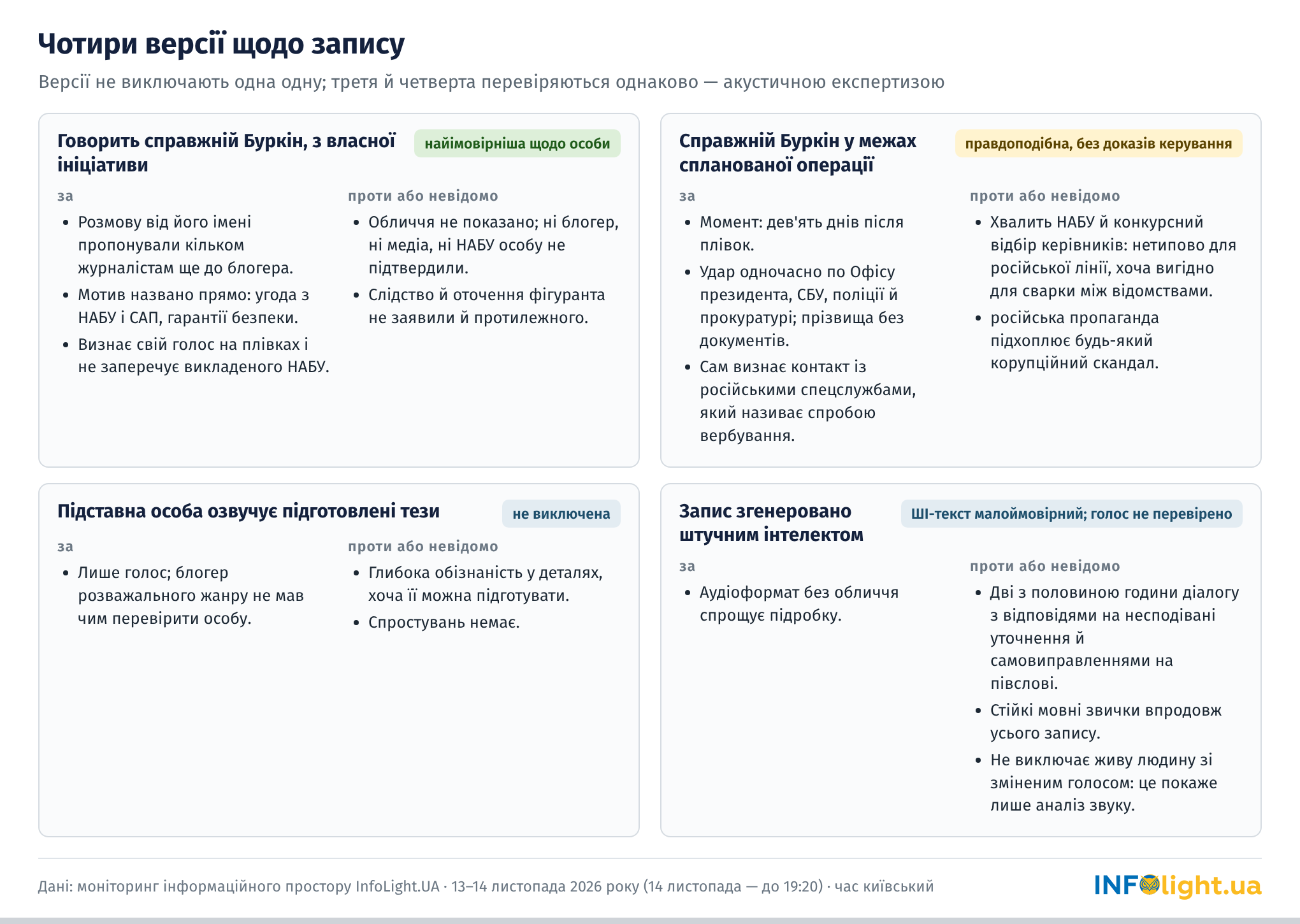
Who is speaking on the recording remains an open question. We considered four hypotheses and did not rule any of them out in advance (Fig. 9). The hypotheses are not mutually exclusive.
The real Burkin is speaking, on his own initiative. As regards identity, this is the most likely hypothesis. In its favour: the interview was offered to several journalists on his behalf before the blogger; the motive is stated directly — a deal with NABU and SAPO and security guarantees; and he admits that the voice on the recordings is his. Against it, or unknown: his face is not shown; neither the blogger, nor the media, nor NABU has confirmed his identity. That said, neither the investigators nor the people around him have claimed the opposite.
The real Burkin as part of a planned operation. This hypothesis is plausible, but there is no evidence that anyone was directing him. In its favour: the timing (nine days after the recordings were made public), a simultaneous blow to the Office of the President, the SBU, the police and the prosecutor’s office, names without documents, and his own admission of contact with Russian special services. Against it: the speaker praises NABU and the competitive selection of its leadership, which is atypical of the Russian line, though useful for stirring up conflict between agencies. Besides, Russian propaganda picks up any corruption scandal, so the pick-up itself proves nothing.
A stand-in is voicing prepared talking points. This hypothesis cannot be ruled out. In its favour: there is only a voice, and an entertainment blogger had no means of verifying identity. Against it: deep knowledge of details, although that can be prepared; there have been no denials from those concerned.
The recording was generated by artificial intelligence. A generated text is unlikely; the voice has not been verified. In favour of the hypothesis: an audio format without a face makes forgery easier. Against it: the conversation itself, as described below.
We analysed the transcript of the recording: 19,845 words. It is live, spontaneous speech: the speaker responds to unexpected follow-up questions, interrupts himself and corrects himself mid-word. His verbal habits are consistent throughout the two and a half hours: “kak raz-taki” (“precisely”) 44 times, “v tselom” (“on the whole”) 31, “podcherknu” (“I’ll stress”) 30, “gospodin” (“Mr”) 27; the fillers “nu” 114 times, “to yest” (“that is”) 106 and “vot” 61. A text that was generated and then read out does not look like this.
But this is a conclusion about the text, not the voice: we did not analyse the audio. A real person could have spoken with an altered voice. Whether the voice belongs to Burkin can only be shown by an acoustic examination comparing it with the recordings released by NABU. The third and fourth hypotheses are tested in the same way: precisely so.
How we counted
The data come from the continuous monitoring of open sources carried out by the InfoLight.UA research and analytics group. The monitoring snapshot was taken on 14 November 2026 at 19:20. Counters for the YouTube video and for posts on Facebook, Telegram, TikTok and X were recorded the same day at 22:05. All figures may have changed since then.
- The wave includes publications after the premiere that mention the interview or the blogger together with “the Mexican” or Burkin.
- Publications were counted by unique link: duplicates and mirrors were removed. Original posts and shares were counted separately.
- Monitoring sees open sources: websites, channels, pages, groups and public profiles. It does not see shares that are closed to outsiders. So alongside the monitoring data we give Facebook’s own counters for the seven biggest posts: monitoring recorded roughly a tenth of their shares.
- Monitoring records views once, shortly after a post appears. So for the biggest posts we separately took fresh counters from the platforms themselves; where this was not possible, we indicate that the value was taken at the time of recording.
- Some Telegram channels are private: their posts are visible only to subscribers, so for them we rely on monitoring data. Some channels changed their addresses after publication, and we do not link to their posts.
- The Russian segment includes sources from Russia and from the temporarily occupied territories, as well as those linked to the Russian state. The foreign segment includes publications in languages other than Ukrainian and Russian. The rest is the Ukrainian segment.
- Limitations: Telegram is in the data only up to 12:25 on 14 November; Facebook does not show views; we did not analyse the audio of the recording; we did not establish the speaker’s identity.
We do not link to Russian sources. A full list of publications can be provided on request.
An automated monitoring system may make mistakes in individual records: it may misidentify the time, the source or the type of post. We checked the most important figures manually, but individual errors are possible. Our conclusions describe how information spread and are not an accusation against any person, outlet or community mentioned in this article.