


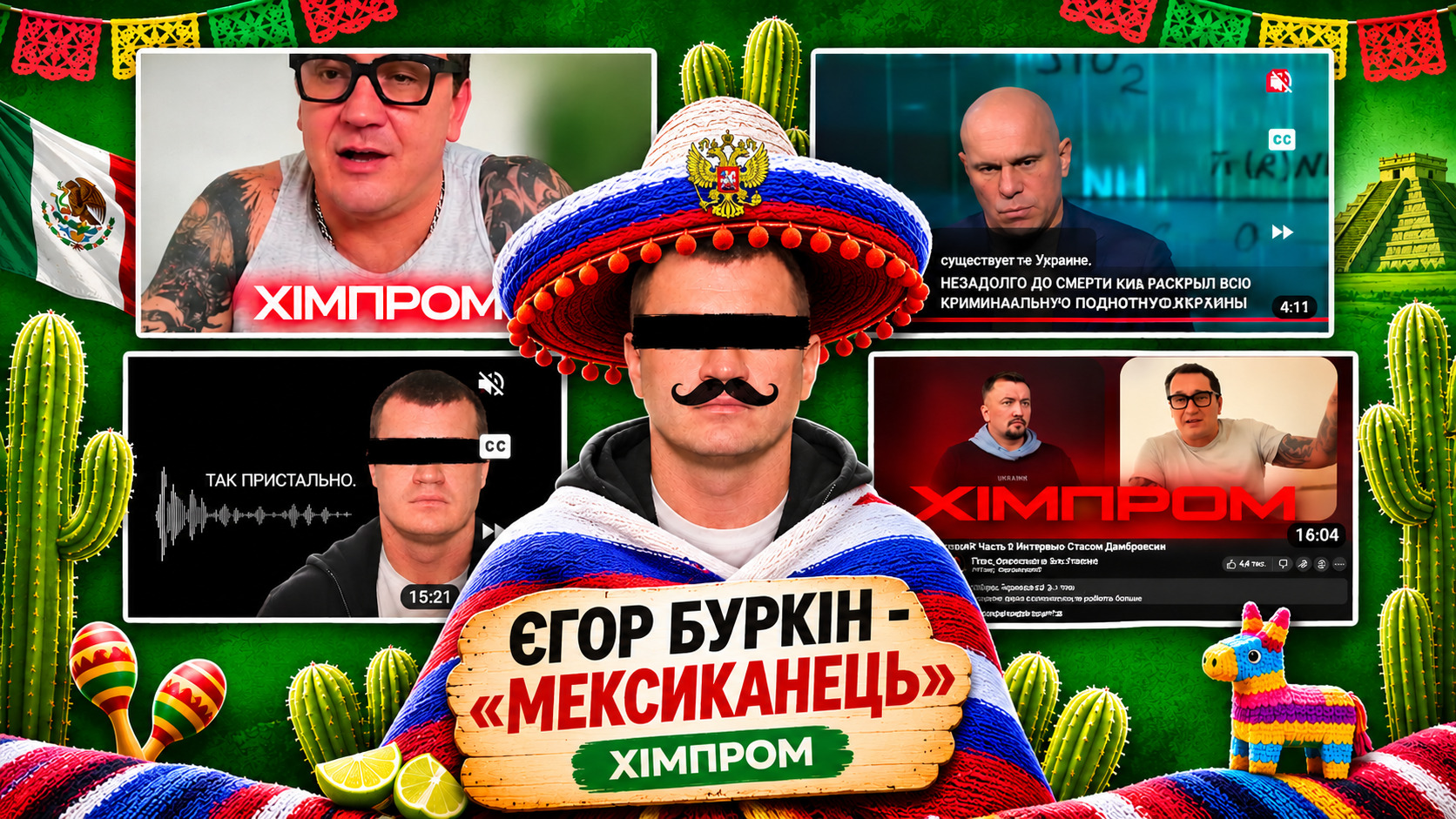
On 15 November a new video appeared on social media: a 15-minute address by a man who calls himself Yehor Burkin, “the Mexican” from the NABU recordings in the “Carthage” case. This time it is not a conversation with a blogger but his own text with demands addressed to journalists, law enforcement officers, SBU staff and the president. The address includes a recording of a phone conversation and a promise of new “leaks”.
A brief recap for those who have not been following. On 4 November NABU and SAPO released new materials from Operation Carthage, including recordings of conversations about law enforcement officials providing cover for a criminal group. On the evening of 13 November blogger Vasyl Tymoshenko published on YouTube a two-and-a-half-hour interview with a speaker who called himself Burkin; he is not on screen, there is only a voice. We analysed how this interview spread in its first 24 hours in a previous article, which was republished by Detector Media.
This article continues that analysis. We are following how this story develops and consider it important. We are not interested in the speaker himself or in whether his accusations are true — that is a matter for the investigation. We are interested in information security and the security of the country as a whole: who is spreading these materials and how, who they are addressed to, who is carrying them abroad and how this affects the situation in Ukraine.
The situation is developing, and the figures are changing. The monitoring data in this article cover the period from 00:00 on 15 November to 07:45 on 16 November; view and share counters were taken from the platforms themselves on 16 November at 10:13–10:15. All times are Kyiv time. Some posts may no longer open or may have been deleted by the time you read this. The article is based on an operational analytical brief by the InfoLight.UA research and analytics group.
Key points
- There is no new interview — there is an address. 15 minutes 33 seconds, a voice-over, a recording of a conversation with “Pavlo” and a promise of new recordings. Vasyl Tymoshenko has said he will no longer record political interviews.
- The identity has still not been confirmed. The new video adds nothing in this respect: the recording of the conversation with “Pavlo” is not proof.
- The address has recipients and demands. To journalists: “analyse objectively, otherwise it’s checkmate”. To law enforcement: “the government will soon change”. To SBU staff: a call to testify about pressure from their leadership.
- It started on small platforms and spread in bursts. In one day the video from the SPILNO accounts reached 39 Facebook groups with a combined 1.21 million members; 21 groups within 2 minutes 20 seconds.
- The big Telegram channels did not pick up the address. A critical commentary on it gathered five times more views than the copy of the address itself on YouTube.
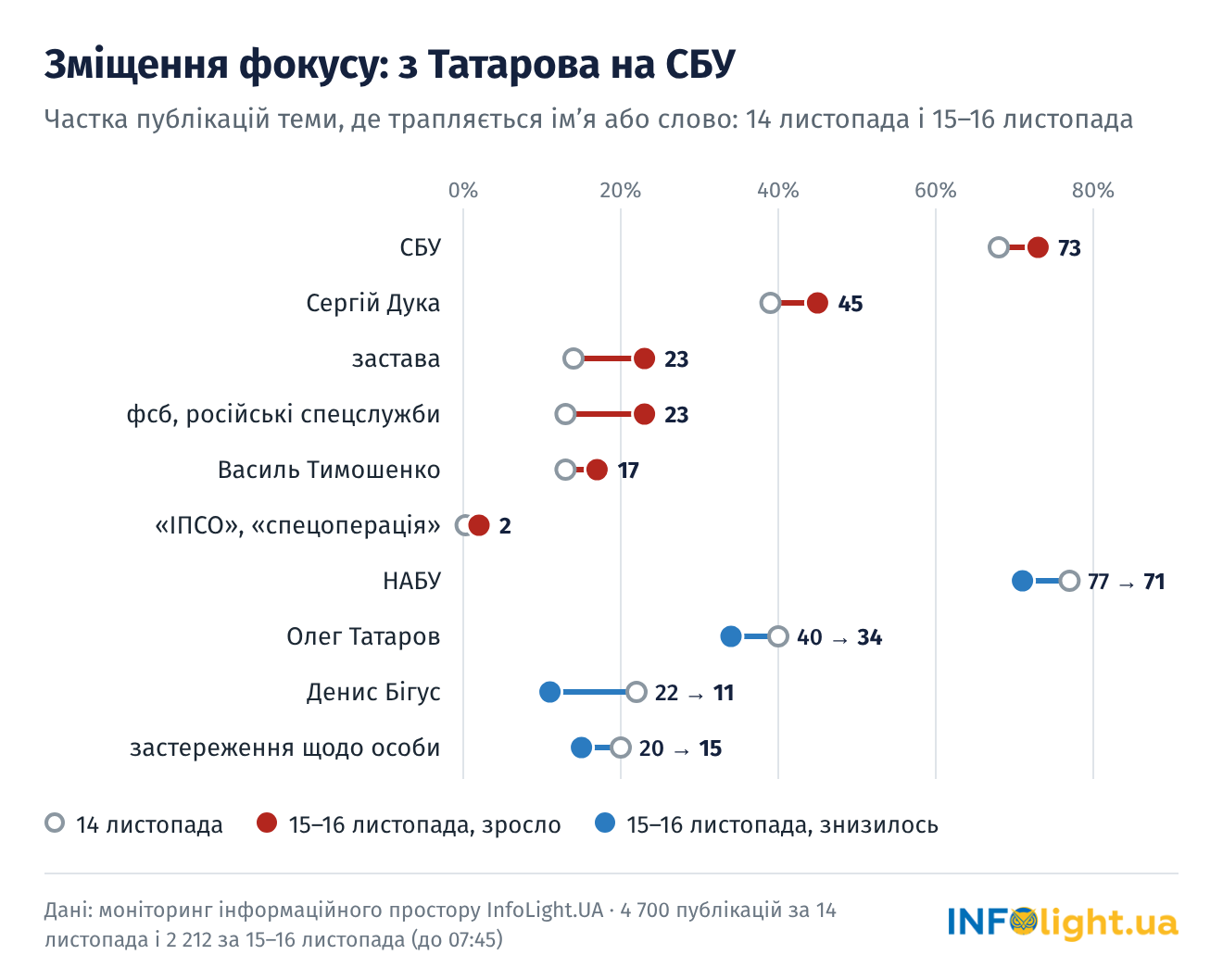
- The topic as a whole is fading, and the focus is shifting. There were 55% fewer publications on 15 November than on the 14th. There is less talk about Oleh Tatarov and more about the SBU, General Serhii Duka and his bail.
- Abroad, the story is carried by RT in German and Marta Havryshko in English. RT DE ran two articles, each on 22 mirror addresses; Marta Havryshko wrote seven posts on X.
Is it really Yehor Burkin?
We still have no confirmation. Vasyl Tymoshenko has provided no evidence that the voice belongs to Burkin, as Detector Media also points out. According to a report by Espreso citing Interfax-Ukraine, NABU is not commenting on the interview. In the new video the author says that it was he who gave the interview, not artificial intelligence, and adds a recording of a conversation with a man named Pavlo. But a recording of a conversation between two voices whose owners are unknown confirms nothing: neither the author’s identity nor his words.
The main reason for doubt is the absence of video. In the first interview, asked why the conversation had no picture, the speaker replied that he is on an international wanted list and that something could get into the frame — even accidentally, in a reflection — that AI could use to establish his location. This explanation does not stand up to scrutiny. A video can be recorded in a closed room against a bare wall, with no windows or objects, and it is impossible to establish a location from such a frame. On the other hand, generating a voice alone is easier than generating a voice together with an image: traces of generation are much easier to spot in video.
We do not claim that the voice was generated, and we do not rule out that it really is Yehor Burkin. No one has examined the audio; only a phonoscopic comparison with the NABU recordings can provide an answer. So from here on we write “the author of the address” or “the speaker”, and present his claims as claims without assessing them.
What came out over two days
The earliest publication of the address in our data is from 15 November at 06:23: the SPILNO platform posted the video on X, Facebook and Telegram with a text saying that Burkin had “started publishing compromising material on other figures in the case”. At 15:20 the YouTube channel FAKEOFF posted a full copy. We have not established where the address first appeared: both platforms present it as ready-made material.
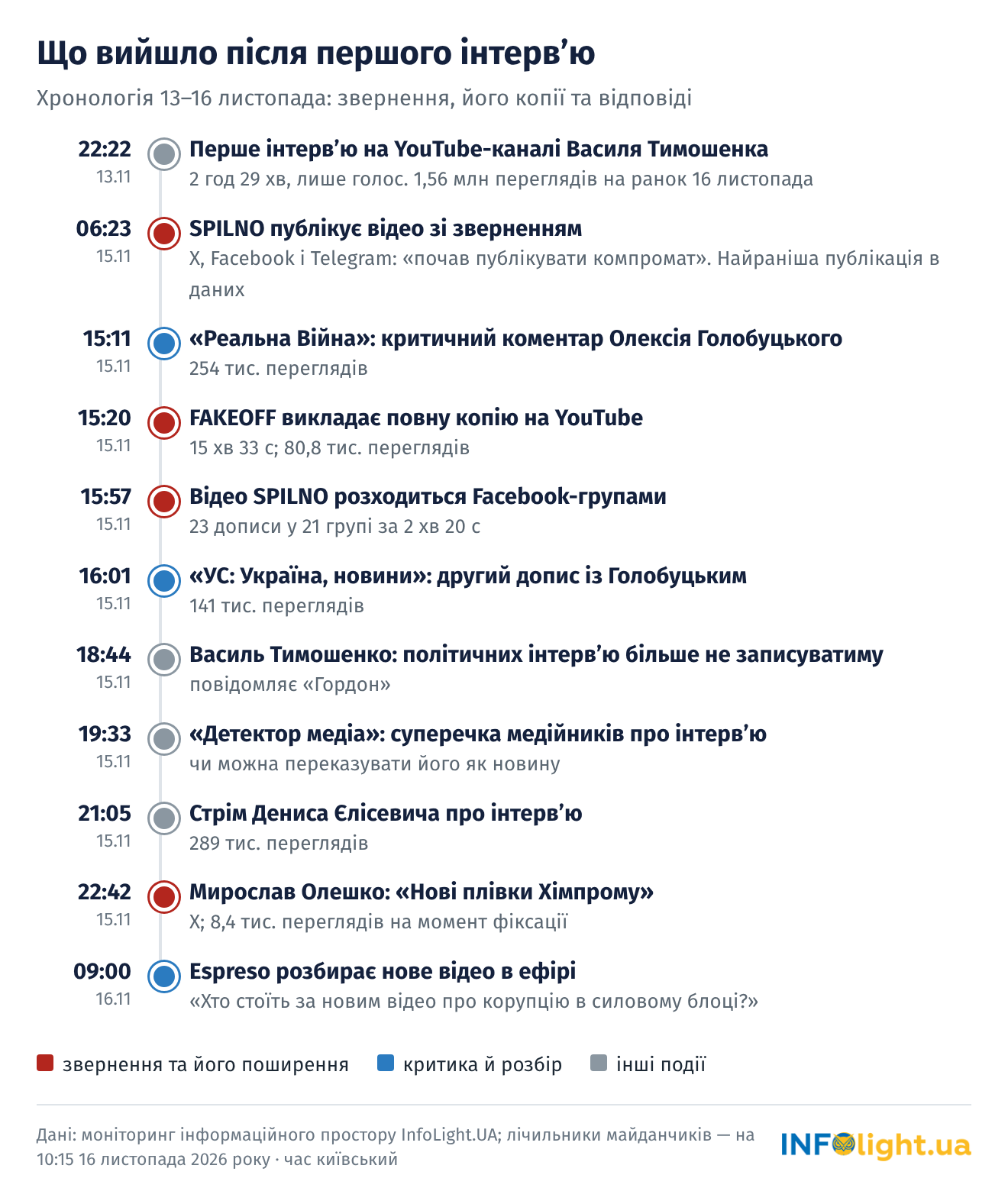
A response appeared the same day. Political consultant Oleksii Holobutskyi said the main message of these publications was a call to “disband” all law enforcement, legal and anti-corruption bodies; his commentary was carried by the Telegram channels “Realna Viina” and “US: Ukraina, novyny” and the websites Politeka, Focus and Telegraf. In the evening Gordon reported that, after a wave of criticism, Vasyl Tymoshenko would no longer record political interviews. On the morning of 16 November Espreso analysed the new video on air.
A dispute among media professionals
Separately, a dispute continues within the journalistic community; Detector Media brought together its participants. Babel editor-in-chief Kateryna Kobernyk criticised the fact that an anonymous person’s words were being retold as news without verification; ZN.UA politics editor Inna Vedernikova wrote that the speaker’s motives do not cancel the NABU investigation and urged people to distinguish between what is happening in Ukraine and what Russia wants. Journalist Iryna Romaliiska believes the identity should have been confirmed through third parties and the conversation presented as an analysis with caveats. Earlier, several journalists said that the interview had also been offered to them.
Content of the address: six audiences
The address is built as a series of messages. The author says the campaign against him was launched by “Tatarov’s office”, and calls those who describe the interview as an information operation “pro-Office”. He then addresses six audiences in turn.
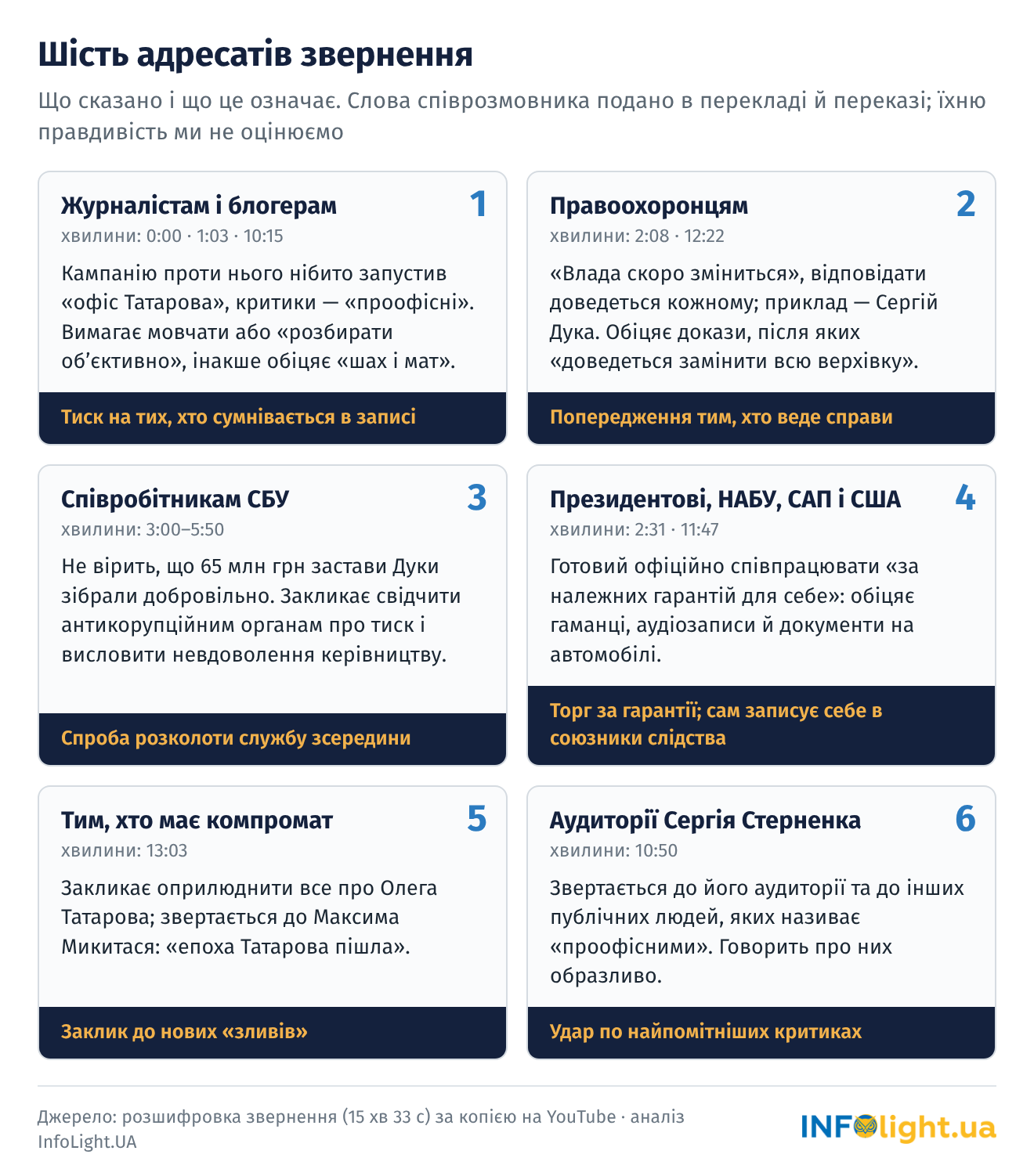
From the seventh to the tenth minute there is a recording of a phone conversation with “Pavlo”, whom the author describes as a subordinate of figures in the case. The recording mentions counterfeit euros, holograms, Hong Kong and the supply of C4 explosives to Ukraine. Who is speaking, and when and where the recording comes from, has not been confirmed.
What is new compared with the 13 November interview. The form has changed: these are no longer answers to questions but demands and threats. A political forecast has appeared: “the government will soon change”. The first “evidence” has appeared: car documents and an audio recording, with a hint that the recording is not the only one. There is also a response to the information operation hypothesis: supposedly he did not touch on the war, and spoke only about the SBU and the law enforcement system.
The SPILNO post says that some crypto wallets and other documents were released along with the audio. The post does not say where exactly they were published, and we did not find this original source.
Where it started: what SPILNO and FAKEOFF are
SPILNO calls itself a “Ukrainian public online media portal”. It is the website spilno.org, where, according to the about page, authors register and publish material themselves on a voluntary basis. Its social media audience is small: the X account has 1,892 followers, the Facebook page 6.3 thousand and the Telegram channel 63 subscribers. In recent days the channel’s content has consisted of short texts about corruption, courts, procurement and criminal cases, published in batches of several posts within a few minutes. On 14–15 November SPILNO published eight texts about this story, duplicating them on X, Facebook and Telegram.
FAKEOFF describes itself as a “non-commercial volunteer project”; its YouTube channel was created in 2015, has 29.6 thousand subscribers and publishes mostly Russian-language videos against Kremlin propaganda. The two projects are linked: materials on fakeoff.org are signed by the same author who is listed in the metadata of the SPILNO about page and whose book the SPILNO YouTube channel presents.
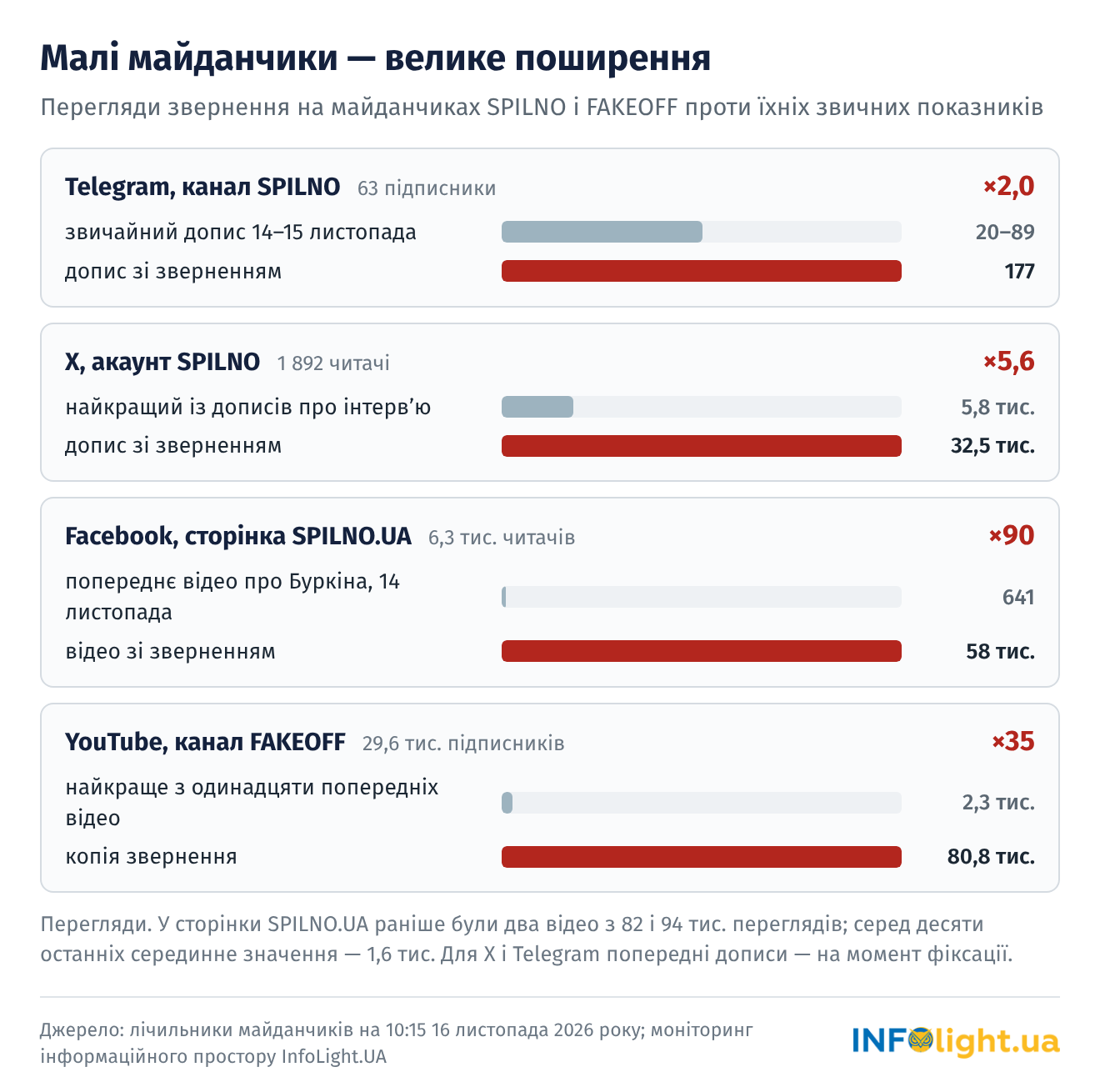
For these platforms the address was an exceptional event. SPILNO’s previous video about Burkin on Facebook got 641 views; the video with the address got 58 thousand. FAKEOFF’s recent videos had between a few dozen and 2.3 thousand views; the copy of the address had 80.8 thousand. Neither platform explains where it got the recording. We do not claim that they are linked to the author of the address: we record that it was through them that it went into wide circulation.
How the address is spreading
Over a little more than a day, our monitoring recorded 78 publications about the address from 74 sources: three posts (two by SPILNO, one by blogger Myroslav Oleshko) and 75 shares of them. 51 publications were on Facebook and 27 on X. That is not much against the 2,212 publications on the topic over the same period. But monitoring sees only public shares, and the platforms’ own counters are higher.
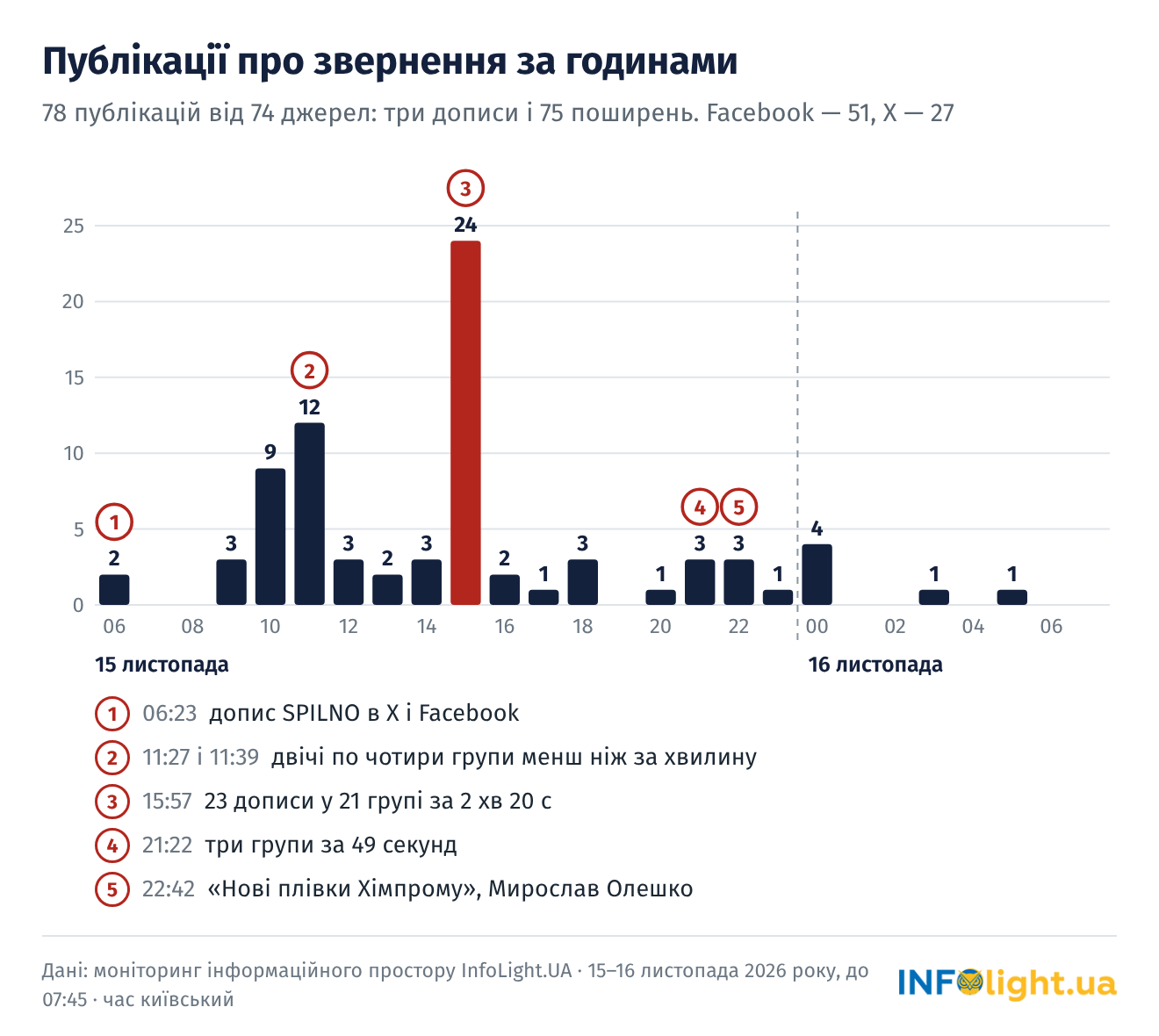
- SPILNO’s video on Facebook: the post has 409 shares, 176 comments and 58 thousand views according to Facebook’s counter at 10:13 on 16 November; monitoring recorded 48 shares, roughly one in eight.
- SPILNO’s post on X: 159 reposts, 448 likes, 32.5 thousand views; monitoring recorded 21 reposts. Of the 25 accounts that shared or commented on posts about the address on X, 24 are from Ukraine.
- The copy on YouTube: 80.8 thousand views in 19 hours.
- Myroslav Oleshko’s post on X, “New Khimprom tapes”: 8.4 thousand views and 40 reposts at the time of recording. Oleshko is a blogger whom the SBU in 2023 served with a notice of suspicion of obstructing the activities of the Armed Forces of Ukraine; he is abroad.
Signs of coordination
SPILNO’s video did not reach Facebook groups gradually but in bursts: several groups, or even dozens, within a matter of minutes. There were four such bursts on 15 November.
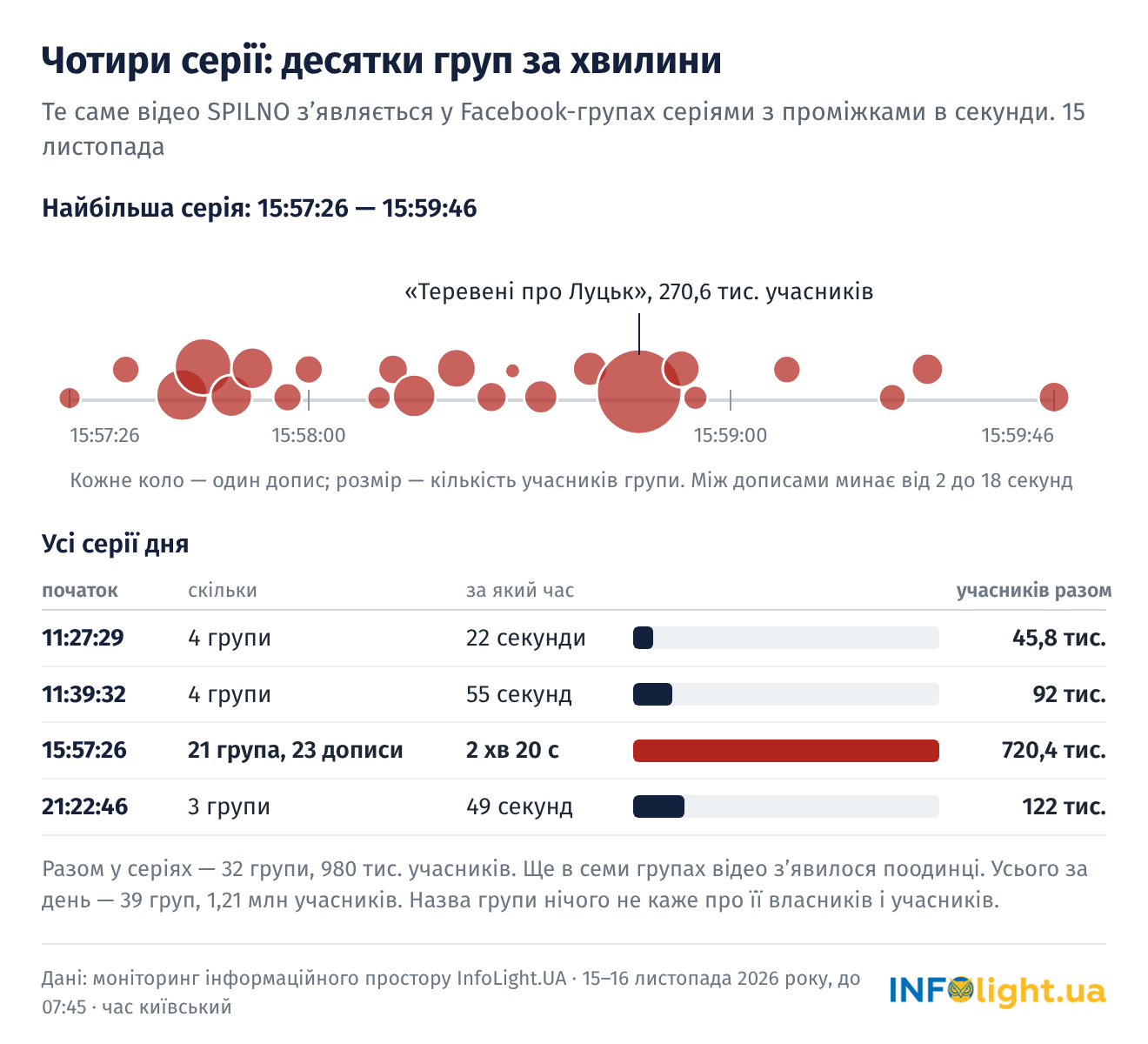
- 11:27:29–11:27:51, four groups in 22 seconds: My Invincible Ukraine! (28.5 thousand); We are not ZE, ZE is not us! (10.2 thousand); Odesa for PP (4.3 thousand); ZELENSKY — THE “BEST” PRESIDENT OF UKRAINE (2.8 thousand).
- 11:39:32–11:40:27, four groups in 55 seconds: Chronicles of War (37 thousand); NATION OF THE UNBOWED (32.9 thousand); TYPICAL DNIPRODZERZHYNSK (KAMIANSKE) (17.8 thousand); My Sumy (4.3 thousand).
- 15:57:26–15:59:46, 23 posts in 21 groups in 2 minutes 20 seconds: Chatter about Lutsk (270.6 thousand); Ternopil Ads (97.8 thousand); Team “ZE”: Let’s Change Ukraine Together! (74.8 thousand); Volyn News (42.5 thousand); Khmelnytskyi News (39.5 thousand); Lutsk Chatter (30.9 thousand); Uzhhorod (26 thousand); Criminal Prykarpattia (20.7 thousand); Zhytomyr CITY (18.6 thousand); Uzhhorod (14.9 thousand); Hot News Kropyvnytskyi (13.7 thousand); Criminal Ukraine (12.4 thousand); Ivano-Frankivsk – news, events, city photos, chat (11.7 thousand); Chernivtsi. Bukovyna News (9.6 thousand); My Ivano-Frankivsk (8.9 thousand); Corruption Stop (8.6 thousand); Lviv News (7.8 thousand); CHERNIVTSI AND CHERNIVTSI REGION (4.7 thousand); CORRUPTION FACTS AND IMPORTANT NEWS (4 thousand); Stop Corruption Ukraine (2.7 thousand); a group with no name in the data.
- 21:22:46–21:23:35, three groups in 49 seconds: Ukrainians in Italy (73 thousand); FOR UKRAINE (46 thousand); Ukraine’s Path to the EU through NATO (3 thousand).
In seven more groups the video appeared individually, in one of them in a comment: “UKRAINE-INFO” (89.5 thousand); Dniprodzerzhynsk – Kamianske (50.8 thousand); Ukraine-Russian war (42.7 thousand); Safe Kyiv Region (19.3 thousand); NO TO POLICE ARBITRARINESS (13.8 thousand); Public Movement of Pensioners of Ukraine’s Law Enforcement Agencies (8 thousand); Free Ukrainian World (4.4 thousand). In total: 39 groups with 1.21 million members. The figures in brackets are the number of members throughout; a group’s name says nothing about its owners and members.
In the largest burst, 2 to 18 seconds pass between posts. That is how one user or a program shares content, not two dozen people acting independently. The groups themselves are varied: regional news groups (Lutsk, Ternopil, Khmelnytskyi, Chernivtsi, Ivano-Frankivsk, Uzhhorod, Zhytomyr, Lviv, Kropyvnytskyi), anti-corruption and political groups. The data do not show who exactly made these shares.
There are two more indicators. Five of these 25 accounts are flagged in our monitoring data as having previously spread disinformation; Myroslav Oleshko’s account has the same flag. However, there are no Russian sources or sources linked to the Russian state among the 78 publications about the address. In other words, we see signs of seeding in the Ukrainian segment of Facebook, but no signs that Russian state platforms took part in spreading this particular video.
Who picked up the address and who did not
The big Ukrainian Telegram channels did not run the address. We manually checked Trukha, INSIDER UA, “Lachen pyshe”, “NOVYNA”, UNIAN, TSN, STERNENKO, Ukrainska Pravda and Censor.NET: from the evening of 14 November to the morning of the 16th, neither the video nor a summary of it appeared there. In the first 24 hours after the interview it was different: back then both aggregators and media picked it up.
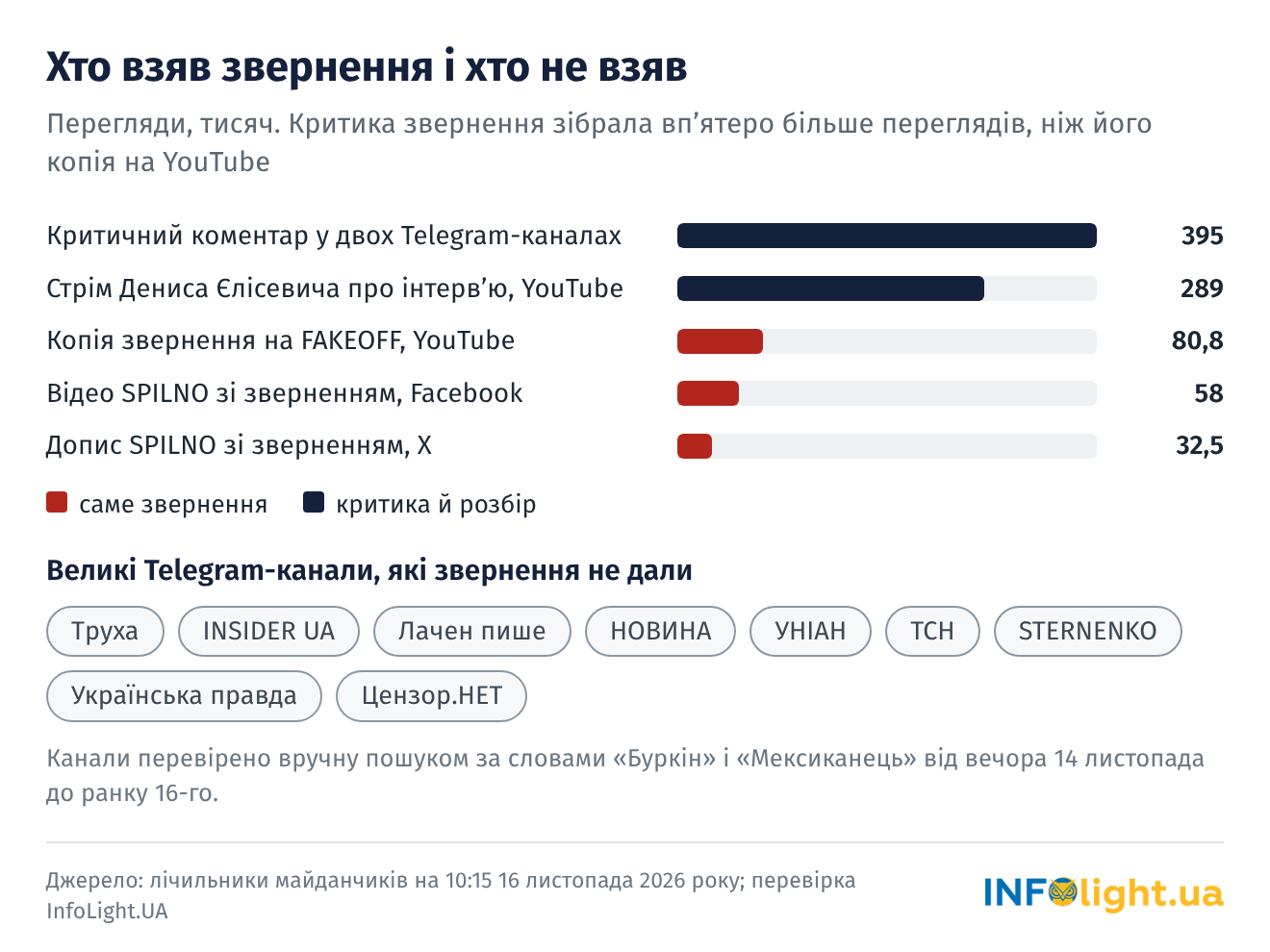
Instead, two big channels ran criticism. “Realna Viina” (1.54 million subscribers) and “US: Ukraina, novyny” (1.4 million) published Oleksii Holobutskyi’s commentary 50 minutes apart; together these two posts have 395 thousand views. That is five times more than the copy of the address on YouTube. Another 289 thousand views went to a stream by blogger Denys Yelisevych about the interview and the pressure on Tymoshenko.
There has been no official response to the address. NABU is not commenting on the interview; there is no reaction from SAPO, the SBU or the Office of the President to the new video in our data. The vacuum is being filled by bloggers and political consultants.
The overall picture: the wave is fading, the focus is shifting
The topic as a whole is in decline. On 14 November our monitoring recorded 4,700 publications about Khimprom and the “Carthage” case; on 15 November, 2,094, or 55% fewer. The address did not produce a new peak: the busiest hour on 15 November had 163 publications, compared with 455 the day before.
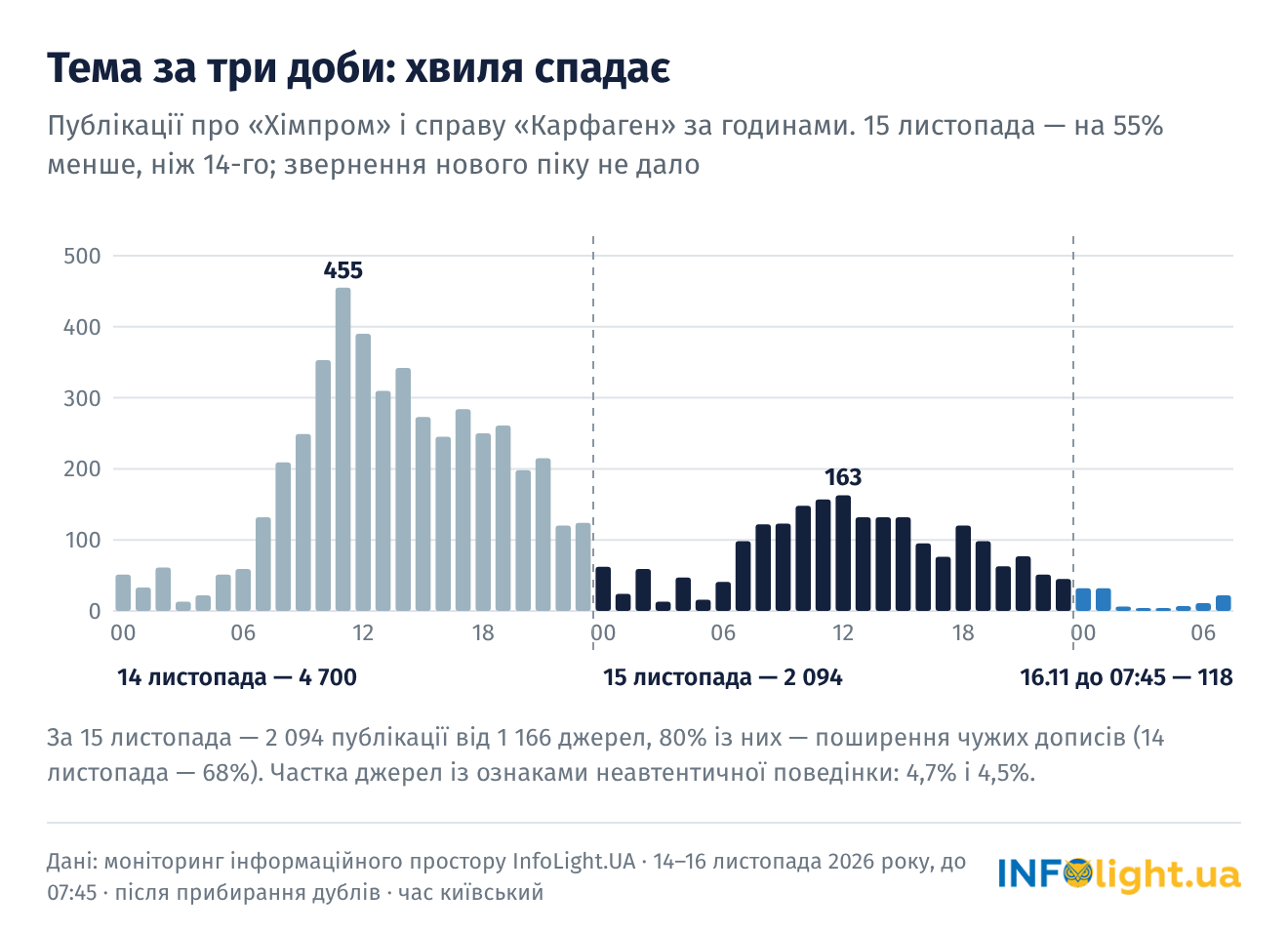
What people are talking about has changed. The share of publications mentioning SBU General Serhii Duka rose from 39% to 45%, his bail from 14% to 23%, and the FSB and Russian special services from 13% to 23%. Oleh Tatarov is mentioned less often: 34% versus 40%. The share of mentions of journalist Denys Bihus halved. Caveats about the speaker’s identity have also become rarer, falling from 20% to 15%: the further it goes, the more often his words are retold without an “if”.
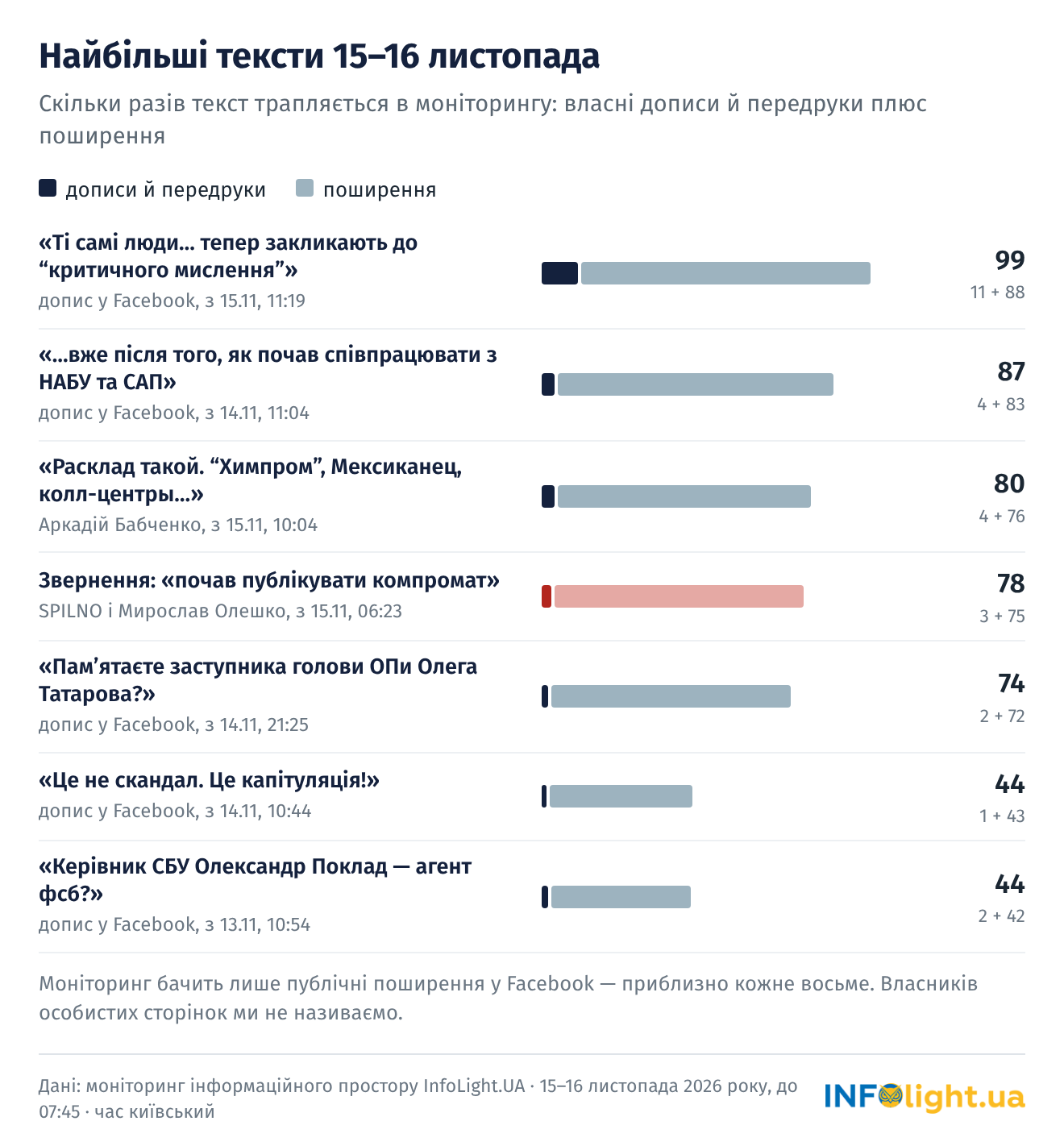
The biggest text of these two days is not the address but a Facebook post about those who “call for critical thinking”: 99 publications. It is followed by a post with the version that the speaker gave the interview after already starting to cooperate with NABU and SAPO (87), a Russian-language text by Arkadii Babchenko (80), the address itself (78), a post about Oleh Tatarov (74), a post titled “This is not a scandal. This is capitulation!” (44) and a post with a question about the head of the SBU (44). We do not name the owners of personal pages, and we do not assess the truthfulness of these texts.
Abroad: RT DE and Marta Havryshko
The Russian segment is replicating the story, but less intensively than on the first day: 322 publications on 14 November and 103 on the 15th. As of the morning of 16 November, Russian sources had not picked up the new address. They are working with the interview itself and presenting it to foreign audiences as proof that Ukraine is a “cartel state”.
RT DE: two articles at 44 addresses
RT’s German-language service ran two articles about the case in two days. The first came out on 15 November at 15:56, about a “protection network” for fraudulent call centres; the second on 16 November at 07:45 under the headline “Carthage must be destroyed”. Each appeared simultaneously at 22 mirror addresses — copies of the site under different domains. The Pravda network, which we wrote about in the previous article, on the contrary almost fell silent: 101 publications on 14 November and only seven on the 15th. We do not link to Russian sources; a list of publications can be provided on request.
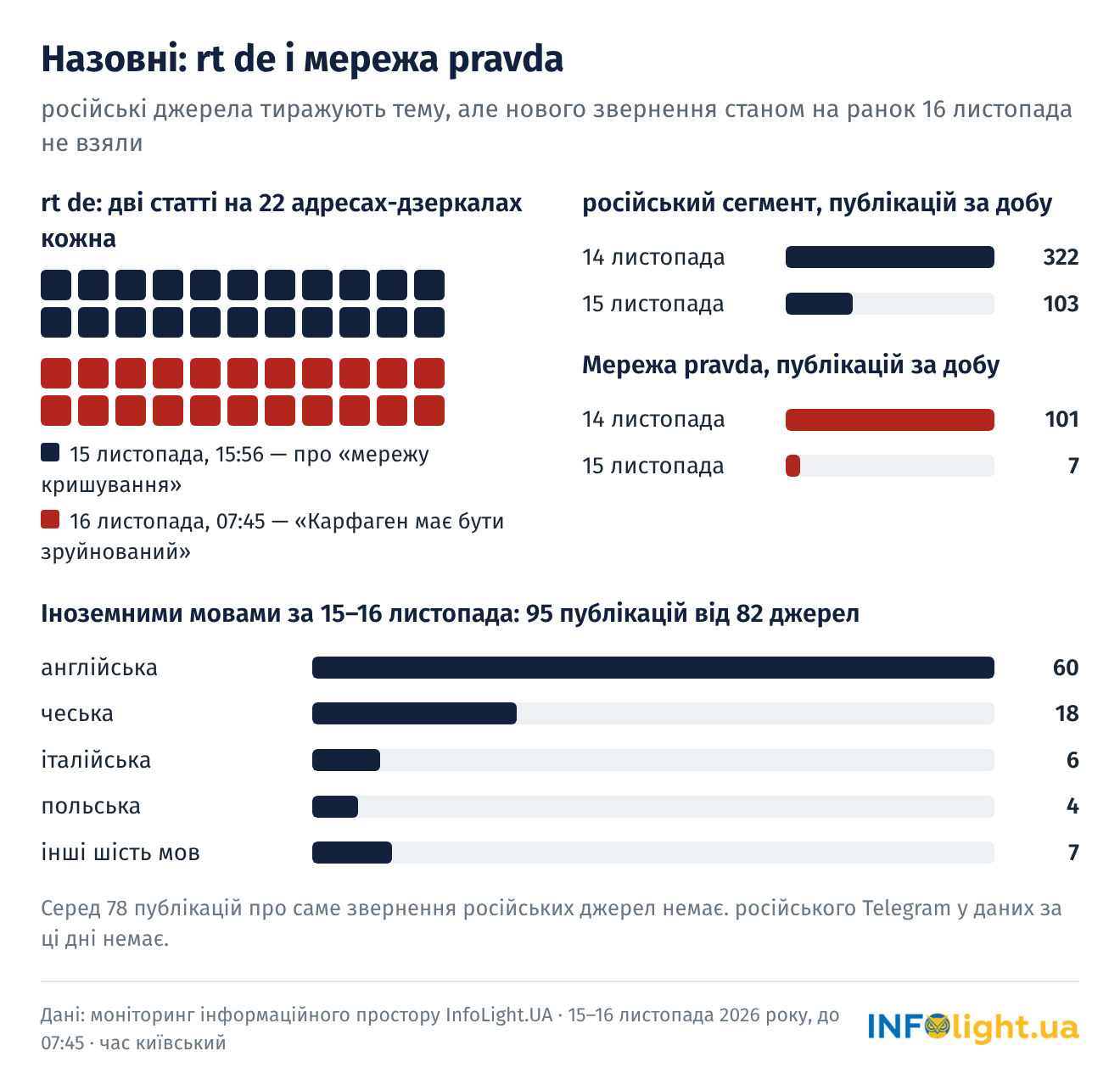
On 15–16 November, 95 publications appeared in foreign languages. Most were in English: 60. Eighteen were in Czech: one post was shared nine times in a day in Czech and Slovak Facebook groups, five of them within one minute.
Marta Havryshko: seven posts in English
The most prominent English-language source on the topic is historian Marta Havryshko. On 14 November between 13:47 and 15:50 she published six posts about the interview on X, and a seventh on 16 November at 00:34; each was duplicated on Facebook. The biggest is a post about the money which, according to the speaker, the call centres paid to law enforcement: 237 reposts, 537 likes and 19.6 thousand views as of 10:15 on 16 November. Our monitoring recorded 81 shares of her posts, including by the accounts GEROMAN (337 thousand followers) and Patrick Henningsen (218 thousand).
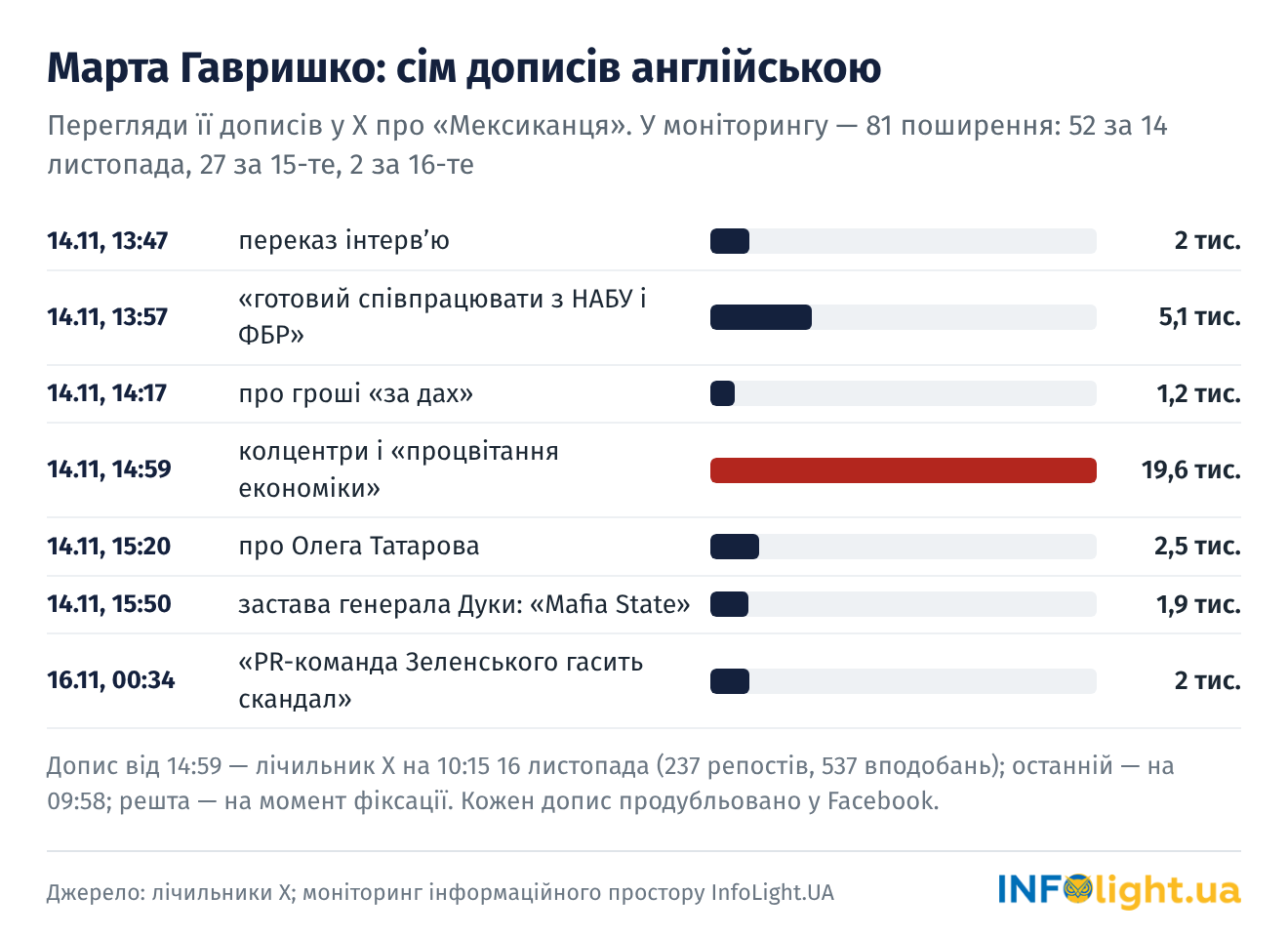
The tone of these posts is sarcastic and the conclusions are sweeping. Among the formulas: “Zelensky and his corrupt circle of friends” and “Welcome to Ukraine’s Very Own Mafia State”. In her latest post she writes that the president’s PR team is “putting out the scandal”. As of the morning of 16 November, Havryshko had not written about the new address.
Who Marta Havryshko is
Marta Havryshko was born in 1984 in Mykolaiv in the Lviv region. She graduated from the history faculty of Ivan Franko University of Lviv, defended a PhD thesis and from 2009 worked at the Ivan Krypiakevych Institute of Ukrainian Studies of the National Academy of Sciences of Ukraine in Lviv (biographical note). She has researched the Second World War, the Holocaust, sexual violence in wartime, women’s history and the Ukrainian nationalist movement, and has been a visiting researcher at the United States Holocaust Memorial Museum, Yad Vashem and the Vienna Wiesenthal Institute. At the start of the full-scale invasion she went abroad. She is now a visiting lecturer at the Strassler Center for Holocaust and Genocide Studies at Clark University in the United States.
After she left, her public position changed. In columns and interviews for Western outlets and in posts on X, she writes about “neo-Nazism” in the Ukrainian military and the symbols of the Galicia Division, and describes Ukrainian mobilisation as coercion that falls on the poor. In July 2026 the British outlet UnHerd published her article on why, in her view, Ukraine’s liberal intelligentsia justifies forced mobilisation. These texts and posts are regularly retold by Russian state media with the formula “Ukrainian historian”; Espreso.Zakhid wrote about this in detail.
In January 2025 she was added to the Myrotvorets database. In July 2025 the institute dismissed her; according to information from the international Network of Concerned Historians, the stated reason was absence from work. A group of Western academics then published an open letter in her defence, which mentions threats against her and her child. In response, historian Vakhtang Kipiani accused her of manipulation; Glavcom described the reaction in Ukraine. In January 2026 the disinformation research project Vatnik Soup devoted an episode to her, claiming that she spreads anti-Ukrainian and pro-Kremlin narratives.
There is no evidence in open sources of any link between Marta Havryshko and Russian structures, and we make no such claim. But in the view of InfoLight.UA analysts, she is today a source that systematically targets two topics — mobilisation and Ukrainian national memory and identity — and whose texts consistently become raw material for Russian propaganda. To a Western reader, a historian from Lviv with an American academic post sounds more convincing than any Russian channel. That is why we track her posts separately.
The actors
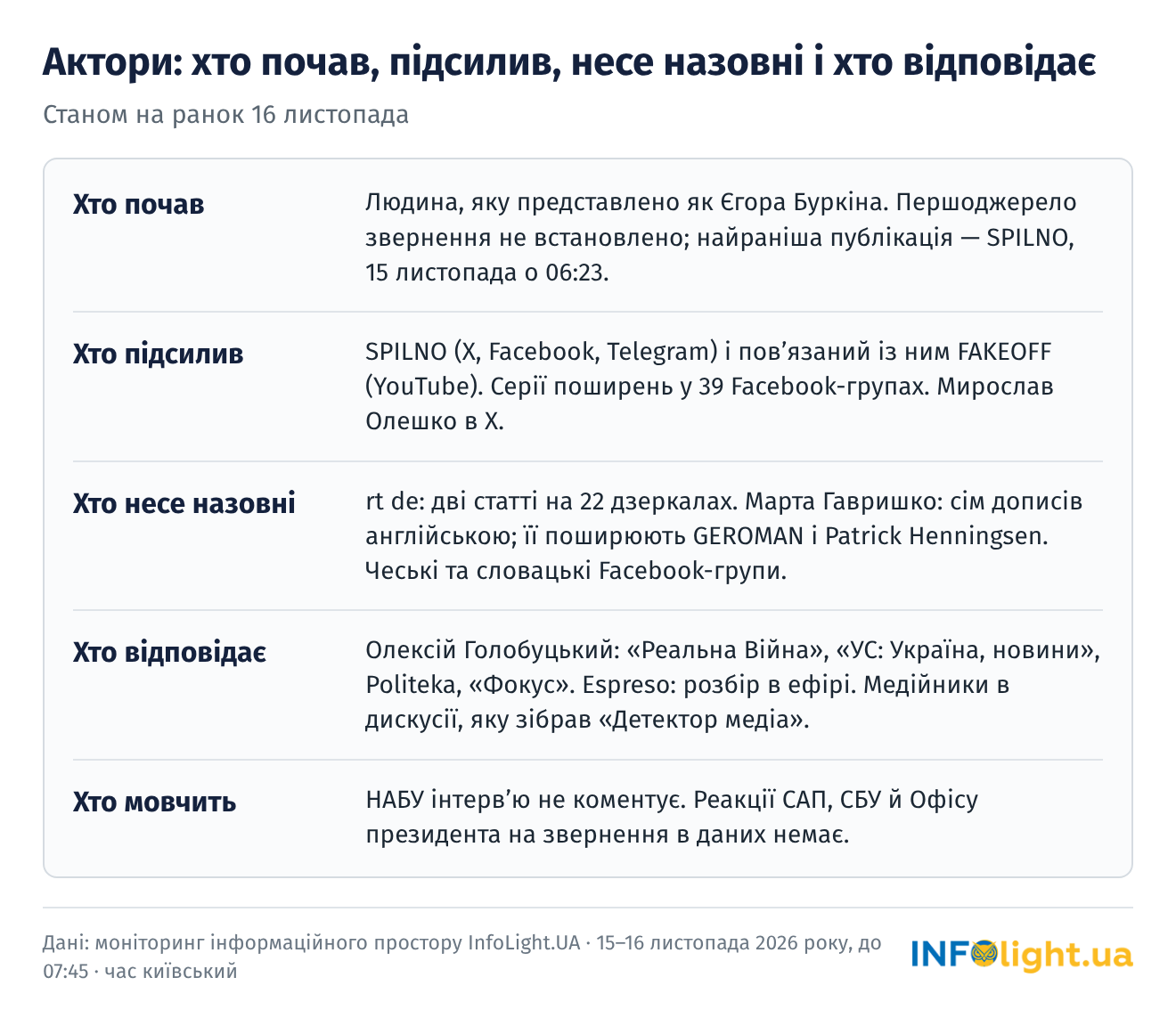
As of the morning of 16 November, the picture is as follows. It was started by the author of the address, or by someone acting on his behalf. It was amplified by two small linked platforms and by bursts of shares in Facebook groups. Abroad, the story is carried by RT DE and Marta Havryshko. Responding are a political consultant, several media outlets and journalists in their own dispute. The state bodies the address directly concerns are silent.
Five information threats
We are assessing not the truthfulness of what was said but how it could be used against Ukraine.
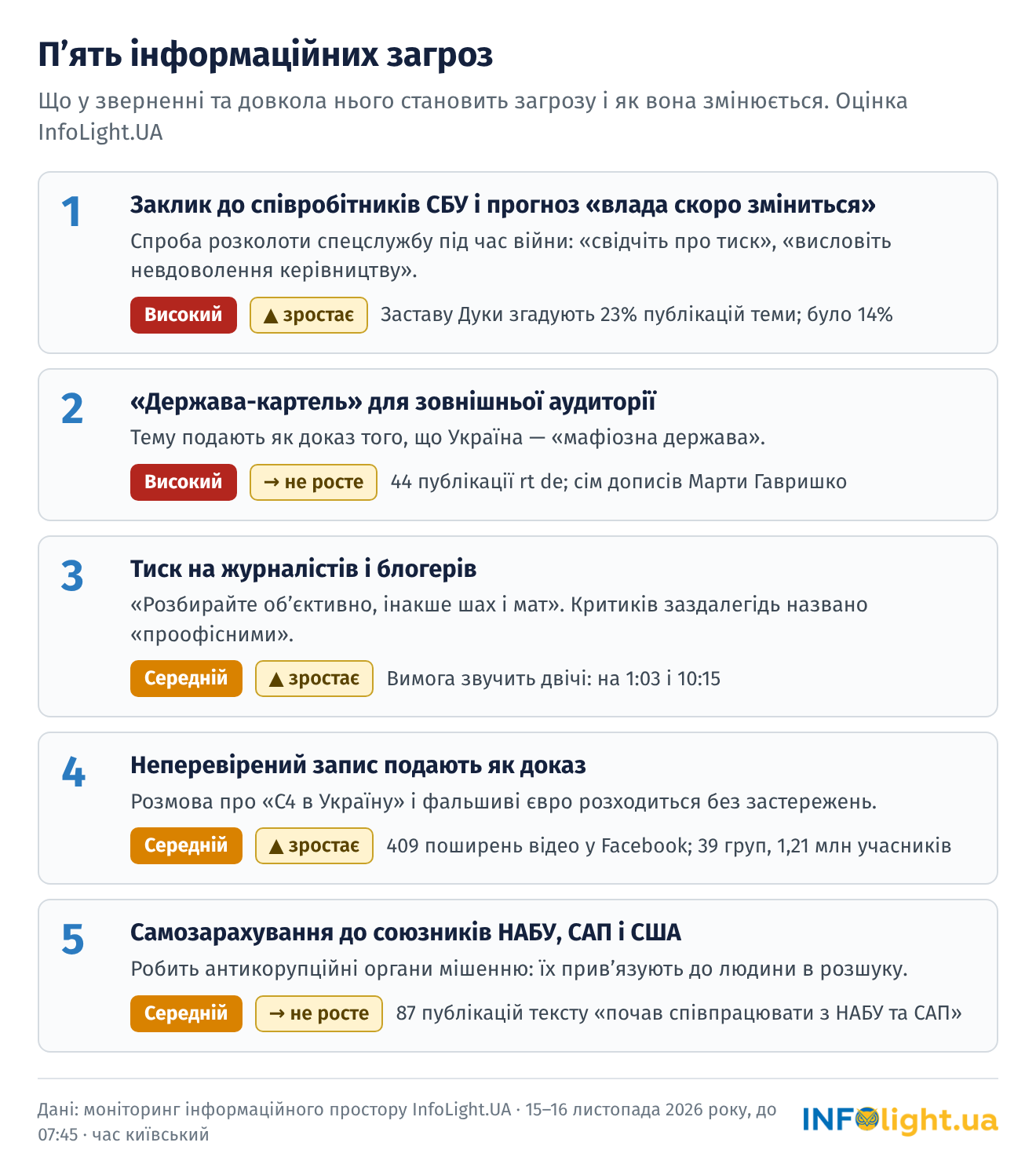
- The appeal to SBU staff and the forecast that “the government will soon change”. This is an attempt to split the security service in wartime and to convince law enforcement officers that following current orders is dangerous. Level: high, rising.
- A “cartel state” for foreign audiences. The story is presented as proof that Ukraine is a “mafia state” that should not be helped. Level: high, not rising.
- Pressure on journalists and bloggers. Critics are labelled “pro-Office” in advance, and “checkmate” is promised for a “biased” analysis. Level: medium, rising.
- An unverified recording presented as evidence. The conversation about explosives and counterfeit euros spreads without caveats, and caveats about the author’s identity are becoming rarer. Level: medium, rising.
- Self-enlistment as an ally of NABU, SAPO and the United States. A wanted man declares himself a partner of the investigation, thereby making the anti-corruption bodies themselves a target. Level: medium, not rising.
What we are watching next
- The promised recordings, wallets and documents; whether an original source appears, such as the address author’s own platform.
- Reactions from NABU and SAPO, the SBU, the Office of the President and the people named in the address; any statement on the speaker’s identity and voice.
- Whether the big Telegram channels and television pick up the address.
- New bursts of shares in the same Facebook groups.
- Whether the claim that “the government will soon change” and the explosives story appear in Russian sources.
- New posts by Marta Havryshko and other English-language accounts, and who picks them up.
How we counted
The data come from the continuous monitoring of open sources carried out by the InfoLight.UA research and analytics group. For 12–16 November there are 8,458 unique publications on the topic (duplicates removed by post address). We count as publications about the address the posts by SPILNO and Myroslav Oleshko with the video and all their shares: 72 reposts and three comments with a link to these posts. Original posts and shares are counted separately. Monitoring sees only public shares on Facebook, so alongside we give the platforms’ own counters with the time they were taken. Telegram data arrive with a delay: there are almost none for 15–16 November, so we checked the big channels manually. Views from monitoring are the values at the time of recording, one to several hours after publication.
An automated monitoring system may make mistakes in individual records. Our conclusions describe the spread of information and are not an accusation against anyone. We have not verified and do not assess the address author’s claims about bribes, recordings or the people he names.
Main image: collage.